• Skip to primary navigation
  • Skip to main content
  • Skip to primary sidebar

Earth Wise

A look at our changing environment.

  • Home
  • About Earth Wise
  • Where to Listen
  • All Articles
  • Show Search
Hide Search
You are here: Home / Archives for sun

sun

Ever Cheaper Solar Power | Earth Wise

May 14, 2021 By EarthWise Leave a Comment

The cost of solar panels continues to decline

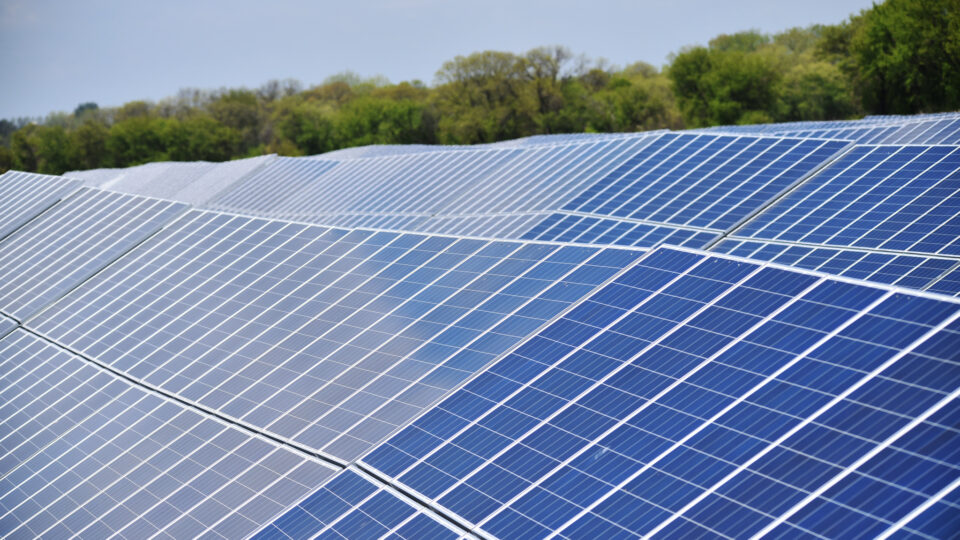
The price of electricity from solar panels has been dropping dramatically over the last decade.  The average cost of utility-scale solar power has gone down more than 80% since 1980, making it the least expensive power source in many places.  The plunging price of solar power is one of the driving forces behind the transition to clean energy. 

The 2020 average cost of solar power was 4.6 cents per kilowatt-hour.  The Department of Energy has recently set a target of reducing the cost of solar power by more than half again by 2030, to an unsubsidized average of 2 cents per kilowatt-hour.  The 2-cent goal is not just the ordinary cost of electricity; it is the levelized cost of energy which is based on a formula that includes the cost of construction and operation of a power plant.

If the least expensive power source becomes that much cheaper, it will really shake the foundation of many energy debates.  One of these debates is how to meet the need for more interstate power lines to transport renewable energy from rural areas to population centers.   If large amounts of additional renewable energy sources are added, policymakers will need to work harder to reform the regulatory system to make sure that new interstate power lines get built.

If the average cost of solar power reaches 2 cents a kilowatt-hour, the actual price will be lower in sunnier regions and higher in those that get less sun.  However, the continuing decrease in solar electricity costs will actually have the greatest impact in the northern, less sunny regions, because solar power may not currently be the least expensive option there but it will become the cheapest alternative over time.

**********

Web Links

Inside Clean Energy: What Happens When Solar Power Gets Much, Much Cheaper?

Photo, posted May 14, 2020, courtesy of Courtney Celley/USFWS via Flickr.

Earth Wise is a production of WAMC Northeast Public Radio.

Should We Block The Sun? | Earth Wise

May 10, 2021 By EarthWise Leave a Comment

The risks of geoengineering need to be better understood

There is growing concern that greenhouse gas emissions are not falling quickly enough to avoid dangerous levels of global warming.  As a result, there is the impetus to examine other options.  Among these are geoengineering, which is one of the most contentious issues in climate policy.  Geoengineering embodies many risks that make even seriously considering it seem risky in itself.

Despite this, the National Academies of Science, Engineering, and Medicine has issued a report saying that governments urgently need to know whether solar geoengineering could work and what its side effects might be.

Solar geoengineering is also called solar radiation modification, which entails reflecting more of the sun’s energy back into space.  This would likely be accomplished by injecting aerosols into the atmosphere, much like what happens after large volcanic eruptions.

Schemes for solar geoengineering raise numerous issues.  Although solar geoengineering might cool the earth’s surface to a global temperature target, the cooling may not be evenly distributed, affecting many ecosystem functions and biodiversity.   It would likely upset regional weather patterns in potentially devastating ways, for example by changing the behavior of the monsoon in South Asia.  It might dangerously relax public commitments to reduce greenhouse emissions. 

Despite these concerns, or perhaps because of them, the committee that produced the report believes that technology to reflect sunlight deserves substantial funding and should be researched as rapidly and effectively as possible.  Once any geoengineering projects get into the hands of policymakers, they may gather momentum that bypasses the advice of scientists.  So, it important to make progress on the science while geoengineering is still only theoretical.

**********

Web Links

Should We Block the Sun? Scientists Say the Time Has Come to Study It.

To intervene or not to intervene? That is the future climate question

Photo, posted August 3, 2018, courtesy of Tomasz Baranowski via Flickr.

Earth Wise is a production of WAMC Northeast Public Radio.

Turning Wood Into Plastic | Earth Wise

May 4, 2021 By EarthWise Leave a Comment

Could wood solve the plastics problem?

Plastic pollution is particularly pernicious because plastics can take hundreds of years to degrade in the environment.  For this reason, researchers across the globe search for ways to shift from petrochemical plastics to ones that are biodegradable.

Producing biodegradable plastics is challenging both from the standpoint of the methods needed and from the results obtained.  Producing them often requires toxic chemicals and can be very expensive.  The materials that emerge often do not have the durability and strength of conventional plastics and can be unstable when exposed to moisture.

Researchers at the Yale School of the Environment have developed a process of decomposing the porous matrix of natural wood into a slurry that can be formed into a biodegradable plastic.  The material shows high mechanical strength, stability when holding liquids, and is resistant to the effects of ultraviolet light.  Along with all these favorable properties, the material can be recycled or safely biodegraded in the natural environment.

The slurry mixture is created by taking wood powder – a processing residue usually discarded in lumber mills – and deconstructing it with a biodegradable and recyclable solvent.  The resulting mixture has a high solid content and high viscosity and can be casted and rolled without breaking.

The researchers conducted a comprehensive life cycle assessment to test the environmental impacts of the bioplastic compared with conventional plastics.  Sheets of it were buried in soil and observed to fracture after two weeks and completely degrade after three months.  The material can also be broken back down into the slurry by mechanical stirring.

The remaining topic to investigate is the potential impact on forests if the manufacturing of this bioplastic is scaled up.

**********

Web Links

Turning wood into plastic

Photo, posted October 12, 2016, courtesy of the US Forest Service via Flickr.

Earth Wise is a production of WAMC Northeast Public Radio.

Red Hot Chili Solar Panels | Earth Wise

April 9, 2021 By EarthWise Leave a Comment

Advances in solar panel technology

The majority of solar panels in use today are made from either single-crystal or polycrystalline silicon, the same stuff used to make the ubiquitous chips in computers, cell phones, and countless other devices.  In addition, a growing fraction of solar panels utilize thin-film technology, which offers cost and flexibility advantages.

Monocrystal silicon still provides the highest efficiency and longest lifespan in commercially available panels, but the lower costs and some other features of thin-film solar panels are growing that market over time.

More recently, perovskite solar cell technology has been a source of great interest in the research community.  Perovskites are a class of minerals with a specific crystalline structure that already have uses in various applications.  As a solar cell material, perovskites offer the potential for converting more sunlight to electricity, being manufactured far more cheaply using no exotic or expensive materials, being more defect-tolerant, as well as a having number of other advantages.  They also have the potential for having very high efficiency. 

Recently, a group of researchers in China and Sweden published results of studies demonstrating that the addition of a novel ingredient has increased the efficiency of perovskite solar cells to nearly 22%, which is better than most commercial silicon solar cells.  The ingredient is capsaicin, the chemical that gives chili peppers their spicy sting.  Adding capsaicin expands the grains that make up the active material of the solar cell, allowing the more effective transport of electricity. 

Why did the researchers think of adding the active ingredient of hot peppers to a solar cell in the first place?  So far, they aren’t saying.

**********

Web Links

Solar panels capture more sunlight with capsaicin – the chemical that makes chili peppers spicy

Photo, posted August 16, 2019, courtesy of Pedro via Flickr.

Earth Wise is a production of WAMC Northeast Public Radio.

Grid-Scale Battery Storage is on the Rise | Earth Wise

February 4, 2021 By EarthWise Leave a Comment

Record growth in grid-scale battery storage

Driven by steeply falling prices and improving technology, grid-scale battery storage systems are seeing record growth in the U.S. and around the world. Battery storage is a way to overcome one of the biggest obstacles to renewable energy:  the cycling between oversupply when the sun shines or the wind blows, and shortage when the sun sets or the wind drops.  Storing excess energy in battery banks can smooth imbalances between supply and demand.

In California, a 300-megawatt lithium-ion battery plant is being readied for operation with another 100 megawatts to come online in 2021.  The system will be able to power roughly 300,000 California homes for four-hour periods when energy demand outstrips supply.  It will be the world’s largest battery system for a while until even larger systems in Florida and in Saudi Arabia come online.

Nationwide, a record 1.2 gigawatts of storage were installed last year and that number is projected to jump dramatically over the next five years to nearly 7.5 gigawatts in 2025.

The price tag for utility-scale battery storage in the U.S. has plummeted, dropping nearly 70% just between 2015 and 2018.  Prices are expected to drop by a further 45% over the next decade.  Battery performance has continued to improve dramatically with increased power capacity and the ability to store and discharge energy over ever-longer periods of time. 

Favorable energy policies including renewable energy mandates coupled with continued price drops will drive the widespread expansion of battery energy storage.

**********

Web Links

In Boost for Renewables, Grid-Scale Battery Storage Is on the Rise

Photo, posted November 17, 2016, courtesy of Steve Ryan via Flickr.

Earth Wise is a production of WAMC Northeast Public Radio.

Why Do Trees Change Color? | Earth Wise

December 24, 2020 By EarthWise Leave a Comment

Explaining the magnificent spectacle of fall foliage

We had a particularly colorful fall in the Northeast this year.  Almost everywhere you looked, there were brilliant displays of yellow, orange, and red.  The colors of fall are a result of chemistry and environmental events that may have taken place many months in the past.

The color of leaves comes from 4 pigments whose effects are governed by photosynthesis.  The one that is actually used in photosynthesis is chlorophyll and it causes leaves to be green.  But when a tree begins to prepare for dormancy, it stops producing chlorophyll, the green pigmentation fades, and the other pigments that were already in the leaves become visible.

There are xanthoplylls, which are the yellow pigments that are seen the most in fall trees.  They are the same pigments that color egg yolks and sometimes parts of the human eye.  They are only produced by plants and appear in humans and animals only through consumption.

There are carotenes, which are the orange pigments found in fruits and vegetables, such as carrots, oranges, some bell peppers and squashes.

And there is anthocyanin, which is the pigment found in blueberries, blackberries, and red or violet roses.  Its color depends on the pH level of the plant; higher pH leads to darker color.  This is the pigment seen in red maples, black cherry trees, Shumard oaks, and more.  Only 10% of trees in temperate climates produce anthocyanin and its red pigmentation and most of those trees are in New England.

All these pigments serve purposes.  They help trees absorb light energy, prevent sun damage, and even regulate how much energy chlorophyll produces.

There are complicated chemical and environmental factors at play in fall foliage but when they come together like they did this year, it’s a magnificent spectacle.

**********

Web Links

Why Do Trees Change Color?

Photo, posted October 17, 2020, courtesy of John Brighenti via Flickr.

Earth Wise is a production of WAMC Northeast Public Radio.

Better Paint For Cooler Buildings | Earth Wise

August 20, 2020 By EarthWise 2 Comments

white paints help keep buildings cool

A research team led by scientists at UCLA have developed a super-white paint that reflects as much as 98% of incoming heat from the sun.  Such paint, if used on rooftops and other parts of buildings, could have a major impact on reducing the costs of keeping buildings cool.

Passive daytime radiative cooling is a well-known method to keep buildings cooler.  By having building surfaces reflect sunlight and radiate heat into space, building temperatures can be significantly lowered.  This in turn cuts down on air conditioner use and associated carbon emissions.

A roof painted white will result in lower indoor temperatures than a darker roof.  But a white roof will do even more:  it can reject heat at infrared wavelengths that are invisible to our eyes.  This results in even more radiative cooling.

The best performing white paints currently available reflect about 85% of incoming solar radiation.  The rest is absorbed by materials in the paint.  The new research has identified simple modifications in paint ingredients that lead to a major increase in reflectivity.

Current reflective white paints use titanium dioxide, which absorbs UV radiation and therefore heats up under sunlight.  The researchers studied replacing it with other substances such as barite – an artist’s pigment – or with powdered Teflon, both of which allow the paint to reflect more of the sun’s radiation. 

Many cities are encouraging the use of cool-roof technologies on new buildings.  Using the most reflective coatings possible on rooftops, if applied on a sufficiently large scale, could have a real impact on climate change as well as saving significant amounts of energy used for running air conditioners in buildings.

**********

Web Links

UCLA-led Team Develops Ways to Keep Buildings Cool with Improved Super White Paints

Photo, posted August 15, 2012, courtesy of Flickr.

Earth Wise is a production of WAMC Northeast Public Radio.
Massachusetts And Energy Policy | Earth Wise

August 4, 2020 By EarthWise Leave a Comment

Massachusetts and clean energy

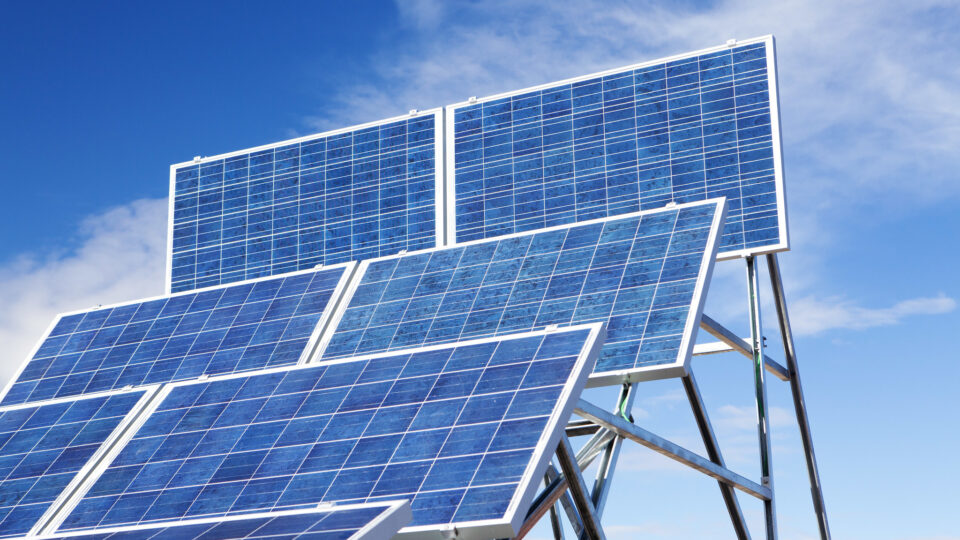
The transition to a renewables-based energy future continues to accelerate, but there are still many forces that can slow it down.  Government policy has a major role to play.  At the moment, the federal government is trying to prop up the fossil fuel industry with financial incentives and rampant deregulation.  So more than ever, innovative policies at the state level are essential drivers for revolutionizing the energy system.

One state where policy is trying to make a big difference is Massachusetts, which has created the Clean Peak Energy Standard or CPS, finalized and approved in late March and now taking effect.   A clean peak standard is a regulatory tool to reduce the costs and environmental impact of periods when electricity demand is highest, and generation tends to be the most polluting.  The CPS requires electric retailers to procure a minimum percentage of their annual electricity sales from renewable generation or energy storage.  That minimum amount will increase each year.

The CPS is formulated to incentivize better utilization of clean energy technologies to supply power when energy demand is high.  The problem is that there are times when the sun is not shining and the wind isn’t blowing, but energy demand is at its highest.  The solution is to use energy storage technologies that can supply power when it is needed.  Furthermore, storage can be relied upon during times of extreme weather that cause power outages.

Massachusetts has already started using energy storage in its grid.  The small town of Sterling installed an energy storage system in 2016 that provides crucial backup power to the police station and emergency dispatch center, thereby keeping first responder operations running even during extended power outages.

**********

Web Links

Massachusetts is setting the benchmark for nationwide clean energy transformation

Photo, posted March 30, 2012, courtesy of Flickr.

Earth Wise is a production of WAMC Northeast Public Radio.
Side Effects Of Geoengineering | Earth Wise

July 20, 2020 By EarthWise Leave a Comment

Reflecting sunlight to cool the planet will cause other global changes

As the world struggles to reduce the greenhouse gas emissions that are warming the global climate, some researchers are exploring proposals to deliberately engineer climate changes to counteract the warming trend.  One of the most widely discussed approaches is to shade the Earth from a portion of the sun’s heat by injecting the stratosphere with reflective aerosol particles.  Proponents of this idea point out that volcanoes do essentially the same thing, although generally for only a limited amount of time.  Particularly large eruptions, such as the Krakatowa eruption of 1883, wreaked havoc with weather around the world for an entire year.

Schemes to launch reflective aerosols – using planes, balloons, and even blimps – appear to be quite feasible from the standpoint of physically accomplishing them. But this says nothing about the political, ethical, and societal issues involved.  The point is that such an approach could indeed lower global temperatures and thereby potentially offset the warming effects of greenhouse gases.

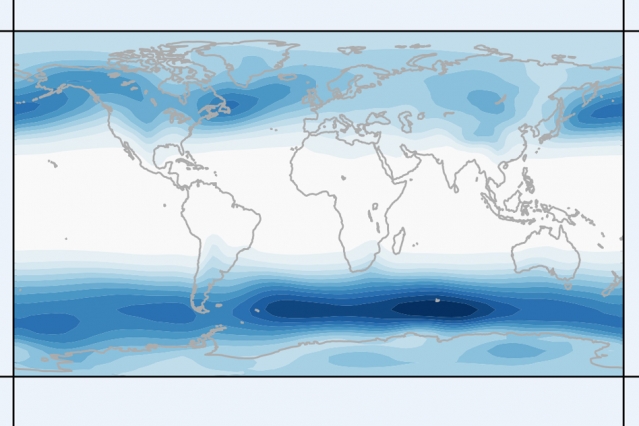
A study by scientists at MIT looked at what other effects such a solar geoengineering project might have on the climate.  Their modeling concluded that it would significantly change storm tracks in the middle and high latitudes.  These tracks give rise to cyclones, hurricanes, and many more ordinary weather phenomena.

According to the study, the northern hemisphere would have weakened storm tracks, leading to less powerful winter storms, but also stagnant conditions in summer and less wind to clear away air pollution.  In the southern hemisphere, there would be more powerful storm tracks.

Aside from turning the world’s weather patterns inside out, solar geoengineering would do nothing to address the serious issue of ocean acidification caused by increasing carbon dioxide levels.

As many have pointed out, playing the geoengineering game would have many unintended consequences.

**********

Web Links

Study: Reflecting sunlight to cool the planet will cause other global changes

Photo courtesy of MIT.

Earth Wise is a production of WAMC Northeast Public Radio.

Powering Amazon By The Sun | Earth Wise

June 29, 2020 By EarthWise Leave a Comment

Amazon and solar power

Amazon.com is a multinational conglomerate company that sells nearly $300 billion dollars a year worth of products, employs over 800,000 people, and by any measure, consumes a tremendous amount of resources.  In terms of its environmental impact, Amazon is estimated to be responsible for the emission of 50 million tons of CO2 annually, which is more than the yearly total for countries like Switzerland, Ireland, New Zealand, Denmark, and about 140 other countries.

Amazon is trying to reduce its environmental impact.  The company recently announced five new renewable energy projects in China, Australia and the U.S. as part of its commitment to reach 80% renewable energy by 2024, 100% renewable energy by 2030, and to reach net zero carbon by 2040.

The projects include a 100 MW solar project in Shandong, China, a 105 MW solar project in New South Wales, Australia, two solar projects in Ohio (one 200 MW and one 80 MW), and a 130 MW solar project in Virginia.

To date, Amazon has announced 31 utility-scale wind and solar renewable energy projects as well as 60 solar rooftops on fulfillment centers and sort centers around the world.  Taken together, these projects provide almost 3 GW of capacity and will deliver more than 7.6 million MWh of renewable energy annually.

In order for the world to meet the climate goals set by the Paris Agreement, it will take more than just countries to make and keep commitments.   Whatever else one may think about Amazon’s place in the world, their latest efforts for the environment are a big step in the right direction.

**********

Web Links

Amazon announces five new utility-scale solar projects to power operations in China, Australia, and the US

Photo, posted November 16, 2018, courtesy of Todd Van Hoosear via Flickr.

Earth Wise is a production of WAMC Northeast Public Radio.

Figuring Out Photosynthesis | Earth Wise

March 16, 2020 By EarthWise Leave a Comment

unraveling the mystery of photosynthesis

Plants have been harnessing the sun’s energy for hundreds of millions of years. Algae and photosynthetic bacteria have been doing the same for even longer, all with remarkable efficiency and resiliency. 

People have used the energy of the sun in one way or another for millennia, but only recently have we gotten sophisticated about it by using devices like solar panels and sensors.  And we still have a long way to go to get anywhere close to the efficiency of plants. It’s no wonder, then, that scientists have long sought to understand exactly how photosynthesis works.

Scientists from the U.S. Department of Energy’s (DOE) Argonne National Laboratory, and collaborators at Washington University in St. Louis, recently solved a critical part of the age-old mystery of photosynthesis, studying the initial, ultra-fast events through which photosynthetic proteins capture light and use it to initiate a series of electron transfer reactions.  Electrons in plants have two possible pathways to travel but only use one.   

But as a result of their efforts, the scientists are now closer than ever to being able to design electron transfer systems in which they can send an electron down a pathway of their choosing. 

By gaining the ability to harness the flow of energy, it may be possible to incorporate new design principles in non-biological energy systems. This could allow us to greatly improve the efficiency of many solar-powered devices, potentially making them far smaller. Understanding the intricacies of photosynthesis creates a tremendous opportunity to open up completely new disciplines of light-driven biochemical reactions, perhaps even ones that haven’t been envisioned by nature.

**********

Web Links

Scientists unravel mystery of photosynthesis

Photo, posted June 14, 2017, courtesy of Alex Holyoake via Flickr.

Earth Wise is a production of WAMC Northeast Public Radio.

Clouds And Global Warming | Earth Wise

March 9, 2020 By EarthWise Leave a Comment

clouds global warming

Recent climate models from multiple organizations project that the amount of warming that doubling atmospheric carbon dioxide would cause would be much more than previously estimated.  And one of the significant changes to the models relates to the role of clouds.

Clouds have long been a major uncertainty in climate calculations.  Clouds can shade the earth and thereby provide cooling.  But clouds can also trap heat.  Which effect dominates depends on how reflective the clouds are, how high up they are, and whether it is day or night.  The dynamics of clouds are complicated.

If you fly across the ocean, you will see blankets of low clouds extending for hundreds of miles.  These marine stratus and stratocumulus clouds predominantly cool the Earth.  In fact, they shade roughly a fifth of the oceans and reflect 30-60% of the solar radiation that hits them back into space.

Recent studies indicate that as global temperatures rise, these clouds are likely to become thinner or burn off entirely, leaving more clear skies through which the sun may add another degree Celsius or more to global warming.

The concerns about clouds are part of the larger issue about feedbacks in warming the world.  It has long been clear that the greenhouse effect of doubling CO2 levels in the atmosphere would raise global temperature.  But there are amplifying feedback effects.  Melting large areas of snow and ice reduces reflectivity and allows the land and oceans to absorb more heat.  More water vapor entering the atmosphere traps more heat.  And now clouds are another concern.

Overall, these effects are leading to climate models predicting much larger global temperature increases, which is a scary prospect for the world.

**********

Web Links

Why Clouds Are the Key to New Troubling Projections on Warming

Photo, posted September 10, 2006, courtesy of Nicholas A. Tonelli via Flickr.

Earth Wise is a production of WAMC Northeast Public Radio.
A Possible Storage Breakthrough: Solar Energy | Earth Wise

January 10, 2020 By EarthWise 2 Comments

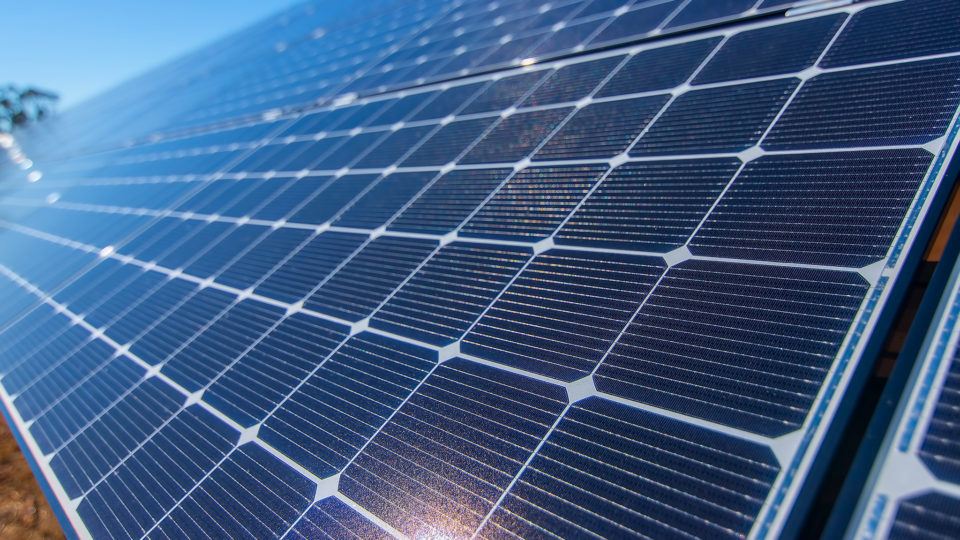
Solar energy is a nearly unlimited resource, but it is only available to us when the sun is shining.  For solar power to provide for the majority of our energy needs, there needs to be a way to capture the energy from the sun, store it, and release it when we need it.  There are many approaches to storing solar energy, but so far none have provided an ideal solution.

Scientists at the Chalmers Institute of Technology in Sweden have developed a way to harness solar energy and keep it in reserve so it can be released on demand in the form of heat—even decades after it was captured. Their solution combines several innovations, including an energy-trapping molecule, a storage system, and an energy-storing laminate for windows and textiles.

The energy-trapping molecule is made up of carbon, hydrogen, and nitrogen.  When hit by sunlight, the molecule captures the sun’s energy and holds on to it until it is released as heat by a catalyst.  The specialized storage unit is claimed to be able to store energy for decades.  The transparent coating that the team developed also collects solar energy and releases heat.  Using it would reduce the amount of electricity required for heating buildings.

So far, the team has concentrated on producing heat from stored solar energy.  It is unclear whether the technology can be adapted to produce electricity, which would be even more valuable.  In any event, the team does not yet have precise cost estimates for its technology, but there are no rare or expensive elements required, so the economics seem promising.  There is much more work to be done, but this could be a very important technology for the world’s energy systems.

**********

Web Links

An Energy Breakthrough Could Store Solar Power for Decades

Photo courtesy of Flickr.

Earth Wise is a production of WAMC Northeast Public Radio.
Clean Gas From An Artificial Leaf

November 27, 2019 By EarthWise Leave a Comment

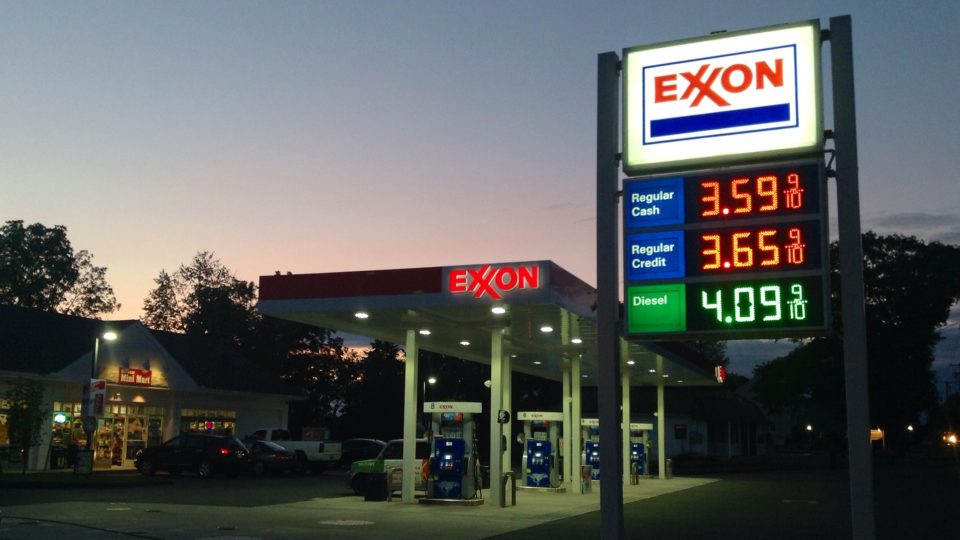
Photosynthesis is the process used by plants, algae and certain bacteria to harness energy from sunlight and turn it into chemical energy.  It is often described as the green engine of life on earth.

For quite some time, there have been extensive research efforts around the world in the area of artificial photosynthesis.  The goal is to somehow mimic the behavior of plants in order to generate clean-burning fuels using nothing more than sunlight and the carbon dioxide in the air.

Researchers at the University of Cambridge have recently demonstrated a so-called artificial leaf that can directly produce syngas using sunlight.   Syngas is a fuel gas mixture consisting primarily of hydrogen and carbon monoxide.  Most people haven’t heard of syngas, but many products are created using it.  Being able to produce it sustainably would be a critical step to a far greener chemical and fuel industry.

The artificial leaf contains two light absorbers, similar to the molecules in plants that harvest sunlight, which are combined with a catalyst made from the naturally abundant element cobalt.  When the device is immersed in water, one light absorber uses the catalyst to produce oxygen.  The other carries out the chemical reaction that reduces carbon dioxide and water into carbon monoxide and hydrogen.  The result is the syngas mixture.

It turns out that even a rainy or overcast day provides enough light to drive the process.

Previous artificial leaf devices have mostly just produced hydrogen.  The Cambridge device produces syngas thanks to the novel combination of materials and catalysts it uses.

The researchers are now focused on finding ways to use the technology to produce a sustainable gasoline substitute.

**********

Web Links

‘Artificial leaf’ successfully produces clean gas

Photo, posted August 15, 2014, courtesy of Mike Mozart via Flickr.

Earth Wise is a production of WAMC Northeast Public Radio.

Solar-Powered Desalination

October 4, 2019 By EarthWise Leave a Comment

Turning seawater into drinking water is an energy-intensive process and is therefore pretty expensive.  Worldwide, one third of people don’t have reliable access to safe drinking water and they are the least able to afford expensive ways to get it.   By 2025, half of the world’s population is expected to live in water-stressed areas.

At a newly-constructed facility in Kenya, a nonprofit company called GivePower has built a desalination system that runs on solar power.  The system started operating in the coastal area of Kiunga in July 2018 and can create nearly 20,000 gallons of fresh drinking water each day – enough for 25,000 people.

GivePower started in 2013 as a nonprofit branch of SolarCity, the solar-panel company that ultimately merged with Tesla in 2016.  However, GivePower spun off as a separate enterprise shortly before that.

GivePower mostly focuses on building solar-energy systems to provide electricity across the developing world. 

Desalination technology is not new, but it is notoriously energy-intensive because it requires high-power pumps.  The GivePower system is integrated with a solar microgrid that makes use of Tesla batteries to store energy for when the sun is not shining. 

Local residents pay about a quarter of one cent for every quart of water from the system.  The Kiunga community has faced ongoing drought and before the GivePower system was installed, was forced to drink from salt water wells, which present serious health risks.

The GivePower system cost $500,000 to build and is expected to generate $100,000 a year, to be eventually used to fund similar facilities in other places.

**********

Web Links

A solar-powered system can turn salt water into fresh drinking water for 25,000 people per day. It could help address the world’s looming water crisis.

Photo courtesy of GivePower.

Earth Wise is a production of WAMC Northeast Public Radio.
Complications For New York Solar Farms

July 12, 2019 By EarthWise Leave a Comment

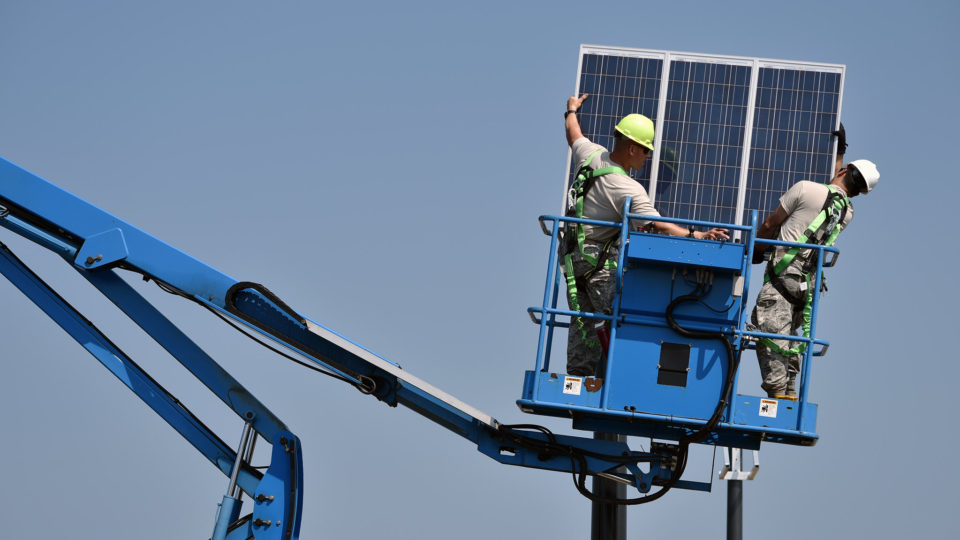
A study by engineers at Cornell University looked at the implications of adding utility-scale solar farms throughout New York State.  Adding such farms could reduce demand for electricity from conventional sources by nearly 10% in some places.  But the engineers caution that winters in upstate New York could create some novel problems for the state’s power system.

Electrical energy demand tends to be low around midday when many people are not home.  Electrical production from solar farms is high at that time when the sun is at its highest position in the sky.  This can lead to what power system operators call “ramping”, which is the term for rapid increases or decreases in demand.

This sort of ramping was first discussed in California years ago.  When people wake up and prepare for the day, there is a morning peak in electrical load, which occurs before solar production ramps up.   When people get home from work in the evening, energy demands create a second peak.  A graph of this lack of synchronicity of load and supply looks a little like the shape of a duck and is popularly known as the duck curve.

The Cornell engineers figured out that maximum ramping in New York – where electrical demand and electricity supply from solar farms are out of synch- will take place in the winter.  In fact, when there are several days of sunshine in a row during winter, the largest ramping in the New York power system will take place.

The general issue of having solar energy available when it is most needed is one that is the driver for energy storage technology. If the energy can be provided when demand calls for it, there would be no more ramping.

**********

Web Links

Winter could pose solar farm ‘ramping’ snag for power grid

Photo, posted September 8, 2015, courtesy of New York National Guard via Flickr.

Earth Wise is a production of WAMC Northeast Public Radio.

Sunlight As A Cash Crop

July 10, 2019 By EarthWise Leave a Comment

It isn’t so easy to be a farmer these days.  Farming has always involved long hours, hard work and the uncertainties of weather and yield.  The 21st Century has added new and unique challenges such as increasingly unpredictable weather, insect infestation and disease, and low commodity prices.  Add in sudden tariffs and farmers struggle even more to make ends meet.  The default rate for farmers’ loans is the the highest in at least nine years.

One thing that remains reliable for farmers is the sun.  It rises in the morning and goes down at night.  The sun can be trusted, unlike politicians, rain, or commodity prices.  These days, many farmers are taking advantage of the dependability of the sun to make money from a new cash crop: solar energy.

The trend is spreading.  North Carolina has been a leading solar energy state for several years and a 2017 report found that solar energy generates 30% of the income of many farms.  Typical annual rent payments for farmland by solar companies range from $500 to $1,400 per acre in North Carolina.

A growing list of states have clean energy mandates targeting 100% use of renewable energy.   These mandates provide incentives for farmers that make installing solar a financially smart decision and falling prices for solar installations make it an even better deal.

Solar works well when co-located on a farm and can be built in ways that minimizes impact.  It is quiet, uses almost no water, doesn’t pollute, and if it is decommissioned, the land can go back to its previous use.  If the solar facilities are raised up, the same land can be used to graze livestock or grow shade-tolerant crops.

**********

Web Links

Harvesting the sun is the new cash crop

Photo, posted December 25, 2017, courtesy of Flickr.

Earth Wise is a production of WAMC Northeast Public Radio.
Two Million Solar Installations

July 1, 2019 By EarthWise Leave a Comment

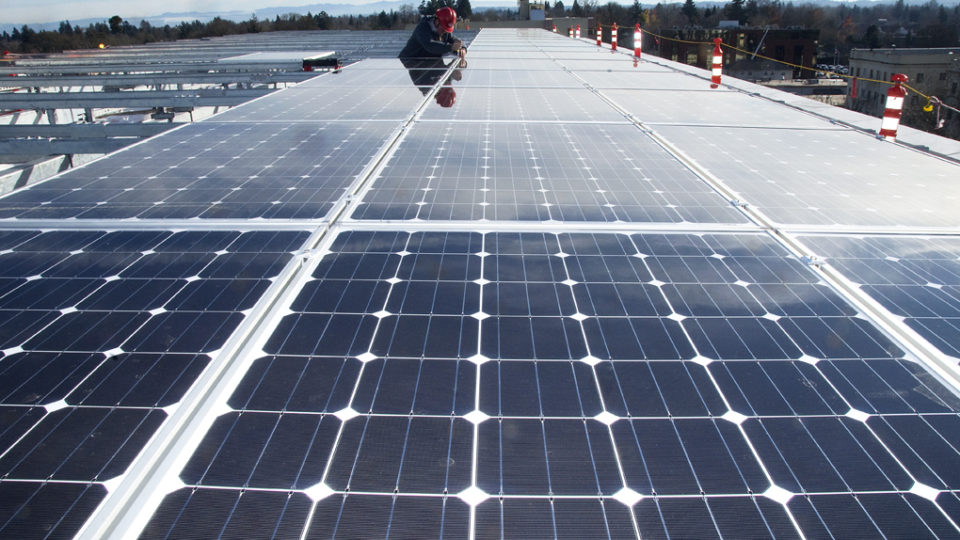
Three years ago, we reported that the United States had installed its one millionth solar energy system, a feat that took 40 years to accomplish.  Recently, the Solar Energy Industries Association announced that there are now more than 2 million U.S. installations.

Analysts forecast that there will be 3 million installation in 2021 and 4 million in 2023.

California continues to lead the nation in installing solar power.  More than 50% of the first million installations were in that state and California accounted for 43% of the second million.  Its share is nevertheless slowly dropping with the growth of the residential solar sector that is rapidly diversifying across state markets.  Some places have seen extremely rapid growth.  In South Carolina, there were barely more than 1,000 cumulative installations in 2016; today, the state is home to more than 18,000 solar systems and expects to add 22,000 more over the next five years.

The five leading states in terms of number of solar installations are California, Arizona, New York, New Jersey, and Massachusetts.    Other states recently seeing rapid growth in solar installations are Texas, Utah, Florida, Rhode Island and Maryland.  Looking ahead, Illinois is forecast to grow from only 4,000 installations today to nearly 100,000 by 2024.  The top ten state markets apart from California expect to add nearly 750,000 installation over the next five years.

The United States is at least the third nation that is home to more than 2 million solar installations.  (Australia hit the milestone late least year and Japan actually topped 2 million in September 2014).

According to forecasts from analyst first Wood Mackenzie, by the year 2024, there will be on average one new solar installation every minute.

**********

Web Links

The United States surpasses 2 million solar installations

Photo, posted January 11, 2012, courtesy of the Oregon Department of Transportation via Flickr.

Earth Wise is a production of WAMC Northeast Public Radio.

Rapid Antarctic Melting

June 28, 2019 By EarthWise 1 Comment

The Ross Ice Shelf in Antarctica is the world’s largest ice shelf, covering an area roughly the size of France.  Scientists have spent several years building up a record of how the northwest sector of the enormous ice shelf interacts with the ocean beneath it.  Their results show that the ice is melting much more rapidly than previously thought because of in-flowing warm water.

In general, the stability of ice shelves is thought to be mostly influenced by their exposure to warm deep ocean water.  But the new research has found that surface water heated by the sun also plays a crucial role in melting ice shelves.

The interactions between ice and ocean water that occur hundreds of meters below the surface of ice shelves have a direct impact on long-term sea level.  The Ross Ice Shelf stabilizes the West Antarctic ice sheet by blocking the ice that flows into it from some of the world’s largest glaciers.

When ice shelves collapse, the glaciers that feed them can speed up by a factor of two or three.  None of the collapsing shelves in the past have come anywhere close to the size of the Ross Ice Shelf, which is more than 100 times bigger.

The new study by New Zealand’s National Institute of Water and Atmospheric Research showed that sun-heated surface water flowing into the cavity under the ice shelf near Ross Islands caused melt rates to nearly triple during the summer months.  This indicates that the loss of sea ice resulting from climate change is likely to increase melt rates in the future.  While the Ross Ice Shelf is still considered to be relatively stable, the new findings show that it may be more vulnerable than previously thought.

**********

Web Links

Rapid melting of the world’s largest ice shelf linked to solar heat in the ocean

Photo, posted February 15, 2009, courtesy of Alan Light via Flickr.

Earth Wise is a production of WAMC Northeast Public Radio.

A Giant Solar Farm In Dubai

June 26, 2019 By EarthWise Leave a Comment

Like many places in the Middle East, Dubai made its fortune from oil.  But the Emirate’s oil resources are limited, and its economy has evolved in other directions.  Today, oil provides less than 5% of Dubai’s revenues; its economy relies on revenues from trade, tourism, aviation, real estate, and financial services.

Dubai is also away from fossil fuels to meet its energy needs. A monumental construction project is underway deep within Dubai’s desert interior which will be the largest solar energy facility in the world.

The Mohammed Bin Rashid Al Maktoum Solar Park – named after Dubai’s ruler – has been under development for 7 years.  Total investment in the project will be nearly $14 billion when it is completed in 2030.  It will have a total capacity of 5,000 megawatts, enough to power 1.3 million homes.  Only some large hydroelectric power plants, the largest nuclear power plants, and a couple of Asian coal plants have more generating capacity.

Phases one and two of the project are already complete and feature more than 2 million solar panels.  Phase three – well along the way in construction – will add another 3 million solar panels and should be completed next year.

Phase four will not involve solar panels but instead will make use of the world’s tallest concentrated solar power tower.  It will use mirrors to focus sunlight at the top of the tower to heat up molten salt that will power steam turbines to generate electricity and will be able to operate long after the sun goes down.

Currently, the Tengger Desert Solar Park in China is the largest photovoltaic park in the world, but a colossal farm in India will take its place in a few years.  Big solar is getting bigger all the time.

**********

Web Links

$13.6B record-breaking solar park rises from Dubai desert

Photo, posted December 15, 2018, courtesy of Anoop S. via Flickr.

Earth Wise is a production of WAMC Northeast Public Radio.

  • « Go to Previous Page
  • Page 1
  • Page 2
  • Page 3
  • Page 4
  • Page 5
  • Page 6
  • Page 7
  • Go to Next Page »

Primary Sidebar

Recent Episodes

  • An uninsurable future
  • Clean energy and jobs
  • Insect declines in remote regions
  • Fossil fuel producing nations ignoring climate goals
  • Trouble for clownfishes

WAMC Northeast Public Radio

WAMC/Northeast Public Radio is a regional public radio network serving parts of seven northeastern states (more...)

Copyright © 2026 ·