
• Skip to primary navigation
  • Skip to main content
  • Skip to primary sidebar

Earth Wise

A look at our changing environment.

  • Home
  • About Earth Wise
  • Where to Listen
  • All Articles
  • Show Search
Hide Search
You are here: Home / Archives for efficient

efficient

Progress On Artificial Photosynthesis | Earth Wise

August 8, 2022 By EarthWise Leave a Comment

Photosynthesis is the process by which plants use the energy from sunlight to turn water and carbon dioxide into biomass and ultimately the foods we and other organisms eat.  Scientists at the University of California Riverside and the University of Delaware have found a way to create food from water and carbon dioxide without using biological photosynthesis and without needing sunlight.

The research, recently published in the journal Nature Food, uses a two-step electrocatalytic process to convert carbon dioxide, electricity, and water into acetate, which is the primary component of vinegar.   Food-producing microorganisms then consume the acetate in order to grow.   Solar panels are used to generate the electricity to power the electrocatalysis.  The result is a hybrid organic-inorganic system that is far more efficient in converting sunlight into food than biological photosynthesis.

The research showed that a wide range of food-producing organisms can be grown in the dark directly on the acetate output of the electrolyzer.  These include green algae, yeast, and the fungal mycelium that produce mushrooms.   Producing algae with this technology is about 4 times more energy efficient than growing it with photosynthesis.  Yeast production is about 18 times more energy efficient than the typical method of cultivating it using sugar extracted from corn.

Artificial photosynthesis has the potential to liberate agriculture from its complete dependence on the sun, opening the door to a wide range of possibilities for growing food under the increasingly difficult conditions imposed by the changing climate.

**********

Web Links

Artificial photosynthesis can produce food without sunshine

Photo, posted September 7, 2016, courtesy of Kevin Doncaster via Flickr.

Earth Wise is a production of WAMC Northeast Public Radio.

A Better Way To Capture Carbon | Earth Wise

April 29, 2022 By EarthWise Leave a Comment

Developing a better way to capture carbon

The goal of carbon capture and storage technology is to remove carbon dioxide from the atmosphere and safely store it for the indefinite future.  There are existing industrial facilities that capture carbon dioxide from concentrated sources – like the emissions from power plants.  The technology currently captures and stores only about a tenth of a percent of global carbon emissions.

Most existing CCS technologies use chemical binders to trap carbon dioxide quickly and efficiently, but they are extraordinarily energy intensive as well as expensive.

Researchers at the University of Colorado Boulder have developed a new tool that could lead to more efficient and cheaper ways to capture carbon dioxide directly out of the air.  The tool predicts how strong the bond will be between carbon dioxide and a candidate molecule for trapping it – that is, a binder.  This new electrochemical diagnostic tool can be used to identify suitable molecular candidates for capturing carbon dioxide from everyday air.

Current carbon capture technologies are very expensive at the scale required to be able to turn the captured CO2 into useful substances, such as carbonates – which are an ingredient in cement – or formaldehyde or methanol, which can be used as fuels.  Making useful materials out of the captured CO2 is an important way to offset the cost of capturing it that merely storing it away does not permit.

The new electrochemical analytical tool developed by the Colorado researchers offers the potential for identifying binders that will be more efficient and less expensive, thereby making direct air carbon capture a realistic part of the efforts to address climate change.

**********

Web Links

New method could lead to cheaper, more efficient ways to capture carbon

Photo, posted October 25, 2015, courtesy of Frans Berkelaar via Flickr.

Earth Wise is a production of WAMC Northeast Public Radio.

An Indoor Farm In Upstate New York | Earth Wise        

March 11, 2022 By EarthWise Leave a Comment

Indoor farms to help feed the world

Vertical farming is the practice of growing crops in vertically stacked layers, generally under controlled environments and using soilless farming techniques like hydroponics, aquaponics, and aeroponics.   Vertical farms are housed in structures such as buildings, shipping containers, tunnels, and abandoned mineshafts.

The potential advantages of vertical farms are that they are very efficient in terms of the amount of land required to produce a given amount of crop, they are resistant to weather, and they allow crops to be produced in close proximity to where they will be used.

The vacant third floor of a building in downtown Glens Falls, New York is about to become the home of a small vertical farm.  The facility will be used to hydroponically grow things like fresh basil, lettuce, and fruits to be used by nearby restaurants.  In fact, the first floor of the building is a restaurant that will be a customer for the crops growing upstairs.  Other local restaurants are likely to benefit as well.

Th pilot program is being funded by a grant from the Smart Cities Innovation Partnership that the city applied for in 2020.  Glens Falls is partnering with Re-Nuble, a New York City-based renewability and sustainability firm.  Apart from the vertical farm project, Re-Nuble also advises on reduction of food waste by composting and on the selection of energy-efficient equipment.

The pilot program will run for a year and the results will be used for scaling it up to a larger vertical farm.  Vertical farms like these are not intended to replace conventional farms but can supplement the existing food stream and provide items that are hard to obtain during the year.

**********

Web Links

Glens Falls is fitting a farm inside a downtown building

Photo, posted July 15, 2007, courtesy of Toshiyuki Imai via Flickr.

Earth Wise is a production of WAMC Northeast Public Radio.
Saving Water At Power Plants | Earth Wise

September 21, 2021 By EarthWise Leave a Comment

Reducing the water needs of power plants

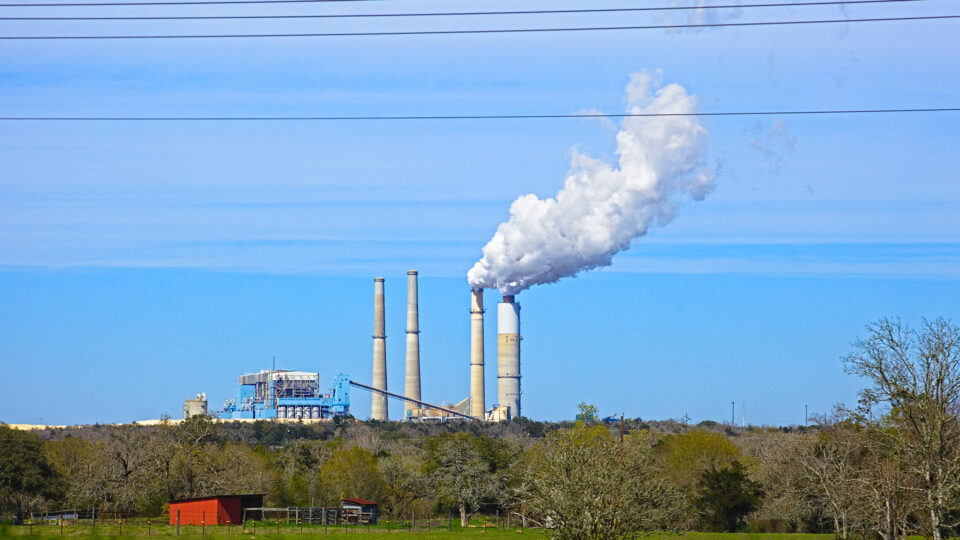
Nearly 40% of all the water taken from lakes, rivers, and wells in the U.S. isn’t used for agriculture, drinking, or sanitation.  It is used to cool power plants that produce electricity by burning fossil fuels or with nuclear reactors.   Two-thirds of these power plants use evaporative cooling, which produces huge white plumes billowing from cooling towers.

A new company using technology developed at MIT has the goal of reducing the water needs of power plants and helping to alleviate water shortages in areas where power plants strain the capacity of local water systems.

The technology is relatively simple in principle but developing it to the point where it can be applied at full scale at industrial power plants was a greater challenge. 

The basic idea is to capture water droplets from both natural fog and from the plumes from power plant cooling towers.  The MIT researchers had to improve the efficiency of fog-harvesting systems, which previously captured only 1-3% of the water droplets that pass through them.  They found that water vapor collection could be made much more efficient by zapping the tiny droplets of water with an ion beam, giving them a slight electric charge, thereby making it easy to capture them with the metal mesh of the harvesting system.

The system can essentially eliminate cooling tower plumes and produce large quantities of high-purity water in the process, which has uses at many power plants.  The new company, called Infinite Cooling, has arranged to install their equipment on two operating commercial power plants later this year.  They expect the system to reduce the overall need for water by 20%.

**********

Web Links

Vapor-collection technology saves water while clearing the air

Photo, posted March 5, 2019, courtesy of Sam LaRussa via Flickr.

Earth Wise is a production of WAMC Northeast Public Radio.

Improving Solar Cells With Human Hair | Earth Wise

June 1, 2021 By EarthWise Leave a Comment

Human hair may improve solar cell performance

Researchers at the Queensland University of Technology in Australia have been able to improve the performance of perovskite solar cells using material made from human hair.

Perovskite solar cells are an up-and-coming technology that offers the possibility of making solar cells less expensive, more efficient, and flexible so that there could be solar-powered clothing, backpacks, or even tents for camping.  While the technology has been shown to be as effective in converting sunlight to electricity as currently available silicon technology, it faces problems with stability and durability.

The Australian research centered on the use of carbon nanodots to improve perovskite solar cell performance.  The nanodots were created in a rather unique way.  The carbon came from hair scraps from a Brisbane barbershop that were first broken down and then burned at nearly 500 degrees Fahrenheit. 

By adding a solution of the carbon nanodots into the process of making the perovskites, the dots formed a wave-like layer in which the perovskite crystals in the cells are surrounded by the carbon dots.  It serves as a protective layer, essentially a kind of armor, for the active portions of the material.

The result was solar cells with a higher power conversion efficiency and greater stability.  The researchers did not explain why they chose human hair as the source of carbon, but it does make for an interesting sidelight to the promising research.

Perovskite solar cells could be very important for spacecraft applications where reducing weight is paramount.  But in order to be able to use them for this purpose, perovskite solar cells will need to be able to cope with the extreme radiation and temperature variations in space.

**********

Web Links

Carbon dots from human hair boost solar cells

Photo, posted October 3, 2009, courtesy of Arktoi via Flickr.

Earth Wise is a production of WAMC Northeast Public Radio.

Cleaner Water Using Corn | Earth Wise

May 12, 2021 By EarthWise Leave a Comment

Using corn waste to clean water

Corn is the largest agricultural crop in the U.S., and it is also one of the most wasteful.  About half of the harvest ends up as stover – corn stalks, leaves, husks, and cobs – once the kernels are used for food.

Corn stover has relatively few commercial or industrial uses.  It can be used to produce biofuel, but that is not very energy efficient.  It is sometimes used as a low-quality livestock feed as well.  Mostly, it is just burned if it is used at all.

Researchers at the University of California Riverside have developed an energy-efficient way to make good use of stover by transforming it into activated carbon for use in water treatment.

Activated carbon – often called activated charcoal – is an organic material that is specially treated to contain millions of microscopic pores that make it highly absorbent.  It has many industrial uses, the most common of which is for filtering pollutants out of drinking water.  Most household water filters such as Brita filters as well as the ones built into refrigerators make use of activated carbon.

The Riverside researchers explored methods for producing activated carbon from charred corn stover and found that processing the material with hot compressed water – a process known as hydrothermal carbonization – produced highly absorbent activated carbon with superior properties compared to material produced by slow pyrolysis, where corn stover is charred at increasing temperatures over a long period of time.

According to the researchers, it is important to create approaches that convert waste into high-value materials, fuels, and chemicals in order to create new value streams and eliminate the environmental harm that comes from a so-called “take-make-dispose” economic model.

**********

Web Links

Cleaner Water Through Corn

Photo, posted September 15, 2010, courtesy of the United Soybean Board / the Soybean Checkoff via Flickr.

Earth Wise is a production of WAMC Northeast Public Radio.

Why Have Crocodiles Changed So Little Over Time? | Earth Wise

February 9, 2021 By EarthWise Leave a Comment

Why haven't crocodiles evolved?

Crocodiles today look very similar to ones from the Jurassic period some 200 million years ago.  In fact, there are very few species of crocodilians alive today – approximately two dozen to be exact.  Many other species have achieved a diversity of many thousands of species in the same amount of time. 

During prehistoric times, many more types of crocodiles roamed the earth, including some as big as dinosaurs and other serpentine forms that lived in the sea.  

According to findings by scientists at the University of Bristol in the U.K., a stop-start pattern of evolution could explain why crocodiles have changed so little over time. In the study, which was recently published in the journal Nature Communications Biology, researchers describe how crocodiles follow a pattern of evolution known as “punctuated equilibrium.”  In other words, crocodiles’ rate of evolution is generally slow, but occasionally picks up because the environment has changed.     

According to the research team, this slow rate of evolution is how crocodile diversity became so limited.  It appears crocodiles arrived at a body that was efficient and versatile.  They didn’t need to continue to change in order to survive.

This efficiency and versatility could be an explanation for why crocodiles survived the meteor impact that wiped out the dinosaurs.  Since crocodiles can’t control their body temperature and rely on the environment for warmth, they generally fare better in warm conditions.  During the age of dinosaurs, the climate was warmer than it is today, which could explain why crocodile diversity was higher.  

The scientists next step is to try to figure out why some prehistoric crocodiles died out while others did not. 

**********

Web Links

Why crocodiles have changed so little since the age of the dinosaurs

Photo, posted December 26, 2012, courtesy of Nicholas Smith via Flickr.

Earth Wise is a production of WAMC Northeast Public Radio.
Generating Hydrogen From Poor-Quality Water | Earth Wise

September 8, 2020 By EarthWise Leave a Comment

generating hydrogen from polluted water

Hydrogen could be the basis of a complete energy system.  It could be stored and transported and could be used to power vehicles and to generate electricity in power plants.  Proponents of the so-called hydrogen economy contend that hydrogen is the best solution to the global energy challenge.  But among the challenges faced by a hydrogen economy is the development of an efficient and green method to produce hydrogen.

The primary carbon-free method of producing hydrogen is to break down water into its constituent elements – hydrogen and oxygen.  This can be done in a number of ways, notably by using electricity in a process called electrolysis.  A method that seems particularly attractive is to use sunlight as the energy source that breaks down the water molecule.

While there is an abundance of water on our planet, only some of it is suitable for people to drink and consume in other ways.    Much of the accessible water on earth is salty or polluted.  So, a technique to obtain hydrogen from water ideally should work with water that is otherwise of little use to people.

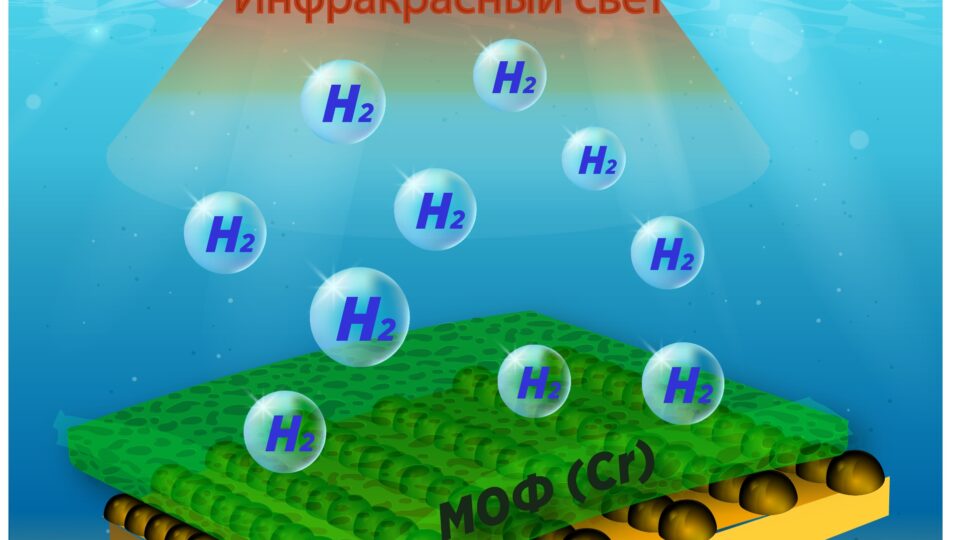
Researchers in Russia and the Czech Republic have recently developed a new material that efficiently generates hydrogen molecules by exposing water – even saltwater or polluted water – to sunlight. 

The new material is a three-layer structure composed of a thin film of gold, an ultra-thin layer of platinum, and a metal-organic framework or MOF of chromium compounds and organic molecules.  The MOF layer acts as a filter that gets rid of impurities.

Experiments have demonstrated that 100 square centimeters of the material can generate half a liter of hydrogen in an hour.  The researchers continue to improve the material and increase its efficiency over a broad range of the solar spectrum.

**********

Web Links

New Material Can Generate Hydrogen from Salt and Polluted Water

Photo courtesy of Tomsk Polytechnic University.

Earth Wise is a production of WAMC Northeast Public Radio.

Solar-Powered Desalination | Earth Wise

March 20, 2020 By EarthWise Leave a Comment

simple desalination using solar power

About 1% of the world’s population is dependent on desalinated water to meet daily needs, but water scarcity is a growing problem that experts believe will affect 14% of the world’s population within the next five years.

Desalination takes much more energy than, for example, transporting fresh water over large distances.  In general, desalination costs are much higher than those associated with fresh water, but beyond costs, freshwater is simply not always available.

Researchers at MIT and Shanghai Jiao Tong University in China have developed a completely passive solar-powered desalination system that could provide more than 1.5 gallons of fresh drinking water per hour for every square meter of solar collecting area.   Such a system could provide an efficient, low-cost water source for coastal areas that are off the grid.

The system uses multiple layers of flat solar evaporators and condensers topped with transparent aerogel insulation.  The key to its efficiency is the way it uses each of its multiple stages to desalinate water.  At each stage, heat released by the previous stage is harnessed instead of wasted.  The proof-of-concept device, which was tested on an MIT building rooftop, produced more than twice as much water as the record amount produced by any previous passive solar-powered desalination system.

The researchers plan further experiments aimed at optimizing the choice of materials and configurations and to test the system under realistic conditions.  The hope is to have a technology that can play a role in alleviating water scarcity in parts of the world where electricity is scarce, but seawater and sunlight are abundant.

**********

Web Links

Simple, solar-powered water desalination

Photo courtesy of MIT/researchers.

Earth Wise is a production of WAMC Northeast Public Radio.
Pulling Water From The Air

October 14, 2019 By EarthWise Leave a Comment

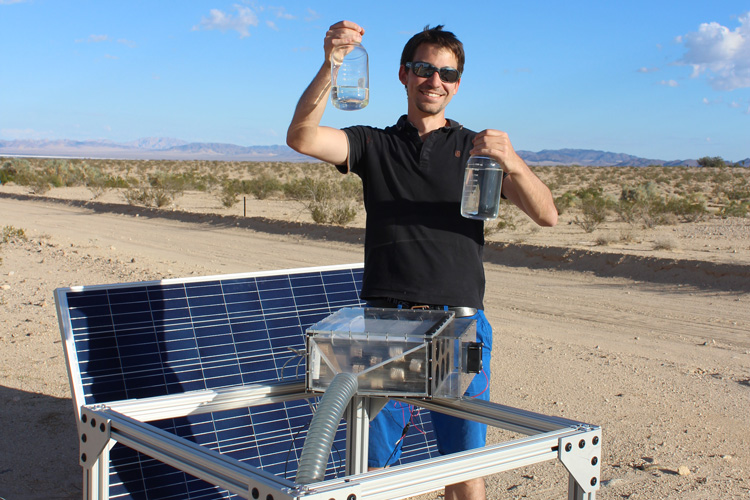
A couple of years ago, we reported on the early development of a device that harvests water from the air that even works in the low humidity environment of a desert.  Since then, the researchers from UC Berkeley have continued to improve the device and it is now 10 times better than it was two years ago.

The harvester is based on a porous water-absorbing material called a metal-organic framework, or MOF.  The latest version can pull more than five cups of water from low-humidity air per day for every kilogram of the improved MOF material and that is more than enough water to sustain a person.  The harvester cycles around the clock and is powered by solar panels and a battery.

Previous techniques for condensing water from air at low humidity required cooling down the air to temperatures below freezing, which is not economically practical.  The MOF-based device does not require any cooling.

The Berkeley researchers have formed a startup company – Water Harvester, Inc. – which is now testing and will soon market a device the size of a microwave oven that can supply 7 to 10 liters of water per day, which is enough drinking and cooking water for two or three adults.

An even larger version of the harvester, which would be the size of a small refrigerator, would provide 200 to 250 liters of water per day, enough for a household to drink, cook, and shower.  The new company envisions a village-scale harvester that would produce 20,000 liters per day, still running off of solar panels and a battery.

Water Harvester believes the water needs for many people can come out of the thin air.

**********

Web Links

Water harvester makes it easy to quench your thirst in the desert

Photo courtesy of Grant Glover (University of South Alabama) via UC Berkeley.

Earth Wise is a production of WAMC Northeast Public Radio.

A Green Way To Turn Blue

August 5, 2019 By EarthWise Leave a Comment

Indigo dye is what is used to color denim cloth and blue jeans.  Historically, the dye came from a tropical plant most often found on the Indian subcontinent.  Eventually, it became economically favorable to synthesize the dye instead and almost all of the 50,000 tons of the dye used annually is synthetic.

The processes used to make synthetic indigo are efficient and inexpensive, but they often require toxic chemicals and create a lot of dangerous waste.  Researchers at the Department of Energy’s Joint BioEnergy Institute have now developed an eco-friendly production platform for a blue pigment called indigoidine.  It has a similarly vividly saturated blue hue as synthetic indigo.

The researchers were investigating the ability of various fungal strains to express large enzymes known as NRPSs.  They chose an NRPS that converts two amino acid molecules into indigoidine – a blue pigment – in order to make it easy to tell if the strain engineering had worked.  Having the culture turn blue was an effective indicator.

Their primary interest was not the pigment but when they saw just how blue the culture was for one particular fungus, they realized that the fungal strain did not just produce indigoidine; it produced large amounts of it.

Thus they have found a way to efficiently produce a blue pigment that uses inexpensive, sustainable carbon sources instead of harsh chemicals.  There is already a great deal of interest from the textile industry, where many companies are eager for more sustainably sourced pigments because customers are increasingly aware of the impacts of conventional dyes.

Thanks to a talented fungus called Rhodosporidium toruloides, there may now be a green way to turn blue.

**********

Web Links

Blue Pigment from Engineered Fungi Could Help Turn the Textile Industry Green

Photo, posted March 7, 2006, courtesy of Willi Heidelbach via Flickr.

Earth Wise is a production of WAMC Northeast Public Radio.

More Power From The Sun’s Heat

November 29, 2018 By EarthWise Leave a Comment

https://earthwiseradio.org/wp-content/uploads/2018/11/EW-11-29-18-More-Power-From-The-Suns-Heat.mp3

When we think of solar power, we usually are talking about the panels that generate electricity using the photovoltaic effect.  These panels are on millions of rooftops around the world and in utility-scale solar farms.   There are also solar water heating systems that use the sun’s heat to provide hot water for homes and businesses.

[Read more…] about More Power From The Sun’s Heat

Using The Sun To Remove Ice

October 3, 2018 By EarthWise Leave a Comment

https://earthwiseradio.org/wp-content/uploads/2018/09/EW-10-03-18-Using-the-Sun-to-Remove-Ice.mp3

Ice buildup can cause all sorts of problems ranging from performance issues to catastrophic failures.  For example, ice buildup can negatively impact things like airplanes, power lines, wind turbines, and the like.  Preventing this ice buildup typically requires energy-intensive heating systems or environmentally-harmful chemical sprays.

[Read more…] about Using The Sun To Remove Ice

Emissions From Electric Buses

September 12, 2018 By EarthWise Leave a Comment

https://earthwiseradio.org/wp-content/uploads/2018/09/EW-09-12-18-Emissions-from-Electric-Buses.mp3

Municipalities and transit agencies are gradually replacing conventional diesel buses with cleaner alternatives such as natural-gas-powered, diesel-electric hybrid, or fully electric buses.  The goal is to reduce the substantial carbon emissions associated with buses as well as reducing unhealthy air pollution. Diesel buses on average get less than 5 miles per gallon as they transport passengers around, so there is plenty of motivation to find more efficient ways to power them.

[Read more…] about Emissions From Electric Buses

Global Warming And Air Conditioners

August 24, 2018 By EarthWise Leave a Comment

https://earthwiseradio.org/wp-content/uploads/2018/08/EW-08-24-18-Global-Warming-and-Air-Conditioners.mp3

All those record high temperatures around the world this summer – such as during the unprecedented heatwave in Japan – put the spotlight on the growing dependence we all have on air conditioning. 

[Read more…] about Global Warming And Air Conditioners

European Diesel Under Siege

June 5, 2018 By EarthWise Leave a Comment

https://earthwiseradio.org/wp-content/uploads/2018/06/EW-06-05-18-European-Diesel-Under-Seige.mp3

Diesel cars have never been very popular in the US and in the aftermath of the so-called Dieselgate scandal at Volkswagen, they are even less so.  Less than a dozen diesel car models are available for purchase in the US and only one of those is from a German automaker: BMW.

[Read more…] about European Diesel Under Siege

Turning Heat Into Electricity

February 19, 2018 By EarthWise Leave a Comment

https://earthwiseradio.org/wp-content/uploads/2018/02/EW-02-19-18-Turning-Heat-Into-Electricity.mp3

Many of our technologies produce waste heat.  Internal combustion engines are a prime example, but all our industrial processes, motors, electronics and other machinery turn some (and, in many cases, most) of the energy it takes to run them into heat that just goes into the environment.

[Read more…] about Turning Heat Into Electricity

A Better Way To Make Hydrogen

February 7, 2018 By EarthWise Leave a Comment

https://earthwiseradio.org/wp-content/uploads/2018/01/EW-02-07-18-A-Better-Way-to-Make-Hydrogen.mp3

There is a great deal of interest in developing cost-effective, energy-efficient and environmentally-friendly ways of producing hydrogen.  If hydrogen-powered vehicles are to catch on, it is essential.

[Read more…] about A Better Way To Make Hydrogen

Accidental Ethanol From Carbon Dioxide

December 27, 2016 By EarthWise

https://earthwiseradio.org/wp-content/uploads/2016/12/EW-12-27-16-Accidental-Ethanol.mp3

Scientists at the Oak Ridge National Laboratory in Tennessee were trying to find a series of chemical reactions that could turn carbon dioxide into a useful fuel.  But the unexpected occurred:  they found that the first step in their process actually got the job done all by itself.   The reaction turns CO2 into ethanol, which is already used to power generators and vehicles.

[Read more…] about Accidental Ethanol From Carbon Dioxide

Energy Intensity

September 7, 2016 By WAMC WEB

https://earthwiseradio.org/wp-content/uploads/2016/09/EW-09-07-16-Energy-Intensity.mp3

Every stage of civilization is characterized by its use of energy.   From burning wood to steam engines to our electrified society, energy is behind everything we do.  Over time, human society has become increasingly energy intensive.  As our standards of living have improved and as we overcome the effects of weather – either cold or warm – it takes more and more energy to live the lives we lead.

[Read more…] about Energy Intensity

  • « Go to Previous Page
  • Page 1
  • Page 2
  • Page 3
  • Go to Next Page »

Primary Sidebar

Recent Episodes

  • An uninsurable future
  • Clean energy and jobs
  • Insect declines in remote regions
  • Fossil fuel producing nations ignoring climate goals
  • Trouble for clownfishes

WAMC Northeast Public Radio

WAMC/Northeast Public Radio is a regional public radio network serving parts of seven northeastern states (more...)

Copyright © 2026 ·