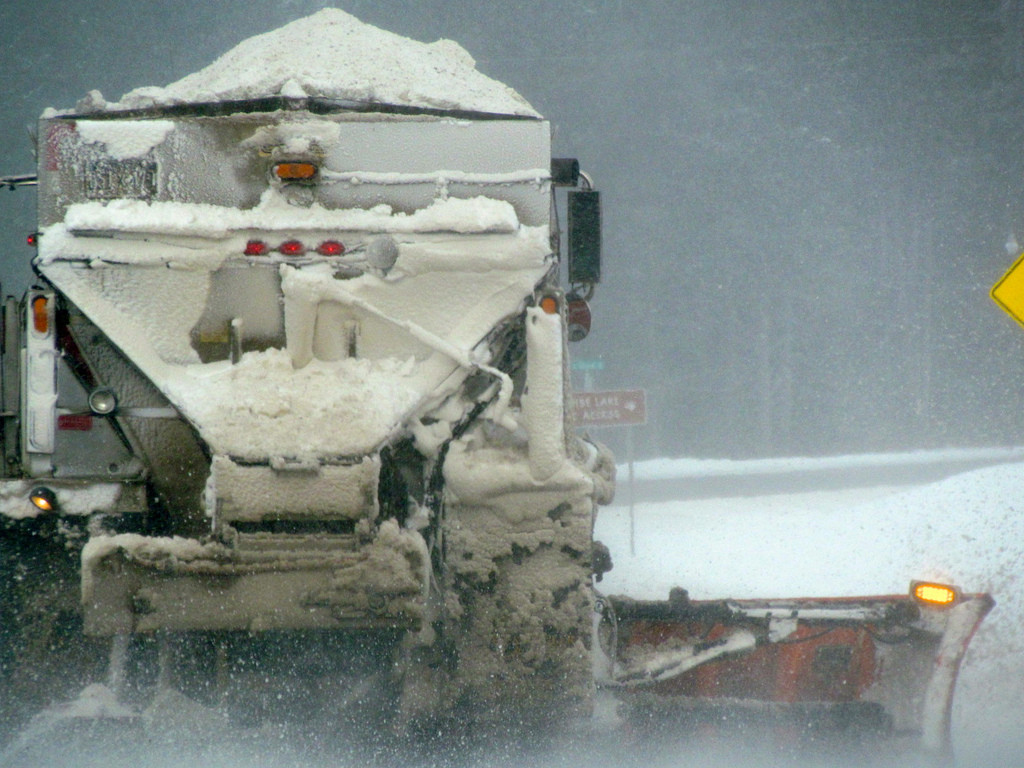
Snow season is here. The chances are good you’ll find yourself behind a truck spreading salt on the roads in an attempt to deice them. You may even try a little salt on your own front porch. Annually we spread about 20 million tons of road salt in the U.S., and we’ve been doing it since the late 1930s.
We know the effects of salt on cars and bridges. Soon after your last car payment, telltale bulges appear around the wheel-well—a harbinger of rust holes. Local communities spend an extraordinary amount of money repainting the steel girders of bridges that receive salt spray and runoff.
More quietly, salt has health impacts on humans and wildlife. When salt is applied to roads, it melts snow and the runoff carries saline waters to local streams. Salty waters can percolate down to the water table, contaminating drinking water.
Roadside trees, especially sugar maple and white pine, show branch dieback and mortality as a result of excessive salt spray. Salt that reaches wetlands has direct impacts on amphibians and other resident wildlife. Salty waters can also prevent the spring mixing of lakes that is essential to the supply of oxygen for deep-water fishes, such as lake trout.
It’s unlikely we will stop using road salt anytime soon. It’s important for highway safety. But, we can use road salt more judiciously. Alternatives such as calcium chloride, calcium acetate, and urea are more expensive than traditional salt, but less harmful to wetlands. At the very least, think twice about using salt on your own walks and driveways.
Sand is a good friend. And, driving slowly in winter has no enemies.
**********
—This segment was adapted from an essay by Dr. William H. Schlesinger. You can read the original piece on his blog Citizen Scientist.
Web Links
Photo, posted January 21, 2013, courtesy of Kate Ter Harr via Flickr.
Earth Wise is a production of WAMC Northeast Public Radio, with script contribution from the Cary Institute of Ecosystem Studies.