• Skip to primary navigation
  • Skip to main content
  • Skip to primary sidebar

Earth Wise

A look at our changing environment.

  • Home
  • About Earth Wise
  • Where to Listen
  • All Articles
  • Show Search
Hide Search
You are here: Home / Archives for enzyme

enzyme

Sun powered carbon capture

June 30, 2025 By EarthWise Leave a Comment

Using solar power to help capture carbon

As the world struggles to implement technologies and find the political will to reduce carbon emissions, there are also ongoing efforts to find ways to capture carbon from emitting sources and from the atmosphere itself.  After capturing carbon dioxide, there is then the need to safely store it or make use of it.

Current methods for capturing and then releasing carbon dioxide are expensive and energy intensive.  In fact, some methods even require the use of fossil fuels.  Recently, researchers at Cornell University have developed a method for capturing carbon dioxide that is powered by sunlight.

The Cornell method mimics the mechanisms that plants use to store carbon which involves using sunlight to make a reactive enol molecule that grabs carbon dioxide.  

Existing chemical-based carbon capture techniques make use of amines, which are organic ammonia-derived compounds that react selectively with carbon dioxide.  But amines are not stable in the presence of oxygen and don’t last, which necessitates the energy-intensive production of more and more amines.

The Cornell method uses the same method that the plant enzyme RuBisCo uses in photosynthesis.  It is based on an inexpensive sorbent material that is capable of a high rate of carbon capture.

The researchers tested the system using flue samples from Cornell’s Combined Heat and Power Building, an on-campus power plant that burns natural gas.  The system was successful in isolating carbon dioxide.

Ultimately, they would like to stage the reaction on what looks like a solar panel, but one that would capture carbon instead of generating electricity.

**********

Web Links

In a first, system uses sunlight to power carbon capture

Photo, posted August 8, 2015, courtesy of Holly Victoria Norval via Flickr.

Earth Wise is a production of WAMC Northeast Public Radio
A New Super-Enzyme For Breaking Down Plastic | Earth Wise

November 13, 2020 By EarthWise Leave a Comment

Breaking down plastic

The problems caused by plastic waste continue to grow.  Plastic pollution is everywhere, from the Arctic to the depths of the ocean.  We consume microplastics in our food and breathe them in the air.  It is very difficult to break down plastic bottles into their chemical constituents in order to make new ones from old ones. Therefore, we continue to produce billions of single-use plastic bottles, creating more and more new plastic from oil each year. 

Scientists at the University of Portsmouth in the UK have developed a new super-enzyme that degrades plastic bottles six times faster than before.  They believe that the new enzyme could be used for plastic recycling within a year or two.

The super-enzyme was derived from bacteria that naturally have the ability to eat plastic.  The researchers engineered it by linking two separate enzymes, both of which were found in a plastic-eating bug discovered in a Japanese waste site in 2016.  They revealed an engineered version of the first enzyme in 2018, which started breaking down plastic in a few days.  They had the idea that connecting two enzymes together would speed up the breakdown of plastic.  Such linkage could not happen naturally in a bacterium. 

Carbios, a French company, announced a different enzyme in April that can degrade plastic bottles within 10 hours but requires heating above 160 degrees Fahrenheit.  The new super-enzyme works at room temperature.

The team is now examining how the enzymes can be tweaked to make them work even faster.  Meanwhile, they plan to work in partnership with companies like Carbios, to bring super-enzymes for breaking down plastics into commercial use.

**********

Web Links

New Super-Enzyme Can Break Down Plastic at Rapid Pace

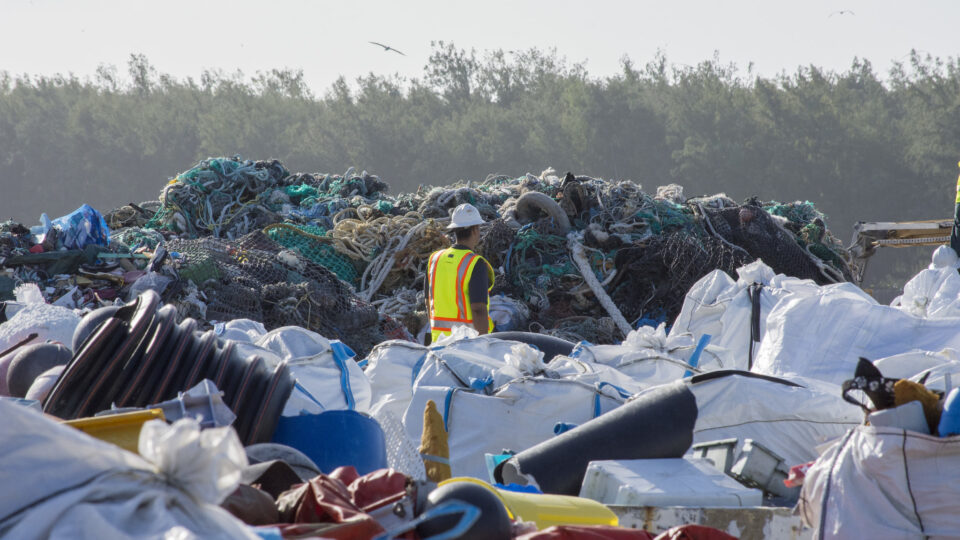
Photo, posted March 24, 2017, courtesy of the USFWS – Pacific Region via Flickr. Photo credit: Holly Richards/USFWS.

Earth Wise is a production of WAMC Northeast Public Radio.

Fighting Malaria With Gene-Drive Technology | Earth Wise

June 8, 2020 By EarthWise Leave a Comment

Using malaria to fight malaria

Malaria continues to be a major health hazard throughout the tropical and subtropical regions of the world. There were 228 million cases of malaria in 2018 and over 400,000 deaths. 

Malaria is a mosquito-borne infectious disease spread by 40 of the world’s 3,500 mosquito species.  So, efforts to control mosquito populations are the primary strategy to eradicate malaria.

A team led by Imperial College London has created a genetic modification that distorts the sex ratio of a population of Anopheles gambiae mosquitoes using “gene drive” technology.  The modification works by using a DNA-cutting enzyme to destroy the X chromosome during the production of sperm, which leads to predominantly male offspring, since females require two X chromosomes.  The modification is coupled to a gene drive to allow it to spread through a population in a very effective way.  A gene drive is a genetic engineering technology that propagates a particular modification by assuring that a specific form of a gene (or allele) will be transmitted with far more than the natural 50% probability.

The result of this is that mosquitoes produce more male offspring, eventually leading to no females being born and a total collapse in the population. The mosquitoes studied are the main malaria vector in sub-Saharan Africa.  The hope is that mosquitoes carrying a sex-distorter gene drive would be released in the future, spreading the male bias with local malaria-carrying populations and causing them to collapse.  Only female mosquitoes bite and take blood meals.  If the gene drive technology works in the field, it could be a game-changer in the fight to eliminate malaria.

**********

Web Links

Malaria mosquitoes eliminated in lab by creating all-male populations

Photo, posted June 20, 2014, courtesy of Flickr.

Earth Wise is a production of WAMC Northeast Public Radio.

Hacking Photosynthesis

February 25, 2019 By EarthWise Leave a Comment

There is an enzyme known as RuBisCo that is involved in carbon fixation, the process plants use to convert carbon dioxide into sugar molecules.  The RuBisCo molecule is inside the leaves of most plants and is probably the most abundant protein in the world.

RuBisCo picks up carbon dioxide from the air and uses energy from the sun to turn the carbon into sugar molecules.  This process of photosynthesis is pretty much the foundation of life on Earth.

Wonderful as it is, the process is not perfect.  RuBisCo is not very selective in grabbing molecules from the air.  It picks up oxygen as well as CO2 and it produces a toxic compound when it does that.

Plants operate a whole other complicated chemical process to deal with this toxic byproduct and uses up a lot of energy along the way, leaving less energy for making leaves or food that we can eat.

A research program at the University of Illinois called Realizing Increased Photosynthetic Efficiency (or RIPE) has been trying to correct this problem; they have been trying to hack photosynthesis.  And they may well have succeeded.

Using genetic modification on tobacco plants, they have shut down the existing detoxification process and set up a much more efficient new one.  The result is super plants that grow faster and up to 40% bigger.

The next step is to get it to work on plants that people actually rely upon for food, like tomatoes, soybeans and black-eyed peas (which are a staple food crop in sub-Saharan Africa where food is scarce.)

It will be years before we know if the process can really produce more food and be safe, but it may end up leading to a major increase in crop productivity.

**********

Web Links

Scientists Have ‘Hacked Photosynthesis’ In Search Of More Productive Crops

Photo, posted June 10, 2013, courtesy of Boon Hong Seto via Flickr.

Earth Wise is a production of WAMC Northeast Public Radio.

An Accidental Plastic Eater

May 29, 2018 By EarthWise Leave a Comment

https://earthwiseradio.org/wp-content/uploads/2018/05/EW-05-29-18-An-Accidental-Plastic-Eater.mp3

A couple of years ago, scientists in Japan discovered bacteria at a recycling plant that were breaking down a type of plastic called polyethylene terephthalate, or PET.  With the world facing a growing plastic pollution problem, British and American researchers began to study the enzyme that the bacteria were using to try to understand how it works.

[Read more…] about An Accidental Plastic Eater

Storing Carbon in the Ocean

October 6, 2017 By EarthWise Leave a Comment

https://earthwiseradio.org/wp-content/uploads/2017/09/EW-10-06-17-Storing-Carbon-in-the-Ocean.mp3

As carbon dioxide levels in the atmosphere continue to rise, it may be that clean energy technologies, electric cars, and other methods of reducing emissions may not be enough.  Carbon sequestration – sucking carbon out of the atmosphere – is seen by many as a crucial part of the solution.

[Read more…] about Storing Carbon in the Ocean

Making Biofuel Cost Effective

June 14, 2017 By EarthWise

https://earthwiseradio.org/wp-content/uploads/2017/06/EW-06-14-17-Making-Biofuel-Cost-Effective.mp3

Biofuels are considered to be a sustainable alternative to fossil fuels.  However, they are generally more expensive than competing fossil fuels.   Government subsidies, such as we have for ethanol in this country, have been necessary to make biofuels competitive in the marketplace.

[Read more…] about Making Biofuel Cost Effective

Primary Sidebar

Recent Episodes

  • An uninsurable future
  • Clean energy and jobs
  • Insect declines in remote regions
  • Fossil fuel producing nations ignoring climate goals
  • Trouble for clownfishes

WAMC Northeast Public Radio

WAMC/Northeast Public Radio is a regional public radio network serving parts of seven northeastern states (more...)

Copyright © 2026 ·