• Skip to primary navigation
  • Skip to main content
  • Skip to primary sidebar

Earth Wise

A look at our changing environment.

  • Home
  • About Earth Wise
  • Where to Listen
  • All Articles
  • Show Search
Hide Search
You are here: Home / Archives for tennessee

tennessee

The cicadas are coming

June 18, 2025 By EarthWise Leave a Comment

After hiding underground for the last 17 years, billions of cicadas are taking to the skies this summer.  This batch of insects, known as Brood XIV, will cover more of the U.S. than any other 17-year brood.  New York and at least 13 other states – Georgia, Kentucky, Maryland, Massachusetts, New Jersey, North Carolina, Ohio, Pennsylvania, South Carolina, Tennessee, Virginia, West Virginia, and parts of Indiana are being serenaded by the sound of cicadas in May and June.

There are 15 broods of periodical cicadas that emerge every 13 or 17 years.  They come out when soil temperatures reach 64 degrees.  Around the world there are annual cicadas while periodical cicadas can only be found in the eastern United States.

Once the insects emerge, they will issue their noisy, chirping mating calls for just a few weeks before they lay eggs and die.  The offspring from the eggs will burrow underground and remain dormant or in the nymph stage feeding on tree roots for another 17 years.  Surfacing in vast numbers is a way to overwhelm predators and ensure that at least some cicadas survive to reproduce. 

The emergence of these insects provides a bounty of food to squirrels, lizards, birds, and other creatures.  A study found that once cicadas emerge, the population of cuckoos, blue jays, and red-bellied woodpeckers grows.

As the climate changes, the timing of cicada cycles may also change.  Warmer weather will lead to cicadas emerging earlier in the year.  Eventually, even the time they spend underground may shorten.

**********

Web Links

After 17 Years Underground, Massive Cicada Brood to Swarm U.S.

Photo, posted July 16, 2017, courtesy of Renee Grayson via Flickr.

Earth Wise is a production of WAMC Northeast Public Radio

Balloon release laws

May 27, 2024 By EarthWise Leave a Comment

Banning the release of balloons

The Florida state legislature has recently passed a law that bans the intentional release of helium balloons outdoors.  It is a rare example of a bipartisan piece of legislation.  Florida is joining six other states that have already enacted balloon restricting laws.

Balloons released into the sky don’t just disappear into the ether.  They often end up in oceans and waterways and the thin material that remains is 32 times more likely to kill seabirds than other types of plastic debris.  Aquatic animals often mistake balloons for jellyfish and fill up on them.   Balloons tied up with ribbons entangle turtles and manatees.  Even grazing cows have died from ingesting balloons.  Balloons contribute to microplastic pollution, which is a growing problem for all living things, including humans.

Other states with balloon release laws are Connecticut, Tennessee, New York, Texas, California, and Virginia.  Details of the laws vary.  They carve out exceptions for specific applications.  They exempt small children.  Some limit the quantity of balloon release.  Others require balloons to be weighted down to prevent them from rising too high.  California’s legislation is aimed at the metallized mylar balloons that have shorted out high-tension electrical wires and triggered wildfires.

The Florida law equates intentionally releasing a lighter-than-air balloon with littering.  It’s a non-criminal offense that carries a fine of $150.

People enjoy releasing helium balloons, particularly en masse.  The spectacle has become part of weddings, gender reveal parties, and even funerals.  But the practice has serious environmental repercussions, and its restriction is being pursued by more and more states and municipalities.

**********

Web Links

Up, Up and Not OK: Letting Go of Balloons Could Soon Be Illegal in Florida

Photo, posted August 16, 2022, courtesy of Ryan Mandelbaum via Flickr.

Earth Wise is a production of WAMC Northeast Public Radio

Mississippi River Running Dry | Earth Wise

October 27, 2023 By EarthWise Leave a Comment

The Mississippi River is losing water

Water levels in the lower Mississippi River are running very low.  During September, the readings in Memphis, Tennessee were within inches of the all-time low.  The situation is causing real problems for the grain export industry.

The water levels of the lower Mississippi are determined by the amount of rainfall in the upper Midwest.  At the point where the Ohio and Mississippi Rivers come together, about 90% of the water headed for the lower Mississippi has been accumulated.

Almost 400 miles of the Mississippi have experienced water levels at or below critical levels for shipping.  During September, parts of the Mississippi have been closed to ship traffic more than 20 times.  At least 36 vessels were reported to have run aground.

The low water levels on the river have caused shippers of soybean and corn exports to lighten their loads to keep the vessels from running aground.  They have also reduced how many barges they pull at once in order to be able to navigate shipping channels that have narrowed because of the reduced water levels.

Fall is the busiest grain export season for the region.  About 60% of grain exports from the Midwest leave the U.S. through terminals on the Gulf Coast.  The low levels of the Mississippi River threaten gridlock for this vital industry.  It has caused freight costs to be the highest since historic river lows last year caused U.S. grain to be less competitive globally.

Unfortunately, October is not normally a strong precipitation month, but the hope is that the El Niño now underway may lead to increased precipitation in the Southern U.S.

**********

Web Links

Mississippi River Nears Historic Lows, Putting Grain Exports at Risk

Photo, posted March 8, 2023, courtesy of Errol Sandler via Flickr.

Earth Wise is a production of WAMC Northeast Public Radio

A Boom In Auto Battery Manufacturing | Earth Wise

June 24, 2022 By EarthWise Leave a Comment

A surge in automobile battery manufacturing

Nearly all automobile manufacturers are in a global race to build electric cars and trucks.  There is a rapidly growing need for the battery packs that power those vehicles and therefore manufacturers are in a race to build battery factories to address that need.

The latest battery plant announcement comes from Stellantis – the new company created in 2021 through the merger of Fiat Chrysler and Peugeot.  Stellantis aims to sell five million electric cars by 2030, which means they will need a lot of batteries.  They will be spending $2.5 billion in partnership with Samsung to build a battery factory in Kokomo, Indiana.  The facility is expected to create 1,400 jobs.  Stellantis already had announced that it would build a battery factory in Windsor, Ontario in partnership with LG Energy Solutions. 

They are not alone in their aggressive efforts on electric vehicle battery development.  Ford Motor is building two battery plants in Kentucky and a third one in Tennessee.   Ford has recently started production of its F-150 electric pickup truck which has attracted large numbers of pre-orders.  The gas-powered Ford F-150 has been the best-selling vehicle in America for years.

General Motors is opening a new battery production plant in Ohio this summer and has two others under construction in Tennessee and Michigan.   Hyundai plans to spend $5.5 billion on an electric vehicle and battery manufacturing facility near Savannah, Georgia that is expected to begin operations in 2025.

The auto industry has been struggling in recent times, but there is clearly a massive boom underway as the industry makes the transition from internal combustion engines to battery electric power.

**********

Web Links

Stellantis and Samsung to spend $2.5 billion on an electric vehicle battery plant in Indiana

Photo, posted July 29, 2017, courtesy of Steve Jurvetson via Flickr.

Earth Wise is a production of WAMC Northeast Public Radio.

A Solar-Powered Airport

August 12, 2019 By EarthWise 1 Comment

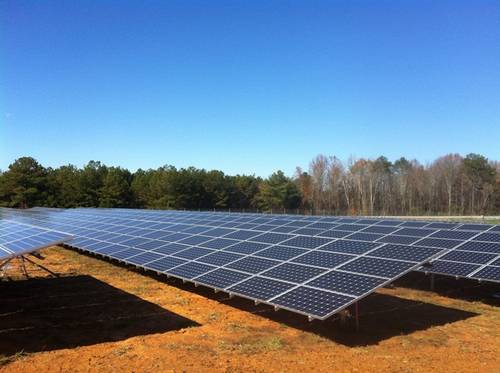
The Chattanooga Metropolitan Airport in Tennessee has become the first airport in the United States to run entirely on solar power.  The small airport operates over 60,000 flights a year and has recently completed work on a 12-acre, 2.64-megawatt solar farm that generates enough clean electricity to account for the airport’s total energy needs.

The project was funded largely by the Federal Aviation Administration, cost $10 million, and took nine years to complete.   The facility uses onsite batteries to help power operations at night.  The installation is expected to last 30 to 40 years.

The solar farm is in the southwest corner of the airfield on land that is unusable for aviation purposes.  It is visible from the two runways at the airport.

Officials from nearly 50 airports around the world have visited or contacted the Chattanooga airfield in recent years to learn about its solar operations.  Several major airports, including San Diego and London’s Gatwick, have also installed solar panels that provide a portion of their power needs.  The world’s busiest airport – Atlanta’s Hartsfield-Jackson – is looking into constructing renewable energy microgrids to power part of its operations.  Airports generally have plenty of vacant land that can be used for solar panels that can lower their power bills.

The largest airport solar installation is actually Cochin International in Kerala, India, which became 100% solar powered in 2015.  It is the 7th largest airport in India.   Its solar array has nearly 30 megawatts of capacity.  Airport managers there were fed up with huge electric bills and invested about $9 million to install the solar array.  It is expected to have paid for itself in the next couple of years.

**********

Web Links

Chattanooga Becomes First U.S. Airport to Run Entirely On Solar

Photo courtesy of Chattanooga Metropolitan Airport.

Earth Wise is a production of WAMC Northeast Public Radio.

Shifting Climate Zones

November 16, 2018 By EarthWise Leave a Comment

https://earthwiseradio.org/wp-content/uploads/2018/11/EW-11-16-18-Shifting-Climate-Zones.mp3

As the climate warms, the planet’s landscape is changing.  The Arctic ice is shrinking, the ocean is rising altering coastlines, and plants, animals and diseases are on the move.  The world’s climate zones are changing in significant and measurable ways.

[Read more…] about Shifting Climate Zones

Accidental Ethanol From Carbon Dioxide

December 27, 2016 By EarthWise

https://earthwiseradio.org/wp-content/uploads/2016/12/EW-12-27-16-Accidental-Ethanol.mp3

Scientists at the Oak Ridge National Laboratory in Tennessee were trying to find a series of chemical reactions that could turn carbon dioxide into a useful fuel.  But the unexpected occurred:  they found that the first step in their process actually got the job done all by itself.   The reaction turns CO2 into ethanol, which is already used to power generators and vehicles.

[Read more…] about Accidental Ethanol From Carbon Dioxide

Primary Sidebar

Recent Episodes

  • An uninsurable future
  • Clean energy and jobs
  • Insect declines in remote regions
  • Fossil fuel producing nations ignoring climate goals
  • Trouble for clownfishes

WAMC Northeast Public Radio

WAMC/Northeast Public Radio is a regional public radio network serving parts of seven northeastern states (more...)

Copyright © 2026 ·