• Skip to primary navigation
  • Skip to main content
  • Skip to primary sidebar

Earth Wise

A look at our changing environment.

  • Home
  • About Earth Wise
  • Where to Listen
  • All Articles
  • Show Search
Hide Search
You are here: Home / Archives for spinach

spinach

A hidden cost of climate change

August 25, 2025 By EarthWise Leave a Comment

Climate change is dramatically impacting food production by altering rainfall patterns, increasing temperatures, and triggering more frequent extreme weather events.  These changes make crops more vulnerable to droughts, floods, heatwaves, pests, and diseases, leading to lower yields and greater uncertainty for farmers worldwide.

But climate change isn’t just reshaping our planet.  It’s also changing what’s on our plates.  According to a new study by researchers from Liverpool John Moores University in the UK, rising carbon dioxide levels and warmer temperatures may be making food less nutritious.

The research team focused on popular leafy vegetables, including kale, rocket, and spinach.  The researchers simulated future UK climate conditions in growth chambers to study how the crops responded to hotter, CO2-rich environments.

The research team found that elevated CO2 levels help crops grow faster and bigger, but not healthier.  Over time, the crops showed a reduction in key minerals like calcium and certain antioxidant compounds.  These changes were exacerbated by increases in temperature.  In fact, the combination had complex effects.  The crops did not grow as big or fast, and the decline in nutritional quality intensified.

This nutritional imbalance poses serious human health implications.  Rising CO2 levels can increase sugar in crops while reducing essential nutrients, leading to calorie-rich but nutrient-poor diets. This shift may raise the risk of obesity, diabetes, and nutrient deficiencies, especially in vulnerable populations.

The challenge ahead isn’t just to grow enough food to feed a growing population, but to preserve the quality of that food in a changing climate.

*********

Web Links

Bigger crops, fewer nutrients: The hidden cost of climate change

Photo, posted May 25, 2010, courtesy of Jason Bachman via Flickr.

Earth Wise is a production of WAMC Northeast Public Radio
Natural Habitats And Strawberry Farms | Earth Wise

April 22, 2020 By EarthWise Leave a Comment

natural habitat benefits farms

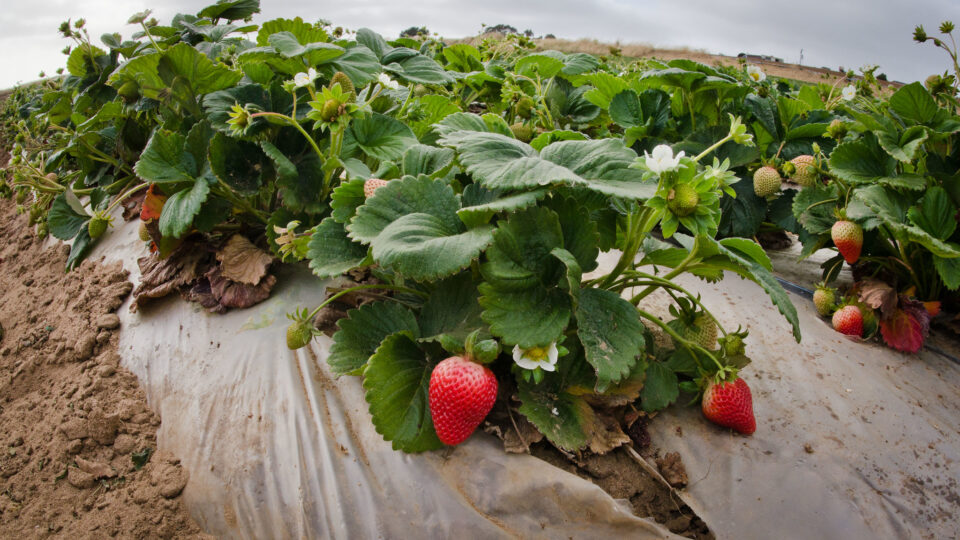
According to a new study led by researchers from the University of California – Davis, conserving natural habitat around strawberry fields can protect farmers’ yields, their bottom line, and the environment.  The study also suggests that conserving natural habitat in this way has no detectable threat to food safety. 

In this study, which was recently published in the journal Ecological Applications, the research team conducted surveys and experiments at 20 strawberry farms along California’s Central Coast.  This region is responsible for 43% of the nation’s strawberry production. 

The researchers found that strawberry farmers were better off with natural habitat, like forests, grasslands, wetlands, and shrubs, around their farms than without it.  According to the study’s models, adding natural habitat can reduce crop damage costs by 23%.  Removing natural habitat can increase costs by as much as 76%. 

Importantly, the strawberry farms with natural habitat surrounding them showed no signs of increased fecal contamination.  While bird feces were regularly encountered on the ground, only 2 of 10,000 strawberries examined show signs of direct fecal contamination.  Those contaminated berries would be discarded during the hand-harvesting process.   

These findings run contradictory to current best practice recommendations that support natural habitat removal around strawberry farms in order to decrease bird fecal contamination and crop damage.  These food safety requirements were a consequence of the deadly outbreak of E. coli in 2006, which was traced back to spinach grown in this region.   

It seems like our agricultural landscapes can both support and benefit from biodiversity. 

**********

Web Links

Natural habitat around farms a win for strawberry growers, birds and consumers

Photo, posted June 16, 2011, courtesy of the USDA via Flickr.

Earth Wise is a production of WAMC Northeast Public Radio.

The Dirty Dozen Of 2018

May 18, 2018 By EarthWise Leave a Comment

https://earthwiseradio.org/wp-content/uploads/2018/05/EW-05-18-18-The-Dirty-Dozen.mp3

Every year, the Environmental Working Group ranks pesticide contamination in 47 popular fruits and vegetables for its Shopper’s Guide to Pesticides in Produce.  The environmental nonprofit has created this ranking annually since 2004. 

[Read more…] about The Dirty Dozen Of 2018

Organic Food Is Increasingly Affordable

July 8, 2016 By WAMC WEB

https://earthwiseradio.org/wp-content/uploads/2016/06/EW-07-08-16-Organic-Food-Increasingly-Affordable.mp3

Organic food is increasingly popular.  Food chains like Sprouts and Whole Foods as well as local food coops and health food stores have led the charge.  More recently, major supermarket chains have growing organic departments in their stores.  In fact, in 2015, sales of organic foods in the U.S. reached $43 billion, an increase of 11% over just the the previous year. 

[Read more…] about Organic Food Is Increasingly Affordable

Primary Sidebar

Recent Episodes

  • An uninsurable future
  • Clean energy and jobs
  • Insect declines in remote regions
  • Fossil fuel producing nations ignoring climate goals
  • Trouble for clownfishes

WAMC Northeast Public Radio

WAMC/Northeast Public Radio is a regional public radio network serving parts of seven northeastern states (more...)

Copyright © 2026 ·