• Skip to primary navigation
  • Skip to main content
  • Skip to primary sidebar

Earth Wise

A look at our changing environment.

  • Home
  • About Earth Wise
  • Where to Listen
  • All Articles
  • Show Search
Hide Search
You are here: Home / Archives for inland

inland

Wasting less wastewater

July 17, 2025 By EarthWise Leave a Comment

Developing technologies to waste less wastewater

Ultra-pure water is essential for multiple industries, for example semiconductors, batteries, and pharmaceuticals, as well as food and beverage companies.  Such water is produced by various processes including desalination plants that use reverse osmosis.  The byproduct of the processing is industrial brine:  salty wastewater.

The brine produced by desalination is generally dumped into the ocean if the desalination plant is located at the seashore, but if the plant is inland, such as in places like Arizona, that isn’t an option.

Nestle runs a water desalinating plant near Phoenix that generates more than 50,000 gallons of brine every day.  Concentrated brines must be carefully managed and disposed of. 

Researchers at Arizona State University are developing a mobile, closed-loop water recovery demonstration system that aims to recover 50%-90% of previously unusable water from industrial brine and reduce the remainder to solid salt. 

The team’s approach involves pretreating Nestle’s brine to remove larger particles.  It then goes through a reverse osmosis process that results in a stream of high-quality water and a salty concentrate.  The salty concentrate goes through a special membrane that recovers even more pure water.  The highly concentrated brine is then dried and crystalized into a solid salt product.  Atmospheric water harvesters capture any remaining water vapor during the drying process.

In places like Arizona where freshwater is a scarce commodity, finding sustainable ways to separate water from salt is both a scientific challenge and an economic necessity.

**********

Web Links

Squeezing every last drop out of wastewater

Photo courtesy of the Global Center for Water Technology.

Earth Wise is a production of WAMC Northeast Public Radio
Antarctic Ice Collapse | Earth Wise

March 2, 2022 By EarthWise Leave a Comment

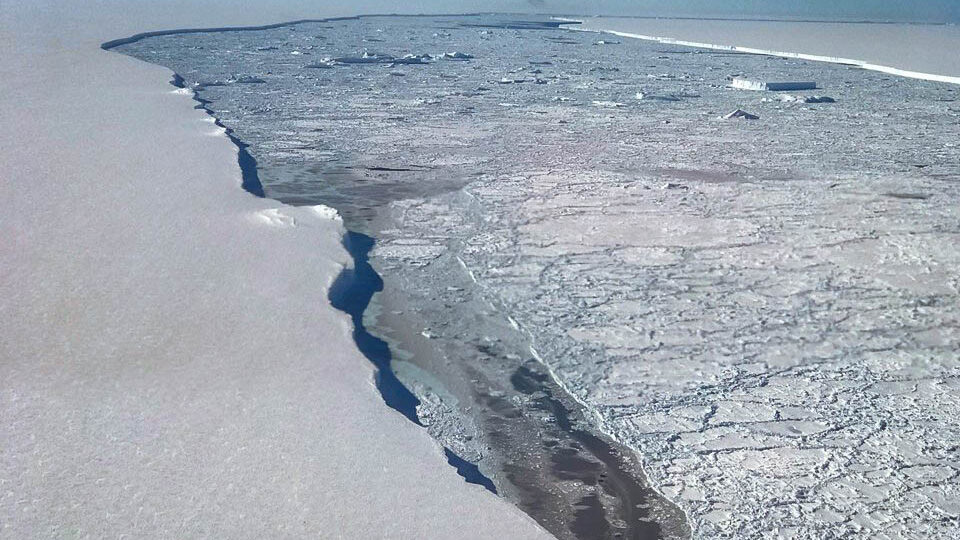
Warming temperatures are causing Antarctic ice collapse

In Antarctica, a huge chunk of the Larsen B Ice Shelf collapsed suddenly and spectacularly in January.

The Larsen Ice Shelf is located on the northeastern side of the Antarctic Peninsula on the Weddell Sea.  It was formed over the course of more than 12,000 years.  The Weddell Sea used to be a completely frozen body of water.  The famous Ernest Shackleton expedition in 1915 was trapped in its ice.  But the Antarctic Peninsula has been steadily warming in recent decades.

The Larsen A Ice shelf collapsed in 1995 and the 1,250-square-mile Larsen B Ice Shelf collapsed in 2002.  After that event, a portion of the detached ice shelf refroze in 2011 and was attached to the Scar Inlet Ice Shelf.  The refrozen ice was called the Larsen B embayment.

In January, the embayment broke apart, taking with it a portion of the Scar Inlet Ice Shelf.  It disintegrated within a matter of days.  The combined Larsen Ice Shelves – called A, B, C, and D – once extended along a 1000-mile stretch of the eastern Antarctic Peninsula.  Since 1995, it has shrunk from 33,000 square miles to 26,000 square miles.

These ice shelves float on the ocean, so their loss does not actually increase global sea levels.   However, the shelves act as dams that hold back glaciers located on the land behind them.  The loss of Antarctic ice shelves dramatically increases the rate at which glaciers flow into the sea, and that does increase global sea levels. 

Now that the sea ice from the Larsen B embayment is gone, it is likely that there will be additional inland ice losses from the newly exposed glaciers.

**********

Web Links

Remnant of Antarctica’s Larsen B Ice Shelf Disintegrates

Photo, posted February 13, 2018, courtesy of NASA/Nathan Kurtz via Flickr.

Earth Wise is a production of WAMC Northeast Public Radio.

Polar Bears And Melting Sea Ice | Earth Wise

January 14, 2022 By EarthWise Leave a Comment

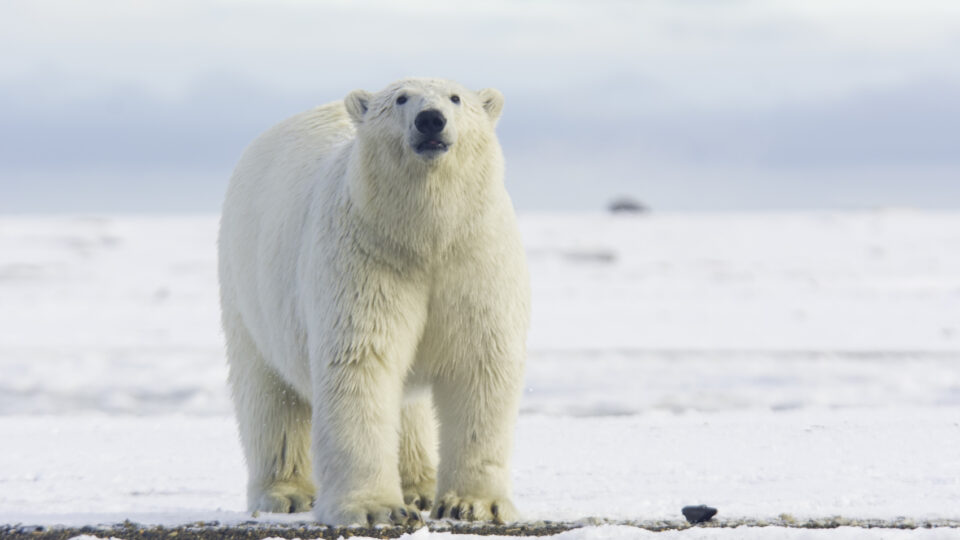
Climate change continues to threaten polar bear survival

Climate change poses a major threat to polar bear survival.  The polar bear, whose native range lies largely within the Arctic Circle, depends on sea ice for nearly all of its lifecycle functions.  And rising temperatures are causing this sea ice to disappear.

Climate change-driven sea ice loss is the primary threat to the future of this iconic species.  In fact, polar bears were the first animal listed as endangered because of the forecasted impacts of climate change.   

Melting sea ice as a result of climate change continues to plague polar bear survival.  According to a new study by researchers from Washington State University, polar bears in the Beaufort Sea have had to travel far outside their traditional arctic hunting grounds in recent years for food.  This has contributed to an almost 30% decrease in their population. 

Researchers used satellite tracking data to analyze the movement patterns of female polar bears from 1986-2016 in the Beaufort Sea area north of Alaska.  Over the last two decades, they found that polar bears are having to travel farther north of their traditional hunting grounds on the continental shelf to remain on their receding sea ice habitat.

The research team also found that around 20% of the polar bear population in the Beaufort Sea is foregoing its traditional sea ice hunting grounds altogether in the summer and fall.  Instead, these bears are moving inland in search of food.  

Scientists estimate that 800 or so polar bears remain in the southern Beaufort Sea.  Curbing global greenhouse gas emissions in order to protect polar bear habitat may be the only way to help these animals survive. 

**********

Web Links

Melting sea ice forces polar bears to travel farther for food

Photo, posted September 27, 2015, courtesy of Anita Ritenour via Flickr.

Earth Wise is a production of WAMC Northeast Public Radio.

California’s Silent Health Hazard | Earth Wise

April 23, 2021 By EarthWise Leave a Comment

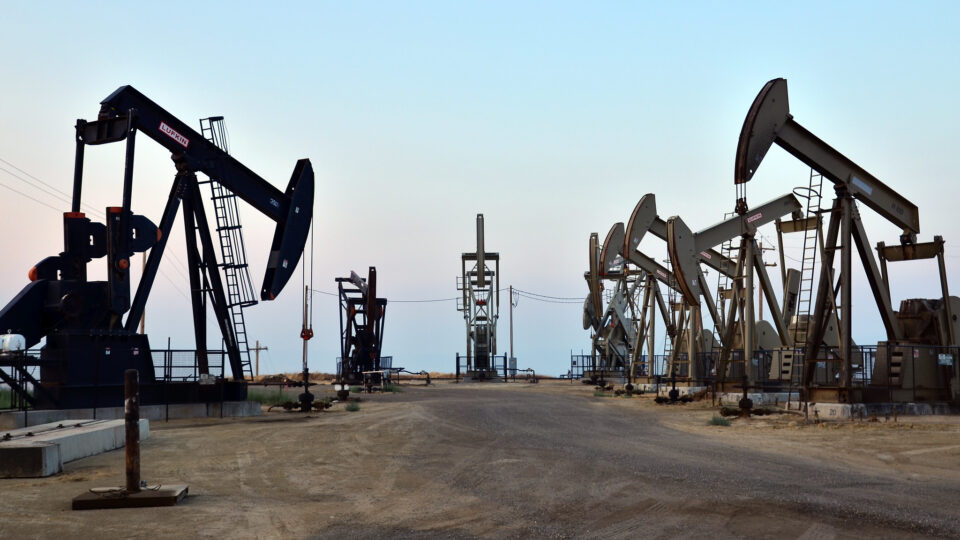
California oil wells a silent public health hazard

For people in the Los Angeles area, it is a familiar sight to see oil wells pumping away on hillsides, in residential neighborhoods, and other places.  In fancier parts of town, oil wells are hidden behind facades located next door to dry cleaners and lamp stores.

Every year, more than 140 million barrels of oil are extracted from the state of California, coming from a vast subterranean formation that spans nearly the entire state along the coast and spreading inland as well.  About 30% of the state’s oil comes from the Los Angeles area.

The oilfields are mostly old, and their wells played out.  As a result, high-tech drilling and a slew of toxic chemicals are needed to extract the last dregs of crude oil.

Unlike more rural oil-producing states, where oilfields might be uninhabited except for the people who work on them, drilling in California happens to a large degree in residential settings.  Over the years, it has become increasingly clear that certain chemical byproducts of oil extraction, among them benzene and hydrogen sulfate, can cause a variety of health problems.  For example, recent research has found connections between exposure to oil and gas well sites and spontaneous pre-term births, low-birthweight babies, and other adverse birth outcomes.

Statewide, little is being done to protect residents and schoolchildren from any of the suspected consequences of living near an oil or gas well.  Regulations are weak and spottily enforced because the oil industry still wields a lot of political power in the state.  Environmental groups and justice advocates are actively seeking to create new protections for California citizens, but it remains an uphill battle.

**********

Web Links

The Oil Well Next Door: California’s Silent Health Hazard

Photo, posted July 11, 2017, courtesy of John Ciccarelli / Bureau of Land Management California via Flickr.

Earth Wise is a production of WAMC Northeast Public Radio.

Primary Sidebar

Recent Episodes

  • An uninsurable future
  • Clean energy and jobs
  • Insect declines in remote regions
  • Fossil fuel producing nations ignoring climate goals
  • Trouble for clownfishes

WAMC Northeast Public Radio

WAMC/Northeast Public Radio is a regional public radio network serving parts of seven northeastern states (more...)

Copyright © 2026 ·