• Skip to primary navigation
  • Skip to main content
  • Skip to primary sidebar

Earth Wise

A look at our changing environment.

  • Home
  • About Earth Wise
  • Where to Listen
  • All Articles
  • Show Search
Hide Search
You are here: Home / Archives for geoengineering

geoengineering

The U.N. meets about geoengineering

October 9, 2025 By EarthWise Leave a Comment

Geoengineering refers to a wide range of mechanical or chemical methods aimed at deliberately changing the global climate system.  It includes a number of unproven concepts, one of which is intentionally polluting the upper atmosphere with thousands of tons of artificial particles such as chemical sprays or mineral dust.  This is referred to as solar radiation management or SRM.  The idea is to dim sunlight, thereby slowing the rise of global temperatures by deflecting solar energy away from the Earth’s surface before it can be trapped as heat by greenhouse gases in the atmosphere.

The United Nations Environmental Program held workshops in May and September to address the issue of such strategies.  This official position of the UN is that strategies such as SRM are not a climate solution given that they do not actually address the underlying causes of climate change.  Recent research has shown that SRM efforts could potentially shift rainfall patterns, intensify heat waves or cold snaps, lead to overall drying, and have other unpredictable consequences.

Many participants expressed concern that the discussion focused too much on engineering aspects and not on the potential risks of such efforts.  The prevailing opinion among scientists is that SRM deployment is too dangerous and ungovernable and therefore should not be pursued.

Current geopolitical trends make the possibility of geoengineering efforts by authoritarian states disturbingly likely.  While there are international guidelines on geoengineering activities, the potential threat of unilateral efforts by rogue nations is growing.

**********

Web Links

UN Sessions on Solar Geoengineering Trigger Unease

Photo, posted May 12, 2016, courtesy of Susanne Nilsson via Flickr.

Earth Wise is a production of WAMC Northeast Public Radio

Modeling geoengineering

May 19, 2025 By EarthWise Leave a Comment

Modeling the impacts of geoengineering

As the impacts of climate change continue to mount up, there is increasing interest in radical intervention measures designed to keep a lid on rising global temperatures.  Such measures are fraught with potential dangers and unintended consequences but there is no guarantee that one or another of them might still be attempted in the future.  Increasing international interest in geoengineering as a potential strategy for mitigating climate change has created a pressing need to consider its impact before any potentially irreversible actions are taken.

The Natural Environment Research Council in the UK is funding four research projects aimed at understanding the potential consequences of solar radiation modification (SRM) being deployed in the real world.

SRM consists of methods to reflect some of the Sun’s radiation back into space instead of allowing it to reach and warm the earth. 

One approach is stratospheric aerosol intervention in which particles such as sulfates are introduced into the upper atmosphere to reflect sunlight thereby producing a dimming effect.   The idea is to mimic the effects of large volcanic eruptions, which naturally send sulfates into the atmosphere.

A second approach is marine cloud brightening, which increases the reflectivity of clouds over the ocean by spraying very small droplets of sea water into the air.  The fine particles of sea salt enhance cloud condensation nuclei, producing more cloud droplets and making clouds more reflective.

The research aims to deliver independent risk analyses to inform policymakers about the potential environmental impacts of SRM.

**********

Web Links

Scientists to model the impact of controlling Earth’s temperature by reflecting solar radiation

Photo, posted May 6, 2009, courtesy of Denys Zadorozhnyi via Flickr.

Earth Wise is a production of WAMC Northeast Public Radio

Renegade geoengineering

October 30, 2024 By EarthWise Leave a Comment

Geoengineering inc

As the dangers of climate change continue to grow, so has interest in geoengineering – deliberate tinkering with the earth’s climate system.  In particular, stratospheric solar geoengineering – releasing aerosols into the stratosphere to reduce the amount of heat from the sun reaching the Earth – is attracting increasing interest.  Scientists at Harvard, Cornell, Colorado State, Princeton, and the University of Chicago are all researching the topic.

Actually doing it on a scale that matters is fraught with peril from unintended consequences of disrupting the delicate interactions between the Earth’s atmosphere, ocean, land, and sea ice. 

Meanwhile, a tiny start-up company in Silicon Valley has raised more than a million dollars in venture capital and is busy releasing balloons full of sulfur dioxide into the atmosphere in the name of combatting global warming.  Furthermore, they are selling so-called “cooling credits” to customers who want to offset their personal carbon emissions.

The aerosol being released is on such a small scale that it can’t possibly have a meaningful effect on temperatures.  There really isn’t scientific analysis guiding or accompanying the work. 

There are no laws prohibiting the dispersal of small amounts of sulfur dioxide in California.  Even if there were, these people could go offshore or elsewhere to do their work.  But this renegade geoengineering highlights a serious issue; namely, that there doesn’t have to be scientific, political, or any other kind of consensus for someone to undertake a potentially catastrophic attempt to alter the climate.  It’s a real worry.

**********

Web Links

Silicon Valley Renegades Pollute the Sky to Save the Planet

Photo, posted September 24, 2006, courtesy of Doc Searls via Flickr.

Earth Wise is a production of WAMC Northeast Public Radio

Ocean geoengineering

October 24, 2024 By EarthWise Leave a Comment

A start-up company is exploring ocean geoengineering

As greenhouse gas emissions continue to be dangerously large and the perils of climate change are increasingly apparent, the world is increasingly exploring ways to deliberately intervene in climate systems.  A number of these ideas involve introducing substances into the atmosphere, but there are also ways to tinker with the oceans.

The oceans naturally absorb about a third of the carbon dioxide that humans pump into the atmosphere, mostly by burning coal, gas, and oil.  People are exploring ways to get the ocean to take up even more of the carbon dioxide.  One approach that is gaining traction is known as alkalinity enhancement.  By adding limestone, magnesium oxide, or other alkaline substances to rivers and oceans, it changes their chemistry and makes them soak up more carbon dioxide.

This approach has been around for a while as a way to mitigate acid rain in rivers and has been very successful.  A start-up company in Canada called CarbonRun is building a machine that grinds up limestone and will release the powder it produces into a local river in Nova Scotia.  The limestone in the river will be naturally converted into a stable molecule that will eventually be washed into the seas, where it should remain for thousands of years.

Expanding this approach to oceans faces many challenges including the costs and complexities of obtaining, processing, and transporting vast amounts of limestone to where it is to be released.  There are also potential environmental issues to grapple with.  But CarbonRun and others are moving forward with testing the approach.

In any event, the biggest barrier to ocean alkalinity enhancement is proving that it works.  That effort is underway.

**********

Web Links

They’ve Got a Plan to Fight Global Warming. It Could Alter the Oceans.

Photo, posted May 27, 2007, courtesy of John Loo via Flickr.

Earth Wise is a production of WAMC Northeast Public Radio

Research on solar geoengineering

July 12, 2024 By EarthWise Leave a Comment

Ideas for potential technologies that could artificially cool the planet as a countermeasure against global warming have been considered radical and dangerous for a long time.  But as climate change continues to become increasingly apparent, ideas like solar geoengineering are gaining increasing attention.

Most environmental organizations are at best skeptical about such ideas and oppose them.  Their opposition is in part based on the assertion that there are no quick fixes for climate change and that not addressing its root causes is a dangerous path to take.  But an even greater concern is that intentionally manipulating global temperatures is likely to have a host of unintended consequences that could prove disastrous.

One of the world’s largest environmental organizations, the Environmental Defense Fund, has decided to fund research into solar geoengineering.  The EDF cautions that is in not in favor of deploying such technology.  Its position is that the discussion about ways to cool the planet is not going away and cannot be ignored.  The lack of proper research can promote unfounded optimism about such technology  So, they are going to fund research that can provide information based on solid, well-formulated science.

A major focus will be what other effects technologies like cloud brightening and injecting aerosols into the atmosphere might have apart from providing cooling. 

The EDF’s own position is that deliberate climate interventions present serious ecological, moral, and geopolitical concerns.  However, they believe that policymakers need to be informed by the most accurate information possible.

**********

Web Links

Environmental Group to Study Effects of Artificially Cooling Earth

Photo, posted February 3, 2008, courtesy of Camilla Cannarsa via Flickr.

Earth Wise is a production of WAMC Northeast Public Radio

Cloud brightening

June 17, 2024 By EarthWise Leave a Comment

Solar geoengineering is a type of climate intervention:  deliberate actions designed to affect the climate.  There are several ways to try to reduce the amount of sunlight reaching the surface of the earth and all of them are controversial.  Perhaps the least controversial approach is cloud brightening.

The idea is based on something called the Twomey effect, which is that large numbers of small droplets in the atmosphere reflect more sunlight than small numbers of large droplets.  Spraying vast quantities of minuscule aerosols into the sky, thereby forming many small droplets, could change the reflective properties of clouds.  If clouds are more reflective, then less sunlight reaches the surface, and the temperature goes down.

This form of geoengineering is thought to be less risky because it can be performed on a localized basis and can use relatively benign materials such as sea salt. 

In early April, scientists from the University of Washington started testing a device that sprays tiny sea-salt particles into the air from the deck of a decommissioned aircraft carrier in Alameda, California.  The test was simply to see whether the machine propelled a mist of suitable size.

Within two weeks, Alameda officials ordered a stop to the experiment, citing potential health and environmental risks.  After a month-long investigation, Alameda ruled that the experiment does not generate a measurable risk to health, wildlife, or the environment.

But before more ambitious experiments take place, there are potential side effects of cloud brightening that need to be studied.  It may turn out to be a useful tool in fighting global warming, but in any case, such technology should not be viewed as a substitute for moving away from fossil fuels.

**********

Web Links

A Test of Cloud-Brightening Machines Poses No Health Risk, Officials Say

Photo, posted September 8, 2011, courtesy of Justin Ladia via Flickr.

Earth Wise is a production of WAMC Northeast Public Radio

Marine carbon dioxide removal

May 23, 2024 By EarthWise Leave a Comment

Marine CO2 removal

About 30% of the carbon dioxide emitted by human activity is absorbed by the oceans.  As a result, they are getting warmer and more acidic, and the currents that help shape global weather are shifting.  To try to reduce global warming, people want to be able to store even more carbon dioxide in the oceans without the negative effects of doing so.

There are multiple efforts across the globe to achieve effective marine carbon dioxide removal.  Some are based on sinking carbon-rich materials to the bottom of the sea.  This is the marine equivalent of capturing CO2 from the air and storing it underground.  Other efforts involve increasing the alkalinity of the ocean, which increases its ability to chemically react with carbon dioxide as well as lowers its acidity, which is desirable in many ways.

Running Tide, a U.S.-based company, has been dumping thousands of tons of wood-industry waste 190 miles off the coast of Iceland.  The company has also been experimenting with dumping algae and kelp and sinking it deep below the ocean.  Such materials on land either get burned or decay, in both cases releasing CO2 into the atmosphere.  On the deep-sea bottom, the carbon is trapped.

Other efforts involve pumping seawater through electrodialysis filter systems to remove excess acidity or adding alkaline rocks to increase water alkalinity.

All of these efforts are a form of geoengineering, and like proposed ideas to cool the atmosphere, pose potential risks.  There is no silver bullet to solve the climate crisis.  It will take a combination of many solutions to address the issue of excess carbon dioxide in the atmosphere.  Marine carbon dioxide removal is one of the solutions that may play a role.

**********

Web Links

Scientists Are Trying to Coax the Ocean to Absorb More CO2

Photo, posted February 22, 2018, courtesy of Bobbie Halchishak/USFWS via Flickr.

Earth Wise is a production of WAMC Northeast Public Radio

Geoengineering could create winners and losers

November 13, 2023 By EarthWise Leave a Comment

Geoengineering – deliberate interventions to alter the climate and curb climate change – is a controversial topic, to say the least.  Once practically considered taboo even to discuss, there in increasing interest in at least exploring various ideas about how to halt or reverse climate change through direct actions that impact global temperatures.

Putting aside the very real concerns about the risks and dangers associated with such action, there is also the issue that climate interventions may create dramatically different effects across the globe, benefitting some areas and adversely affecting others.

A recent study by scientists at Rutgers University tackled this very issue.  Published in the journal Nature Food, it described the results of computer models simulating the impacts of stratospheric aerosol intervention (SAI), which is spraying sulfur dioxide into the stratosphere, where it would partially shield the Earth from the Sun, lowering temperatures.

The study looked at 11 different SAI scenarios and found that none of them benefitted everyone.  Uncontrolled global warming favors crop production in cold, high-latitude areas such as Canada, Russia, Scandinavia, and our northern border states.  Moderate amounts of SAI favors food production in the mid-latitudes (such as in the US and Europe.)  Large amounts of intervention favors agricultural production in the tropics. 

Even if geoengineering might not have dire consequences – which is by no means certain – it would create winners and losers.  Nations may have different ideas of what constitutes an optimal global temperature.  So, who gets to decide where to set the global thermostat?  The prospects for conflict loom large. 

**********

Web Links

Climate Intervention Technologies May Create Winners and Losers in World Food Supply

Photo, posted November 18, 2021, courtesy of Conall via Flickr.

Earth Wise is a production of WAMC Northeast Public Radio

Ocean-based Climate Intervention And Deep-sea Ecosystems | Earth Wise

May 2, 2023 By EarthWise Leave a Comment

Climate interventions could jeopardize deep sea ecosystems

Deep-sea ecosystems cover more than 40% of the Earth.  These regions are some of the least well-known and understood areas of our planet but are home to numerous ecosystems.  The deep seas are already directly exposed to the effects of human-induced climate change but could potentially be greatly threatened by efforts to artificially counteract climate change.

A class of geoengineering solutions called ocean-based climate interventions are increasingly being claimed as promising ways to mitigate climate change.  Such interventions would remove carbon dioxide from the atmosphere and sequester it in the deep sea.  There is very little known about the impact of such efforts on ocean biogeochemistry and the biodiversity of ocean ecosystems.

One approach is direct CO2 injection into the deep ocean, which would sequester large amounts of it and reduce the concentration in the atmosphere.  However, too much carbon dioxide in the water is called hypercapnia, which can have serious consequences on marine life.

Other approaches include ocean fertilization – which is enhancing phytoplankton production at the surface, leading to their eventual deposition on the deep-sea floor – and crop waste deposition – which is deep-sea disposal of terrestrial crop waste. 

A multinational study led by the Scripps Institution of Oceanography warns that there needs to be much more research and governance before any such interventions ever take place.  The deep sea faces unprecedented threats from industrial fisheries, pollution, warming, deoxygenation, acidification, and other climate-related problems.  Ocean-based climate intervention represents yet another serious threat to the functioning of these essential ecosystems.

**********

Web Links

HKU Marine Scientist contributes to research assessing the potential risks of ocean-based climate intervention technologies on deep-sea ecosystems

Photo, posted January 6, 2010, courtesy of Emrys Roberts via Flickr.

Earth Wise is a production of WAMC Northeast Public Radio

Scientists Call For Geoengineering Research | Earth Wise

April 18, 2023 By EarthWise Leave a Comment

A group of more than 60 climate researchers has published an open letter calling for accelerated research into what is called solar radiation management.  This means changing the amount of solar energy reaching the surface of the earth by adding various substances into the stratosphere or into the clouds in order to help cool down the planet.

This form of geoengineering is controversial to say the least.  While such approaches would most likely be successful in cooling things down, such climate manipulation could have dangerous and unexpected consequences.

For their part, the scientists explicitly state that they do not support the use of solar radiation management or SRM.  Their position is that our current level of knowledge is not sufficient to accurately assess potential risks and consequences.  What they are advocating is for scientific research to be conducted to support the assessment of the potential effectiveness of various SRM techniques, to determine how these techniques would affect climate change under various greenhouse gas scenarios, and to determine the capabilities for detecting and attributing possible impacts of SRM interventions.

The letter was a response to a larger group of scientists and academics who called for a strict ban on geoengineering, saying that it could divert attention and resources from much-needed greenhouse gas reductions.  The new letter claims that gaining additional knowledge about SRM is a critical part of making effective and ethical decisions about its implementation.  They state that we have no right to ban the ability to search for a solution to the mess we created.

Opponents of such research are concerned that even pursuing it normalizes in the public eye what could potentially be a catastrophically dangerous activity.

**********

Web Links

60 Scientists Call for Accelerated Research Into ‘Solar Radiation Management’ That Could Temporarily Mask Global Warming

Photo, posted February 11, 2006, courtesy of Janice Waltzer via Flickr.

Earth Wise is a production of WAMC Northeast Public Radio

A Geoengineering Research Plan | Earth Wise

July 22, 2022 By EarthWise Leave a Comment

The 2022 federal appropriations act, signed into law in March, directed the Office of Science and Technology Policy to develop a cross-agency group to coordinate research on climate interventions, in partnership with NASA, the National Oceanic and Atmospheric Administration, and the Department of Energy.

The group is tasked with creating a research framework to “provide guidance on transparency, engagement, and risk management for publicly funded work on solar geoengineering research.”  The group is supposed to develop a five-year plan that will define research goals for the field, assess the potential hazards of climate interventions, and evaluate the level of federal funding required to carry out the work.

This marks the first federally coordinated effort of this kind and is especially significant because it contributes to the perception that geoengineering is an appropriate and important area of research as the climate continues to warm.

It is an understatement to say that such research is controversial.  Geoengineering has often been a taboo topic among scientists. There are significant questions about potential environmental side effects and concerns that the impact of any such efforts would be felt unevenly in different parts of the world.  There are challenging questions about global governance , including who should be able to make decisions about any potential deployment of climate interventions and what the goals of such interventions should be.

These are momentous issues to grapple with, but as the threat of climate change grows and nations continue to fail to make rapid progress on emissions, researchers, universities, and nations are increasingly motivated to seriously explore the potential effects of geoengineering approaches.  We can’t hide from the fact that these issues are going to be explored.

**********

Web Links

The US government is developing a solar geoengineering research plan

Photo, posted June 28, 2013, courtesy of Fernando Aramburu via Flickr.

Earth Wise is a production of WAMC Northeast Public Radio.

Understanding Geoengineering | Earth Wise

September 7, 2021 By EarthWise Leave a Comment

Climate mitigation measures increasingly discussing geoengineering

The most recent report from the UN Intergovernmental Panel on Climate change includes discussion of a number of extreme and untested solutions to the climate crisis.  Among these are solar geoengineering – modifying clouds or spraying tiny reflective particles into the upper atmosphere in order to block some of the sun’s light and thereby cool the planet.  The underlying principles are relatively straightforward.

There have been various models that predict the extent to which solar geoengineering would lower the earth’s average temperature.  What hasn’t been modeled to any real extent is what other effects it would have.

The new report discusses the results of models that predict how temperatures would vary at different latitudes and how geoengineering would affect rainfall and snowfall.  According to the models, releasing sulfate aerosols into the upper atmosphere to block sunlight would lower average precipitation.  But every region would be affected differently.  Some regions would gain in an artificially cooler world, but others might, for example, suffer by no longer having suitable conditions to grow crops.

The drop in temperature would allow the planet’s carbon sinks (plants, soils, and oceans) to take up more carbon dioxide from the atmosphere.  However, as long as people continue to pollute, carbon dioxide would continue to make the oceans more acidic, causing significant harm to marine ecosystems.  Furthermore, solar geoengineering would have to be an ongoing process that would go on indefinitely and if it were to suddenly stop, it would lead to rapid warming.

The more we learn about geoengineering, the more it becomes clear that there would be many side effects as well as serious moral, political, and practical issues.  Society has to consider if all these things represent too much danger to allow us to seriously consider such a strategy.

**********

Web Links

In the New UN Climate Report, a Better Understanding of Solar Geoengineering

Photo, posted September 9, 2012, courtesy of Kelly Nighan via Flickr.

Earth Wise is a production of WAMC Northeast Public Radio.

Should We Block The Sun? | Earth Wise

May 10, 2021 By EarthWise Leave a Comment

The risks of geoengineering need to be better understood

There is growing concern that greenhouse gas emissions are not falling quickly enough to avoid dangerous levels of global warming.  As a result, there is the impetus to examine other options.  Among these are geoengineering, which is one of the most contentious issues in climate policy.  Geoengineering embodies many risks that make even seriously considering it seem risky in itself.

Despite this, the National Academies of Science, Engineering, and Medicine has issued a report saying that governments urgently need to know whether solar geoengineering could work and what its side effects might be.

Solar geoengineering is also called solar radiation modification, which entails reflecting more of the sun’s energy back into space.  This would likely be accomplished by injecting aerosols into the atmosphere, much like what happens after large volcanic eruptions.

Schemes for solar geoengineering raise numerous issues.  Although solar geoengineering might cool the earth’s surface to a global temperature target, the cooling may not be evenly distributed, affecting many ecosystem functions and biodiversity.   It would likely upset regional weather patterns in potentially devastating ways, for example by changing the behavior of the monsoon in South Asia.  It might dangerously relax public commitments to reduce greenhouse emissions. 

Despite these concerns, or perhaps because of them, the committee that produced the report believes that technology to reflect sunlight deserves substantial funding and should be researched as rapidly and effectively as possible.  Once any geoengineering projects get into the hands of policymakers, they may gather momentum that bypasses the advice of scientists.  So, it important to make progress on the science while geoengineering is still only theoretical.

**********

Web Links

Should We Block the Sun? Scientists Say the Time Has Come to Study It.

To intervene or not to intervene? That is the future climate question

Photo, posted August 3, 2018, courtesy of Tomasz Baranowski via Flickr.

Earth Wise is a production of WAMC Northeast Public Radio.

Side Effects Of Geoengineering | Earth Wise

July 20, 2020 By EarthWise Leave a Comment

Reflecting sunlight to cool the planet will cause other global changes

As the world struggles to reduce the greenhouse gas emissions that are warming the global climate, some researchers are exploring proposals to deliberately engineer climate changes to counteract the warming trend.  One of the most widely discussed approaches is to shade the Earth from a portion of the sun’s heat by injecting the stratosphere with reflective aerosol particles.  Proponents of this idea point out that volcanoes do essentially the same thing, although generally for only a limited amount of time.  Particularly large eruptions, such as the Krakatowa eruption of 1883, wreaked havoc with weather around the world for an entire year.

Schemes to launch reflective aerosols – using planes, balloons, and even blimps – appear to be quite feasible from the standpoint of physically accomplishing them. But this says nothing about the political, ethical, and societal issues involved.  The point is that such an approach could indeed lower global temperatures and thereby potentially offset the warming effects of greenhouse gases.

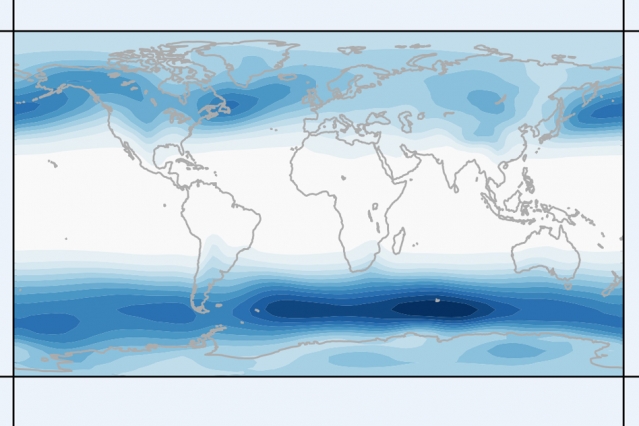
A study by scientists at MIT looked at what other effects such a solar geoengineering project might have on the climate.  Their modeling concluded that it would significantly change storm tracks in the middle and high latitudes.  These tracks give rise to cyclones, hurricanes, and many more ordinary weather phenomena.

According to the study, the northern hemisphere would have weakened storm tracks, leading to less powerful winter storms, but also stagnant conditions in summer and less wind to clear away air pollution.  In the southern hemisphere, there would be more powerful storm tracks.

Aside from turning the world’s weather patterns inside out, solar geoengineering would do nothing to address the serious issue of ocean acidification caused by increasing carbon dioxide levels.

As many have pointed out, playing the geoengineering game would have many unintended consequences.

**********

Web Links

Study: Reflecting sunlight to cool the planet will cause other global changes

Photo courtesy of MIT.

Earth Wise is a production of WAMC Northeast Public Radio.

Cooling The Earth With A Warmer Arctic | Climate Change | Earth Wise

January 24, 2020 By EarthWise 1 Comment

Melting Ice Cooling Earth Warmer Arctic Climate Change

Researchers are considering a wide range of approaches to mitigate the effects of global climate change.  Among these are various strategies of geoengineering, which must be viewed with enormous caution, given the high likelihood of unintended consequences from almost anything we might do.

Researchers at the International Institute for Applied Systems Analysis have investigated potential strategies for cooling the planet in the absence of Arctic sea ice.

The Arctic region is heating up faster than any other place on earth and its sea ice is rapidly disappearing.  Estimates are that summer sea ice in the Arctic Ocean will be largely gone within a generation.  Arctic ice and snow reflect the sun’s energy into space, which helps to keep the planet cool.  What happens if that ice is gone?

The researchers explored the fact that the Arctic Ocean ice actually insulates the Arctic atmosphere from the warmer water under the ice.  Without the ice layer, the surface water would actually increase air temperatures by 20 degrees C during the winter.  That in turn would increase the heat irradiated into space and thereby cool down the planet.

The Arctic sea ice is in part maintained because the upper regions of the Arctic Ocean have lower salinity than the Atlantic Ocean.  This stops Atlantic water from flowing above the cold Arctic waters.  So, if we were to somehow deliberately increase the salinity of the Arctic Ocean surface water, warmer, less salty Atlantic Ocean water would flow in, increase the temperature of the Arctic atmosphere, and release heat trapped in the ocean into space.

It all sounds pretty crazy, but the researchers say that given the seriousness of climate change, all options should be considered when dealing with it.

**********

Web Links

Could we cool the Earth with an ice-free Arctic?

Photo, posted August 19, 2016, courtesy of Flickr.

Earth Wise is a production of WAMC Northeast Public Radio.

Geoengineering And Volcanoes

November 14, 2019 By EarthWise Leave a Comment

Solar geoengineering is a theoretical strategy for curbing the effects of climate change by introducing aerosol particles in the upper atmosphere to reflect some of the Sun’s radiation back into space and thereby cool the planet.  It would basically be intentionally tinkering with the climate system on a global scale.

The concept is fraught with the danger of unintended consequences and most experts consider the idea almost unthinkable.  But there are those who see it as a last resort if all our other efforts to mitigate the effects of climate change are unsuccessful.

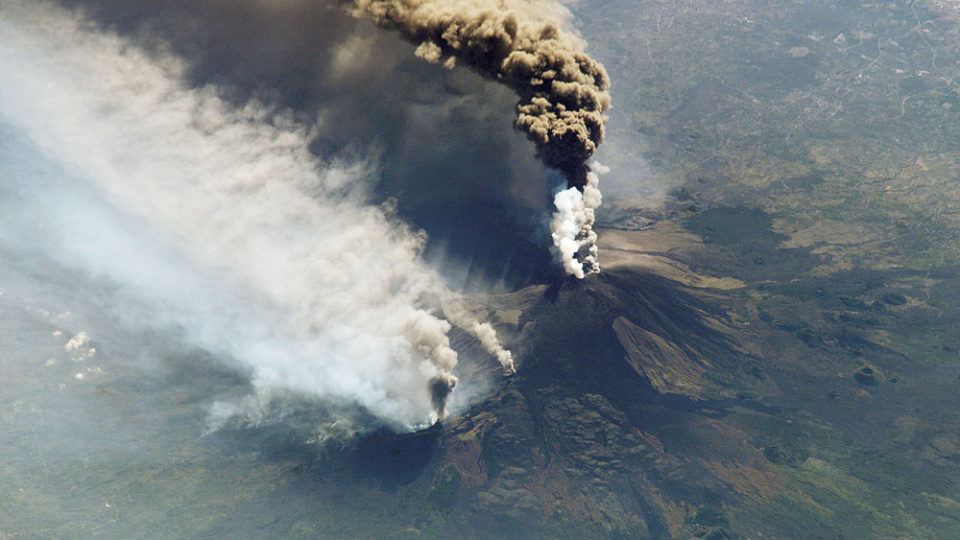
Proponents of the idea like to describe the technique as being like a human-made volcano.  Major volcanic eruptions spew ash particles into the atmosphere which can linger for as long as a few years.  The result is cooler temperatures, sometimes across much of the globe.  The Krakatoa eruption of 1883 lowered average Northern Hemisphere temperatures by more than 2 degrees and created chaotic weather patterns until about 1888.

Researchers at the Carnegie Institution and two Chinese research institutions used sophisticated modeling techniques to compare the effects on the climate of a volcanic eruption with long-term geoengineering deployment.

They found that the volcanic eruption created a greater temperature difference between the land and sea than the geoengineering and resulted in very different precipitation scenarios.  In both cases, there would be less available water for people on land.

Overall, the study demonstrated that volcanic eruptions are imperfect analogs for geoengineering and that scientists should be very cautious about extrapolating too much from them.  It is important to evaluate geoengineering from an informed position, but the truth is that it represents a great and perilous unknown.

**********

Web Links

Geoengineering Versus A Volcano

Photo, posted November 1, 2002, courtesy of the NASA Goddard Space Flight Center via Flickr.

Earth Wise is a production of WAMC Northeast Public Radio.

Can We Remove Enough CO2 From The Air?

January 9, 2019 By EarthWise Leave a Comment

As atmospheric carbon dioxide levels continue to set new records and the effects of climate change grow stronger, humanity has continued to procrastinate on reducing emissions.  As a result, it is increasingly clear that any strategy to avoid runaway climate change will have to involve the use of “negative emissions”- techniques or technologies that actually remove CO2 from the air.

There are both low-tech and high-tech methods for removing carbon dioxide from the atmosphere and both are likely to be needed. 

On the low-tech side, afforestation (planting trees where there were none before), reforestation, changes in forest management, rebuilding the carbon backbone in agricultural soils, and the use of energy from waste biomass are all ways to take carbon out of the atmosphere.

On the high-tech side, direct air capture technologies that take CO2 out of the air and store it in the ground are making rapid progress.   Right now, they are still very expensive,but that is changing.  There is an analogy to wind and solar technology. Not very long ago, both of those technologies were quite expensive but now their costs have plummeted to the point where they are often the cheapest way to make electricity.  With sufficient development effort and deployment, direct air capture technology could become quite affordable.

Some people advocate geoengineering as a solution for climate change.  While removing carbon dioxide amounts to tackling the root cause of the warming climate,geoengineering would address the problem by changing the climate again in some other way.  It is at best an extremely dangerous approach.

Removing CO2 using a combination of natural and man-made techniques is an important part of mitigating the effects of climate change.

**********

Web Links

Climate Solutions: Is It Feasible to Remove Enough CO2 from the Air?

Photo courtesy of Climeworks. 

Earth Wise is a production of WAMC Northeast Public Radio.

Glacial Engineering

October 24, 2018 By EarthWise Leave a Comment

https://earthwiseradio.org/wp-content/uploads/2018/10/EW-10-24-18-Glacial-Engineering.mp3

As the world struggles with trying to limit carbon emissions and slow the pace of global warming, there is increasing analysis of various forms of geoengineering.   Often, these consist of nearly unthinkable efforts to intervene in the climate on a global scale with unpredictable and possibly catastrophic consequences.

[Read more…] about Glacial Engineering

Strategies For Limiting Global Warming

July 30, 2018 By EarthWise Leave a Comment

https://earthwiseradio.org/wp-content/uploads/2018/06/EW-07-30-18-Strategies-for-Limiting-Global-Warming.mp3

A new study published in Nature Energy shows that the goal of limiting global temperature rise to 1.5 degrees Celsius could be achieved by a combination of dramatic improvements in the energy efficiency of everyday activities.

[Read more…] about Strategies For Limiting Global Warming

Geoengineering And Developing Countries

June 21, 2018 By EarthWise Leave a Comment

https://earthwiseradio.org/wp-content/uploads/2018/06/EW-06-21-18-Geoengineering-and-Developing-Countries.mp3

There are some mind-boggling schemes being discussed to mitigate the global warming caused by greenhouse gases.  These include placing giant mirrors in orbit to reflect sunlight before it reaches Earth and launching millions of tons of sulfur into the stratosphere to simulate the effects of a major volcanic eruption.

[Read more…] about Geoengineering And Developing Countries

  • Page 1
  • Page 2
  • Go to Next Page »

Primary Sidebar

Recent Episodes

  • An uninsurable future
  • Clean energy and jobs
  • Insect declines in remote regions
  • Fossil fuel producing nations ignoring climate goals
  • Trouble for clownfishes

WAMC Northeast Public Radio

WAMC/Northeast Public Radio is a regional public radio network serving parts of seven northeastern states (more...)

Copyright © 2026 ·