• Skip to primary navigation
  • Skip to main content
  • Skip to primary sidebar

Earth Wise

A look at our changing environment.

  • Home
  • About Earth Wise
  • Where to Listen
  • All Articles
  • Show Search
Hide Search
You are here: Home / Archives for availability

availability

Giant batteries in the Earth

December 23, 2024 By EarthWise 1 Comment

The wind and the sun are inexhaustible sources of energy, and we are tapping into them to produce electricity at a growing rate around the world.  But neither of them is always available when we need them.  When the sun isn’t shining and the wind isn’t blowing, they don’t work.

An opposite problem also exists.  When our energy needs are low, but it is sunny or windy, solar and wind power are all dressed up with nowhere to go.  Energy storage is the answer to both of these problems.   When there is excess generation, store the energy for later use.  When there is need for energy and not enough is being generated, tap into the energy that is stored.

Giant banks of lithium-ion batteries are the rapidly growing form of energy storage, and they are increasingly providing resilience in the electric grid.  But battery storage is short-term energy storage.  Even the largest battery banks can only provide a few hours of electricity. 

So, there is a real need for “long-duration energy storage” – systems that provide at least 10 hours of backup power and sometimes much more – for the grid to be fully reliable.

Pumped hydro storage, which uses water from elevated reservoirs to drive turbines, has been around for a long time.  Historically, this is the largest form of energy storage in the world.  Other methods include pumping compressed air into underground caverns or lifting massive blocks into elevated positions.  All of these techniques use excess electricity to place things like water, air, or cement into a position where they can be used to drive electrical generators.

The grid of tomorrow will store energy in giant battery banks, but also in the ground, in reservoirs, and in large structures.

**********

Web Links

How giant ‘batteries’ in the Earth could slash your electricity bills

Photo, posted March 21, 2024, courtesy of Sandra Uecker/USFWS via Flickr.

Earth Wise is a production of WAMC Northeast Public Radio

Positive tipping points and climate

January 29, 2024 By EarthWise Leave a Comment

We often hear about tipping points and climate change.  Tipping points are critical thresholds that, when crossed, lead to large, accelerating, and often irreversible changes.  Some of the ones of concern with the climate are thawing permafrost, melting glaciers and ice sheets, and global temperatures reaching certain levels.  These are all tipping points that are essential to avoid.

A study published in the journal One Earth by researchers at the University of Exeter in the UK contends that in order to avoid the severe consequences of climate change, we need to trigger some positive tipping points.

Many climate-friendly changes are happening too slowly.  Triggering positive tipping points is a way to rapidly reach the high levels of decarbonization required to avoid triggering the negative tipping points of great concern.

Reaching a positive tipping point is a way that beneficial changes can rapidly gain momentum.  One example is the adoption of electric vehicles.  It has clearly reached a tipping point across Scandinavia and has happened rapidly.  Norway has managed to transition the market share of electric vehicles from under 10% to nearly 90% in less than 10 years.  At some point, everybody wanted an electric car.  This is evidence that positive tipping points can happen.

Many of the other forms of decarbonization need to move from their current level of adoption to rapid expansion.  A combination of affordability, attractiveness, availability, and political will are needed to trigger tipping points.  Exactly what those tipping point are is not necessarily known, but unless something accelerates the current pace of change, it will be very difficult to prevent negative climate tipping points from changing the world in destructive ways.

**********

Web Links

Positive tipping points must be triggered to solve climate crisis

Photo, posted July 8, 2023, courtesy of Michael Swan via Flickr.

Earth Wise is a production of WAMC Northeast Public Radio
Cutting The Cost Of Energy Storage | Earth Wise

September 9, 2021 By EarthWise Leave a Comment

Energy storage is the solution to the problem of intermittency with renewables

The cost of both solar and wind power continues to drop making the two renewable energy sources the cheapest way to make electricity in more and more places.  Given the virtually inexhaustible supply of both wind and sun power, these clean electricity sources can in principle meet all our energy needs.  The hang up is that both of them are intermittent sources – the wind doesn’t blow all the time and the sun doesn’t shine all the time.

The solution to the intermittency problem is energy storage.  If energy produced by wind and sun can be stored so it can be made available for use at any time, then the goal of having 100% clean energy can be realized.

Energy storage technology has continued to improve over time and to get cheaper.  The Department of Energy recently announced a new initiative aimed at accelerating both of these trends.

The new program – called Long Duration Storage Shot –  has the goal of reducing the cost of grid-scale, long-duration energy storage by 90% within this decade.

Long-duration energy storage is defined as systems that can store energy for more than ten hours at a time.  Such systems can support a low-cost, reliable, carbon-free electric grid that can supply power even when energy generation is unavailable or lower than demand.  With long-duration storage, solar-generated power can be used at night.

The program will consider multiple types of storage technologies – electrochemical (that is: batteries), mechanical, thermal, chemical carriers, and various combinations thereof.  Any technology that has the potential to meet the necessary duration and cost targets for long-term grid storage are fair game for the program.

**********

Web Links

DOE announces goal to cut costs of long-duration energy storage by 90%

Photo, posted October 16, 2017, courtesy of UC Davis College of Engineering via Flickr.

Earth Wise is a production of WAMC Northeast Public Radio.

Solar-Powered Desalination | Earth Wise

March 20, 2020 By EarthWise Leave a Comment

simple desalination using solar power

About 1% of the world’s population is dependent on desalinated water to meet daily needs, but water scarcity is a growing problem that experts believe will affect 14% of the world’s population within the next five years.

Desalination takes much more energy than, for example, transporting fresh water over large distances.  In general, desalination costs are much higher than those associated with fresh water, but beyond costs, freshwater is simply not always available.

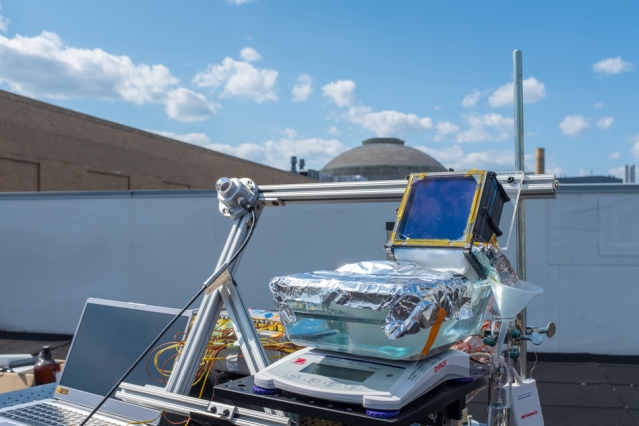
Researchers at MIT and Shanghai Jiao Tong University in China have developed a completely passive solar-powered desalination system that could provide more than 1.5 gallons of fresh drinking water per hour for every square meter of solar collecting area.   Such a system could provide an efficient, low-cost water source for coastal areas that are off the grid.

The system uses multiple layers of flat solar evaporators and condensers topped with transparent aerogel insulation.  The key to its efficiency is the way it uses each of its multiple stages to desalinate water.  At each stage, heat released by the previous stage is harnessed instead of wasted.  The proof-of-concept device, which was tested on an MIT building rooftop, produced more than twice as much water as the record amount produced by any previous passive solar-powered desalination system.

The researchers plan further experiments aimed at optimizing the choice of materials and configurations and to test the system under realistic conditions.  The hope is to have a technology that can play a role in alleviating water scarcity in parts of the world where electricity is scarce, but seawater and sunlight are abundant.

**********

Web Links

Simple, solar-powered water desalination

Photo courtesy of MIT/researchers.

Earth Wise is a production of WAMC Northeast Public Radio.

Cities And Monarch Butterflies

August 13, 2019 By EarthWise Leave a Comment

Monarchs are some of the most well-known butterflies in the U.S.   It is well-known that populations of the iconic orange-and-black butterflies have been in a steep decline for the last 20 years.  In fact, the Monarch population has declined by 80% over that period.

Milkweed, the only plant that Monarchs can lay their eggs on, continues to disappear across the United States and with it, the butterflies can disappear too.

Two new studies published in the journal Frontiers of Ecology and Evolution show that one of the most important things that can be done to save the Monarchs is to plant milkweed in cities.

We tend to think of cities as being the enemy of nature.  But metropolitan areas actually matter for wildlife conservation and that is especially true for pollinators like butterflies that can actually survive with very small patches of habitat.

The new study estimates the amount of habitat in cities that is available to Monarchs and other pollinators and how much more can potentially be added.  It looked at cities from the Monarch’s point of view by identifying the best places and most effective ways to engage land owners to transform low-quality green space – such as lawns – into high-quality homes for butterflies and other wildlife.

Just because urban dwellers can plant milkweed doesn’t always mean that they will.  There has to be a public perception that milkweed and other native flowers are acceptable and beautiful elements in home landscaping.  It will require some shifting of societal norms of what is desirable in neighborhood gardens in order for cities to be able to do their part in protecting butterflies and other species struggling in the modern world.

**********

Web Links

Cities are Key to Saving Monarch Butterflies

Photo, posted August 31, 2012, courtesy of Chris via Flickr.

Earth Wise is a production of WAMC Northeast Public Radio.

Drowning Atolls

June 15, 2018 By EarthWise Leave a Comment

https://earthwiseradio.org/wp-content/uploads/2018/06/EW-06-15-18-Drowning-Atolls.mp3

The rising seas represent an existential threat to low-lying atoll islands and that threat now appears to the more imminent than previously thought.

[Read more…] about Drowning Atolls

Nitrogen In The Rocks

May 23, 2018 By EarthWise Leave a Comment

https://earthwiseradio.org/wp-content/uploads/2018/05/EW-05-23-18-Nitrogen-in-the-Rocks.mp3

The carbon cycle is the biogeochemical process by which carbon is exchanged between the atmosphere, the terrestrial biosphere, the ocean, sediments, and the earth’s interior.  Its balance is a key factor that influences the climate.

[Read more…] about Nitrogen In The Rocks

Primary Sidebar

Recent Episodes

  • An uninsurable future
  • Clean energy and jobs
  • Insect declines in remote regions
  • Fossil fuel producing nations ignoring climate goals
  • Trouble for clownfishes

WAMC Northeast Public Radio

WAMC/Northeast Public Radio is a regional public radio network serving parts of seven northeastern states (more...)

Copyright © 2025 ·