• Skip to primary navigation
  • Skip to main content
  • Skip to primary sidebar

Earth Wise

A look at our changing environment.

  • Home
  • About Earth Wise
  • Where to Listen
  • All Articles
  • Show Search
Hide Search
You are here: Home / Archives for visible

visible

Climate change and Antarctic meteorites

May 1, 2024 By EarthWise Leave a Comment

Researchers from Switzerland and Belgium have investigated the effects of the warming climate on access to meteorites in Antarctica.  Meteorites are of great scientific interest because they provide unique information about the makeup of our solar system.  Of all the meteorites that people have found, 62.6% of them were found in Antarctica.

Why is this?  It is not because more meteorites land in Antarctica.  Statistically, they can land anywhere on earth.  Most end up in the ocean since the world’s oceans cover 70% of the planet. 

Meteorites in Antarctica are more visible because environmental conditions are favorable for their preservation and their visibility.  The arid and cold Antarctic environment helps to preserve meteorites and the lack of rocks and contrast with ice makes spotting meteorites much easier.  The flow of ice sheets tends to concentrate meteorites in so-called meteorite stranding zones where the dark colored space rocks can be easily detected.

There are an estimated 300,000 to 800,000 meteorites in Antarctica.  When meteorites warm up, they can transfer heat to the ice, which locally melts.  Eventually, the meteorites sink beneath the surface.  A recent study using satellite imagery, climate model projections, and AI predicts that for every tenth of a degree of increase in global air temperature, an average of 9,000 meteorites in Antarctica will disappear from the surface and will no longer be able to be found. 

The study estimates that a quarter of Antarctic meteorites will be lost to glacial melt by 2050.  If warming continues to accelerate, closer to three-quarters of the meteorites on the continent will be lost. 

**********

Web Links

Climate change threatens Antarctic meteorites

Photo, posted April 21, 2005, courtesy of Kevin Walsh via Flickr.

Earth Wise is a production of WAMC Northeast Public Radio

Windows To Cool Buildings | Earth Wise

December 15, 2022 By EarthWise Leave a Comment

Developing windows that help to cool buildings

About 15% of global energy consumption is for cooling buildings.  Because of this, there is an ever- growing need for technologies that can more efficiently cool buildings.   Researchers at Notre Dame University have used advanced computing technology and artificial intelligence to design a transparent window coating that is able to lower the temperature inside buildings without using any energy.

The idea is to create a coating that blocks the sun’s ultraviolet and near-infrared light, which are parts of the solar spectrum that otherwise pass through glass and help to heat an enclosed room.  Cooling needs can be reduced further if the coating can radiate heat from the surface of the window so it can pass through the atmosphere into space.  Designing a coating that does both of those things simultaneously while transmitting visible light is difficult.  Coatings should not interfere with the view out the window.

The Notre Dame researchers used advanced computer modeling to create a so-called transparent radiative cooler that meets these goals.  The coating consists of alternating layers of common materials like silicon dioxide, silicon nitride, and aluminum oxide or titanium dioxide on top of a glass base and topped with a film of polydimethylsiloxane.  The computing method was able to optimize this structure far faster and better than conventional design techniques.

The researchers say that in hot, dry cities, the coating could potentially reduce cooling energy consumption by 31% compared with conventional windows.  The same materials could be used in other applications, such as car and truck windows.  In addition, the quantum computing-enabled optimization method used for this work could be used to design other composite materials.

**********

Web Links

Clear window coating could cool buildings without using energy

Photo, posted September 6, 2015, courtesy of Robert Otmn via Flickr.

Earth Wise is a production of WAMC Northeast Public Radio

A Bad Year For California Rice | Earth Wise

November 2, 2022 By EarthWise Leave a Comment

Rice production is the third largest cereal crop in the United States after corn and wheat.  Four regions in the country produce almost the entire U.S. rice crop:  the Arkansas Grand Prairie, the Mississippi Delta, the Gulf Coast, and the Sacramento Valley in California.  Arkansas is the largest producer of rice in the country by far, but California ranks second.

A combination of drought and water shortages in the Sacramento Valley has taken a major toll on the California rice crop.  This year, rice growers have only planted half as much grain as usual.  The changes in rice plantings in California are so substantial that they are easily visible from space.

In Colusa and Glenn counties, rice acreage this year dropped by 84 and 75 percent respectively, compared to 2021.  Farther to the east, in Butte Country, rice acreage was down by 17%.  The change was smaller there because farmers in that county had more groundwater to tap into.

According to the USDA, the California rice crop will be reduced by 38% this year, making it the smallest rice crop in the state since 1977.  California mostly grows short- and medium-grained rice, which is used in dishes like sushi, paella, and risotto.  Arkansas and other states produce most of the long-grain rice such as basmati and jasmine rice.

In late September, there was a burst of rain, which offered some short-term relief for farmers.  However, it will take much more wet weather to ease the ongoing drought conditions.  As of the end of September, over 40% of California remained in extreme drought and 17% was in exceptional drought.

**********

Web Links

A Rough Year for Rice in California

Photo, posted March 21, 2020, courtesy of Ajay Suresh via Flickr.

Earth Wise is a production of WAMC Northeast Public Radio

Global Light Pollution

October 14, 2021 By EarthWise 1 Comment

Light pollution increasing globally

Light pollution is excessive or obtrusive artificial light. It’s a consequence of industrial civilization.  Too much artificial light can cause a host of problems, including disrupting ecosystems, causing adverse health effects, and wasting energy. 

According to a new study led by researchers from the University of Exeter in the U.K., global light pollution has increased by at least 49% over 25 years.  But this figure only includes light visible via satellites.  Scientists estimate that the true increase may be significantly higher – up to 270% more globally. 

That’s because there is a hidden impact of LED technology that isn’t accounted for in the satellite data. LEDs emit more blue light than previous lighting technologies, but satellite sensors fail to pick up this blue light.   This leads to a large underestimate of global light pollution.

The researchers examined light pollution from 1992 to 2017.  They found persistently increasing light pollution in Asia, South America, Oceania and Africa.  In Europe, detected light increased until around 2010, after which it leveled off.  In North America, artificial light appears to be on the decline.  However, the researchers point out that the satellites inability to detect blue light of LEDs means that light pollution has likely actually increased in most locations.

Light pollution has widespread impacts on both animals and plants.  For example, light pollution can confuse the migratory patterns of animals and change predator-prey relationships.   It’s also been shown to cause trees to bud earlier in spring.      

While there’s no off switch for the planet, there are ways that we could reduce the amount of light drastically with little impact on our lives. 

**********

Web Links

Rapid increase in global light pollution

Photo, posted November 2, 2008, courtesy of Timothy Tsui via Flickr.

XXXXXXXXXXXXXXXXXX

Floating Turbines For Offshore Wind | Earth Wise

June 18, 2020 By EarthWise Leave a Comment

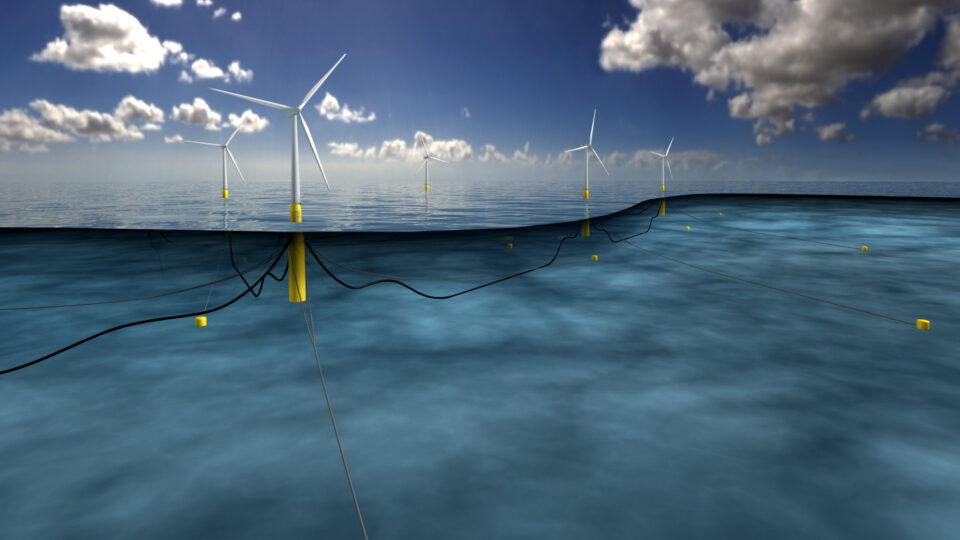
floating wind turbines

Offshore wind is big in Europe.  There are more than 5,000 offshore wind turbines across 12 European countries with a total capacity of more than 22 gigawatts.  Almost every one of those turbines sits on a long tower sunk into the seabed and bolted into place in places where the water is 60 to 160 feet deep.

But off the coast of northern Scotland, there is the Hywind Wind Park which has five 574-foot-tall turbines located 15 miles offshore where the water is 300 feet deep.  The giant masts and turbines sit on buoyant concrete-and-steel keels that allow them to stand upright and float on the water like a giant buoy.  The giant cylindrical bases are held in place with mooring cables attached to anchors that sit on the seafloor.

A key advantage of floating turbines is that they can access outlying ocean waters up to half a mile deep, which is where the world’s strongest and most consistent winds blow.  Another advantage is that such turbines can be installed over the horizon, out of sight of coastal residents who might not like to have wind turbines visible in their scenic ocean views.

Floating wind power has enormous potential for contributing to the expansion of renewable energy.  Offshore wind is still quite a bit more expensive than land-based turbines, and the cost of electricity from distant floating turbines is more than that from near-shore wind turbines.   But all of these costs are likely to come down with improving technology and increased production volume.

There are real challenges to the expanded used of floating wind farms, but the promise of harnessing so much of the open seas for electricity generation is an attractive proposition.

**********

Web Links

Will Floating Turbines Usher in a New Wave of Offshore Wind?

Photo, posted July 17, 2017, courtesy of Crown Estate Scotland via Flickr.

Earth Wise is a production of WAMC Northeast Public Radio.

Primary Sidebar

Recent Episodes

  • An uninsurable future
  • Clean energy and jobs
  • Insect declines in remote regions
  • Fossil fuel producing nations ignoring climate goals
  • Trouble for clownfishes

WAMC Northeast Public Radio

WAMC/Northeast Public Radio is a regional public radio network serving parts of seven northeastern states (more...)

Copyright © 2026 ·