• Skip to primary navigation
  • Skip to main content
  • Skip to primary sidebar

Earth Wise

A look at our changing environment.

  • Home
  • About Earth Wise
  • Where to Listen
  • All Articles
  • Show Search
Hide Search
You are here: Home / Archives for urban planning

urban planning

New Orleans is sinking

August 14, 2025 By EarthWise Leave a Comment

As climate change accelerates, rising sea levels are putting coastal communities at greater risk of flooding and storm surge. Driven by melting glaciers and warming oceans, global sea levels are rising at an increasing rate. For low-lying cities like New Orleans, even small increases can have serious consequences. And that risk is compounded by another factor: the land itself is sinking.

Much of New Orleans already sits at or below sea level, and parts of the city and its surrounding wetlands are gradually sinking. While most of the city remains stable, a new study by researchers from Tulane University suggests that sections of the region’s $15 billion post-Katrina flood protection system may require ongoing upgrades to keep pace with long-term subsidence.

The study, recently published in the journal Science Advances, used satellite data to track changes in ground elevation across Greater New Orleans between 2002-2020.  The researchers found that some areas – including neighborhoods, wetlands, and even concrete floodwalls – are sinking by more than an inch each year. In some spots, the land is dropping by nearly two inches annually.

Alarmingly, some of the concrete floodwalls and levees built to protect the city after Hurricane Katrina are themselves sinking. In a few cases, they are losing elevation faster than sea levels are rising, reducing their capacity to block storm surges.

The study highlights how satellite monitoring can play a critical role in guiding infrastructure maintenance and urban planning – not just in New Orleans – but in vulnerable coastal cities around the world.

**********

Web Links

Vertical land motion in Greater New Orleans: Insights into underlying drivers and impact to flood protection infrastructure

Photo, posted September 22, 2010, courtesy of U.S. Army Corps of Engineers via Flickr.

Earth Wise is a production of WAMC Northeast Public Radio

Cooling Down Urban Heat Islands

November 6, 2019 By EarthWise Leave a Comment

Researchers have known about and studied the urban heat island effect for quite some time.  Since large cities began to emerge in the 19th century, it has been understood that various aspects of the urban environment lead to warmer temperatures than the surrounding countryside.

Researchers led by a group at Portland State University in Oregon have been utilizing a new way of studying the urban heat island effect.  They have used citizen science volunteers in 24 cities around the world to map temperatures in the cities at ground level in great detail using mobile sensors attached to slow-moving vehicles.  Previous studies have used data from satellite or stationary sensors.  They have learned that the urban heat island effect is more complicated, more varied, and subtler than the earlier data indicated.

They found that there are six things that affect urban heat. Three are living — the volume of the tree canopy, the height of the tree canopy, and the ground level vegetation. Three are human-built — the volume of buildings, the difference in building heights, and the coloring of the buildings.

Buildings can have both negative and positive effects. Tall buildings that cast shade actually lower relative afternoon temperatures, while densely packed shorter buildings, like the big-box stores in suburban areas, lead to hotter afternoon temperatures. The studies show that increasing the difference in building heights in an area creates more air circulation, which has a cooling effect.

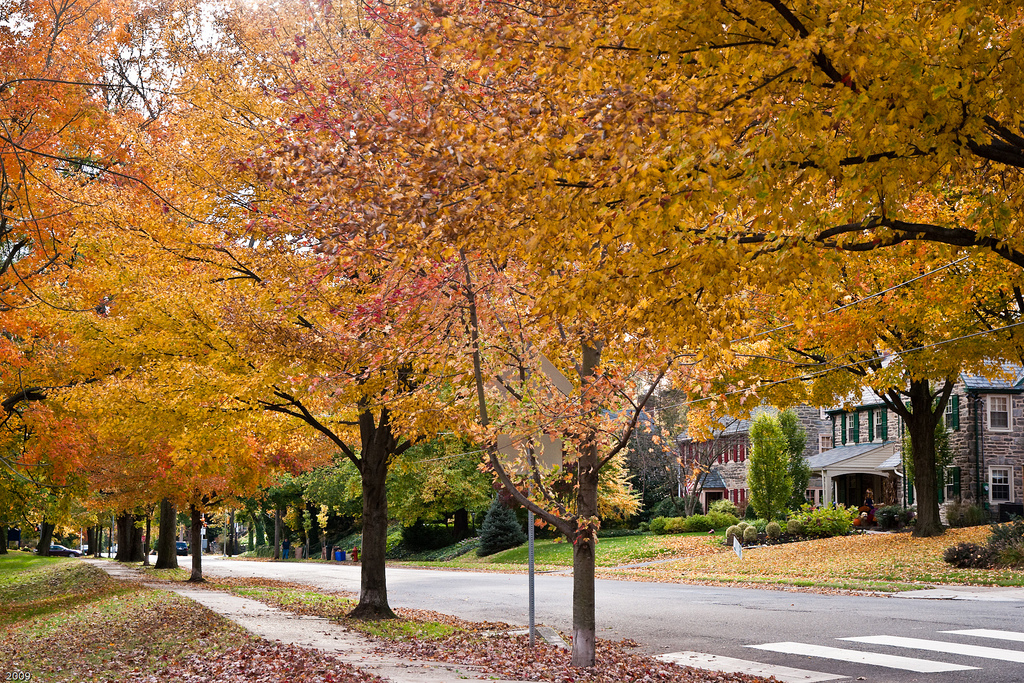
The study also showed that urban heat is a social justice issue.  Lower-income neighborhoods largely barren of trees have considerably higher temperatures than more affluent, tree-shaded areas.

Such detailed research can be used to guide decisions in urban planning with regard to trees, building heights, and the color and type of surfaces in our urban spaces.

**********

Web Links

Can We Turn Down the Temperature on Urban Heat Islands?

Photo, posted July 21, 2009, courtesy of Daniel Dionne via Flickr.

Earth Wise is a production of WAMC Northeast Public Radio.

Trends Influencing Our Cities

February 23, 2018 By EarthWise Leave a Comment

https://earthwiseradio.org/wp-content/uploads/2018/02/EW-02-23-18-Trends-Influencing-Our-Cities.mp3

The Environmental Protection Agency removed its information hub about climate change last year.  In response, 17 cities reposted the information on their own city government sites.  This is indicative of the fact that cities are increasingly taking on a leadership role in environmental, social and economic change.

[Read more…] about Trends Influencing Our Cities

Planning Cooler Cities

October 28, 2015 By EarthWise

https://earthwiseradio.org/wp-content/uploads/2015/10/EW-10-28-15-Planning-Cooler-Cities.mp3

Anyone who has walked the streets of New York City or Washington, D.C. on a stifling summer day can attest to the fact that cities feel hotter.  It’s not a matter of perception.

[Read more…] about Planning Cooler Cities

Street Trees Are Good For Us

September 11, 2015 By EarthWise

street trees

https://earthwiseradio.org/wp-content/uploads/2015/08/EW-09-11-15-Street-Trees-and-Health.mp3

Want to feel younger? Live on a street with more trees. That’s the finding of University of Chicago researchers who studied the impact of street trees on the real and perceived health of residents of Toronto, Canada.

[Read more…] about Street Trees Are Good For Us

Primary Sidebar

Recent Episodes

  • An uninsurable future
  • Clean energy and jobs
  • Insect declines in remote regions
  • Fossil fuel producing nations ignoring climate goals
  • Trouble for clownfishes

WAMC Northeast Public Radio

WAMC/Northeast Public Radio is a regional public radio network serving parts of seven northeastern states (more...)

Copyright © 2025 ·