• Skip to primary navigation
  • Skip to main content
  • Skip to primary sidebar

Earth Wise

A look at our changing environment.

  • Home
  • About Earth Wise
  • Where to Listen
  • All Articles
  • Show Search
Hide Search
You are here: Home / Archives for sulfates

sulfates

Modeling geoengineering

May 19, 2025 By EarthWise Leave a Comment

Modeling the impacts of geoengineering

As the impacts of climate change continue to mount up, there is increasing interest in radical intervention measures designed to keep a lid on rising global temperatures.  Such measures are fraught with potential dangers and unintended consequences but there is no guarantee that one or another of them might still be attempted in the future.  Increasing international interest in geoengineering as a potential strategy for mitigating climate change has created a pressing need to consider its impact before any potentially irreversible actions are taken.

The Natural Environment Research Council in the UK is funding four research projects aimed at understanding the potential consequences of solar radiation modification (SRM) being deployed in the real world.

SRM consists of methods to reflect some of the Sun’s radiation back into space instead of allowing it to reach and warm the earth. 

One approach is stratospheric aerosol intervention in which particles such as sulfates are introduced into the upper atmosphere to reflect sunlight thereby producing a dimming effect.   The idea is to mimic the effects of large volcanic eruptions, which naturally send sulfates into the atmosphere.

A second approach is marine cloud brightening, which increases the reflectivity of clouds over the ocean by spraying very small droplets of sea water into the air.  The fine particles of sea salt enhance cloud condensation nuclei, producing more cloud droplets and making clouds more reflective.

The research aims to deliver independent risk analyses to inform policymakers about the potential environmental impacts of SRM.

**********

Web Links

Scientists to model the impact of controlling Earth’s temperature by reflecting solar radiation

Photo, posted May 6, 2009, courtesy of Denys Zadorozhnyi via Flickr.

Earth Wise is a production of WAMC Northeast Public Radio

Scrubbers to clean up shipping

May 1, 2025 By EarthWise Leave a Comment

Cargo ships are significant sources of global air pollution because of their fuel oil.  Most ships burn heavy fuel oil that is loaded with sulfur, so when it is burned it produces noxious gases and fine particles that can harm human health and the environment.  The International Maritime Organization enacted a mandatory cap of 0.5% for the sulfur content of marine fuels in 2020.  Heavy fuel oil has a sulfur content of 2 to 3 percent.

Shipping companies can comply by burning low-sulfur fossil fuels or biofuels, but these are much more expensive.  The most feasible and cost-effective option is to install exhaust gas cleaning systems, known as scrubbers. 

A scrubber is a huge metal tank installed in a ship’s exhaust stack.  Seawater is sprayed from nozzles to wash the hot exhaust.  The seawater reacts with sulfur dioxide and converts it to sulfates, which are environmentally benign natural components in seawater.

A study by the National Technical University of Athens in Greece has performed a lifecycle assessment of the use of scrubbers and has found that burning heavy fuel oil with the use of scrubbers can match or even surpass the benefits of using low-sulfur fuels.

Producing low-sulfur fuel causes additional greenhouse gas and particulate matter emissions in refineries. On the other hand, scrubbers reduce sulfur dioxide emissions by 97% and dramatically reduce other pollutants as well.

The study shows the importance of incorporating lifecycle assessments into evaluation of environmental impact reduction policies.

**********

Web Links

Study: Burning heavy fuel oil with scrubbers is the best available option for bulk maritime shipping

Photo, posted August 3, 2015, courtesy of Lotsemann via Flickr.

Earth Wise is a production of WAMC Northeast Public Radio
Wildfires And The Climate | Earth Wise

September 24, 2021 By EarthWise Leave a Comment

Wildfires had a bigger impact on climate than the pandemic lockdowns

Scientists from the National Center for Atmospheric Research recently published a study analyzing the events that influenced the world’s climate in 2020.  Among these were the pandemic-related lockdowns that reduced emissions and resulted in clearer air in many of the world’s cities.

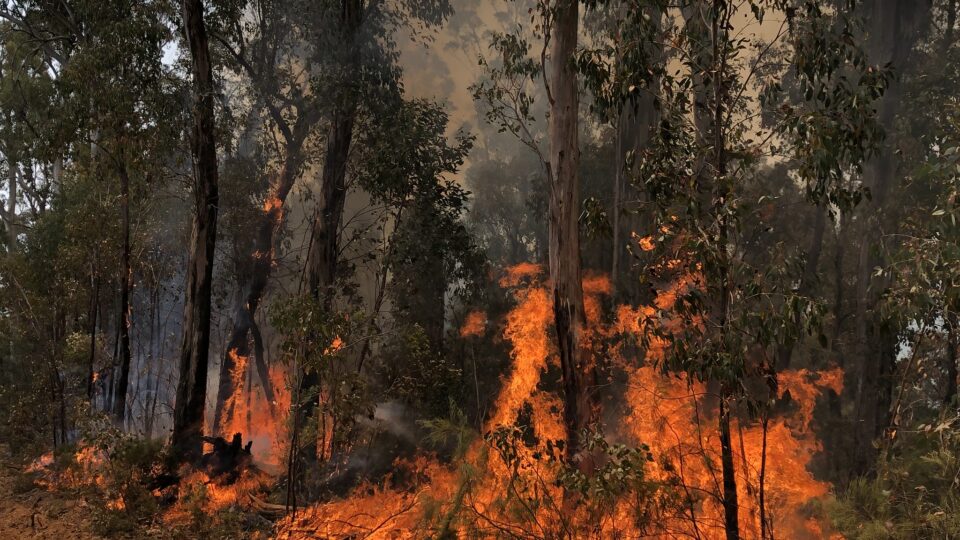
While this was a significant event, the study found that something entirely different had a more immediate effect on global climate:  the enormous bushfires that burned in Australia from late 2019 to 2020, producing plumes of smoke that reached the stratosphere and circled much of the southern hemisphere.

Those fires sprung up in September 2019 and lasted until March 2020.  The fires burned more than 46 million acres (about 72,000 square miles), which is roughly the same area as the entire country of Syria.  Thousands of homes and other buildings were lost.

Major fires inject so many sulfates and other particles into the atmosphere that they can disrupt the climate system, push tropical thunderstorms northward from the equator, and potentially influence the periodic warming and cooling of tropical Pacific Ocean waters known as El Nino and La Nina.

According to the study, the COVID-19 lockdowns actually had a slight warming influence on global climate, as a result of clearer skies enabling more heat to reach the earth’s surface.  In contrast, the Australian bushfires cooled the Southern Hemisphere because the atmospheric particles reflected some of the incoming solar radiation back to space.

This summer, there have been raging wildfires in the western US and Canada, which have affected air quality in many parts of the nation and have been a serious health hazard.  Undoubtedly, these fires are influencing the climate system as well in ways that we are still trying to understand.

**********

Web Links

Bushfires, not pandemic lockdowns, had biggest impact on global climate in 2020

Photo, posted January 18, 2020, courtesy of BLM-Idaho via Flickr.

Earth Wise is a production of WAMC Northeast Public Radio.

Less Sulfur In The Soil

June 9, 2016 By WAMC WEB

https://earthwiseradio.org/wp-content/uploads/2016/05/EW-06-09-16-Less-Sulfur-in-the-Soil.mp3

Acid rain is rain containing high levels of nitric and sulfuric acids.  The main culprit for it is the burning of fossil fuels, particularly coal-burning power plants.  The most serious effect of acid rain is the creation of toxicity in lakes, wetlands and other aquatic environments, doing great harm to a wide range of aquatic animals.

[Read more…] about Less Sulfur In The Soil

Primary Sidebar

Recent Episodes

  • An uninsurable future
  • Clean energy and jobs
  • Insect declines in remote regions
  • Fossil fuel producing nations ignoring climate goals
  • Trouble for clownfishes

WAMC Northeast Public Radio

WAMC/Northeast Public Radio is a regional public radio network serving parts of seven northeastern states (more...)

Copyright © 2026 ·