• Skip to primary navigation
  • Skip to main content
  • Skip to primary sidebar

Earth Wise

A look at our changing environment.

  • Home
  • About Earth Wise
  • Where to Listen
  • All Articles
  • Show Search
Hide Search
You are here: Home / Archives for pollutant

pollutant

Tracking atmospheric mercury

May 13, 2025 By EarthWise Leave a Comment

A cheap way to track atmospheric mercury levels

Atmospheric mercury is a toxic pollutant released into the air from natural sources—such as volcanoes and wildfires—and from human activities like coal burning and gold mining.  Once in the atmosphere, mercury can travel long distances before settling onto land or into water, transforming into toxic forms that threaten ecosystems and human health.

But tracking atmospheric mercury is a costly and challenging endeavor, requiring specialized equipment and trained personnel. Active monitors, which pump air to collect mercury, are expensive and need electricity, while passive samplers, using activated charcoal for remote areas, cost up to $100 each.

Researchers from Cornell University have found a cheap method for tracking toxic atmospheric mercury near gold mining sites throughout the Global South: wild fig trees.  In the study, which was conducted in the Peruvian Amazon and recently published in the journal Frontiers in Environmental Science, the research team found that the rings in wild fig trees can serve as natural archives of atmospheric mercury, capturing and preserving historical pollution levels over time.

The technique itself is not actually new.  Previous studies have used tree rings to track mercury pollution from coal combustion, particularly in Canada. But the research team wanted to test this method in regions of the Global South, where mercury emissions from gold mining are widespread.

According to the research team, wild fig trees might soon serve as an important biomonitoring tool, helping scientists better understand how mercury disperses across landscapes and through time.

**********

Web Links

Tree rings track atmospheric mercury cheaply

Photo, posted November 13, 2012, courtesy of Steve Kessler via Flickr.

Earth Wise is a production of WAMC Northeast Public Radio
Caterpillars And Light Pollution | Earth Wise

May 3, 2023 By EarthWise Leave a Comment

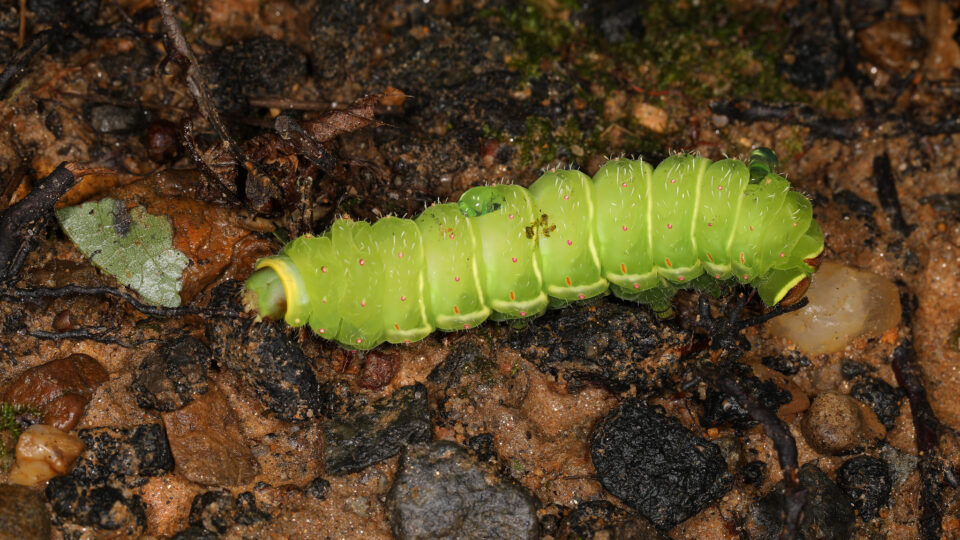
Most of us are familiar with air pollution, water pollution, soil pollution, and even noise pollution.  But it turns out that light can be a pollutant as well, and it’s a consequence of industrial civilization.  In fact, nighttime light pollution now covers approximately 23% of the globe and over 80% of inhabited regions. 

Light pollution affects more than just our view of the stars.  For example, light pollution can alter our circadian rhythm, disrupting our sleep cycle.  In nature, light pollution can kill baby turtles by causing them to head inland instead of into the ocean, can cause birds to migrate during the wrong season, and can deter nighttime pollinators like bats.  And those are just a few of the examples.    

According to new research from scientists at Cornell University, moderate levels of artificial light at night – like a porch light – attract caterpillar predators and reduce the chance that caterpillars grow up to become moths. 

In the study, which was recently published in the journal Proceedings of the Royal Society B: Biological Sciences, the researchers placed 552 lifelike caterpillar replicas made of soft clay in a forest to measure predation rates compared to a control group.  They found that predation rates on clay caterpillars and the abundance of arthropod predators were significantly higher on the artificial light at night treatment plots.  In fact, of the 552 clay caterpillars deployed and glued to leaves to look authentic, 521 models were recovered and 249 of them- or 47.8% – showed predatory marks from arthropods during the summer-long nighttime study.

In addition to light pollution, caterpillars also face major threats from habitat loss, pollution, invasive species, and climate change.

**********

Web Links

Artificial light at night aids caterpillar predators

Photo, posted July 23, 2020, courtesy of Judy Gallagher via Flickr.

Earth Wise is a production of WAMC Northeast Public Radio

Living in a Carbon Bubble | Earth Wise

July 18, 2022 By EarthWise Leave a Comment

The earth’s atmosphere is a little over 0.04% carbon dioxide, currently about 420 parts per million.  That’s more than it’s been in millions of years and is changing our climate.  But these levels of CO2 are not enough to directly affect people.

However, people are sensitive to the amount of carbon dioxide they are breathing.  It is actually an indoor pollutant.  High concentrations have been shown to reduce our cognitive performance, our health, and our comfort.  For example, a study in 2012 showed that performance in a variety of cognitive function tests was reduced by 12% when CO2 levels reached 1,000 parts per million and by 51% at 2,500 ppm.

How common are high levels of carbon dioxide?  Pretty common.  Offices often have CO2 levels of 600 ppm or higher, but 5% of US offices have average concentration about 1000 ppm and some conference rooms can reach 1900 ppm.  Classrooms often reach average levels above 1000 ppm.  Passenger aircraft have average levels around 1400 ppm during flight, and can peak over 4,000 ppm.  Cars with one occupant with the windows closed and the air recirculating have levels above 4,000 ppm. 

Where does it all come from?  From us.  We exhale CO2 and if we are in enclosed spaces with insufficient air circulation and ventilation, we end up living in a carbon dioxide bubble.  Most of us live with high CO2 levels – all day and every day.  It is a form of indoor pollution that has not gotten enough attention.

**********

Web Links

I’m living in a carbon bubble. Literally.

Photo, posted October 24, 2013, courtesy of Cory W. Watts via Flickr.

Earth Wise is a production of WAMC Northeast Public Radio.

Artificial Light And Nature | Earth Wise

December 4, 2020 By EarthWise Leave a Comment

Light pollution has far reaching consequences

Most of us are familiar with air pollution, water pollution, soil pollution, and noise pollution.  But it turns out that light can also be a pollutant as well. 

Light pollution is a consequence of industrial civilization.  Sources of light pollution include building interior and exterior lighting, advertising billboards, factories, commercial properties, streetlights, and sporting venues.      

According to findings in a new report from the University of Exeter, artificial nighttime lighting has a wide range of effects across the natural world and should be limited wherever possible.  The research team analyzed more than 100 studies and found that artificial lighting has widespread impacts on both animals and plants. 

In the study, which was funded by the Natural Environment Research Council in the U.K., researchers consistently found changes to animals’ bodies and behavior as a result of artificial lighting.  In particular, levels of the sleep cycle-regulating hormone melatonin were reduced by exposure to artificial lighting at night in all animal species studied. 

Exposure to artificial nighttime lighting also affected the timing of animals’ activities.  For rodents, which are largely nocturnal, the duration of activity was often reduced by exposure to nighttime lighting.  On the other hand, for diurnal birds, exposure to nighttime lighting led to an extension of the duration of their activities.  

Previous studies have found other wide-ranging impacts of nighttime lighting, from reducing pollination by insects to trees budding earlier in spring.  

Artificial nighttime lighting is human driven and very disruptive to the natural world.  While there’s no off switch for the planet, we could reduce the amount of light pollution drastically with no impact on our lives. 

**********

Web Links

Artificial night lighting has widespread impacts on nature

Photo, posted July 29, 2017, courtesy of spacedust2019 via Flickr.

Earth Wise is a production of WAMC Northeast Public Radio.

Tracking Climate Opinions

May 1, 2017 By EarthWise

https://earthwiseradio.org/wp-content/uploads/2017/04/EW-05-01-17-Tracking-Climate-Opinions.mp3

Public opinion about global warming is an important influence on decision making about policies to combat global warming and to be prepared for its consequences.  An extensive polling effort by Yale University has produced an estimate of public opinions down to state, congressional district, and county levels.  

[Read more…] about Tracking Climate Opinions

Climate Change And A Divided Country

April 20, 2017 By EarthWise

https://earthwiseradio.org/wp-content/uploads/2017/04/EW-04-20-17-Climate-Change-and-a-Divided-Country.mp3

This Saturday is Earth Day and it’s also the occasion for the March for Science taking place in Washington, DC and in many other cities around the world.  The purpose is to express support for scientific research and evidence-based policies in a tumultuous political environment.

[Read more…] about Climate Change And A Divided Country

Primary Sidebar

Recent Episodes

  • An uninsurable future
  • Clean energy and jobs
  • Insect declines in remote regions
  • Fossil fuel producing nations ignoring climate goals
  • Trouble for clownfishes

WAMC Northeast Public Radio

WAMC/Northeast Public Radio is a regional public radio network serving parts of seven northeastern states (more...)

Copyright © 2026 ·