• Skip to primary navigation
  • Skip to main content
  • Skip to primary sidebar

Earth Wise

A look at our changing environment.

  • Home
  • About Earth Wise
  • Where to Listen
  • All Articles
  • Show Search
Hide Search
You are here: Home / Archives for physics

physics

Better blue LEDs

August 27, 2025 By EarthWise Leave a Comment

Developing better blue LEDs

LEDs have become the standard source of energy-efficient lighting.  They make use of semiconductors to turn electricity into light.  Depending upon the materials used to make them, LEDs produce different colors.  In the early 1990s, the first blue LEDs were discovered, ultimately earning the Nobel Prize in physics, and enabling LEDs to produce white light, which is essential for general lighting applications.

Blue LEDs have shortcomings.  Some have issues with stability, scalability, cost, efficiency, complexity in manufacturing, or have environmental concerns because of the use of toxic components. 

Researchers at Rutgers University in collaboration with scientists at several other institutions have found a way to make blue LEDs more efficient and sustainable.  These LEDs use a new type of hybrid material that is a combination of copper iodide with organic molecules.  The impressive performance of these LEDs was achieved through an innovative technique called dual interfacial hydrogen-bond passivation.  This new manufacturing technique boosts the performance of LEDs by a factor of four.

The material has several advantages.  It has a very high photoluminescence quantum yield, which means that it converts nearly all the photoenergy it receives into blue light.  The LEDs last longer than many others and they work well in larger-scale applications, maintaining high efficiency.  The materials are eco-friendly and cost-effective.

According to the researchers, this new approach could be a versatile strategy for generating high-performance LEDs that can pave the way for better, brighter, and longer-lasting LEDs.

**********

Web Links

Scientists Develop Deep-Blue LEDs Expected to Greatly Enhance General Lighting

Photo, posted February 1, 2021, courtesy of Ivan Radic via Flickr.

Earth Wise is a production of WAMC Northeast Public Radio
Community Solar On The Rise | Earth Wise

April 14, 2023 By EarthWise Leave a Comment

Community solar continues to grow

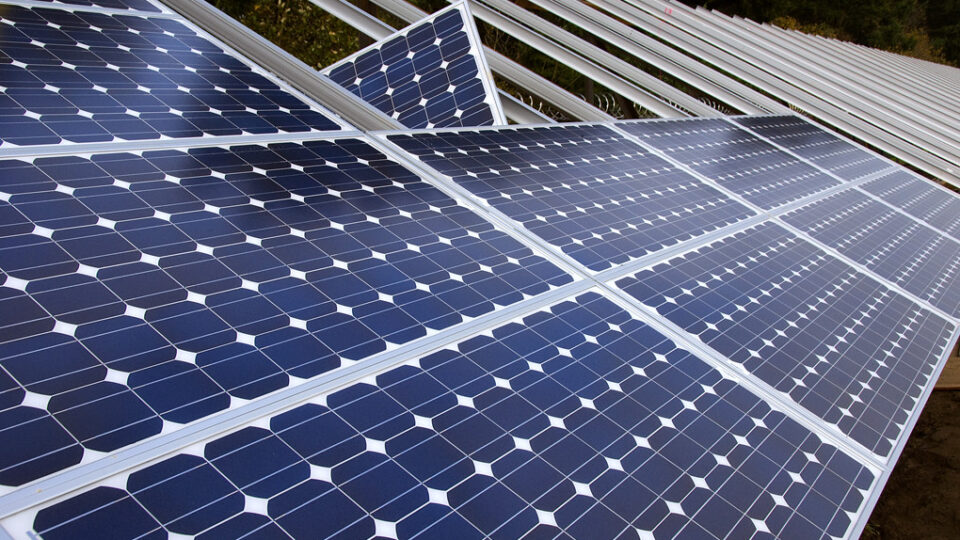
Community solar is a way for people who can’t put solar on their own roofs to still take advantage of its benefits.  Whether they can’t afford to install their own panels, have too much shade on their roof, or don’t even own a home, community solar is another way to participate in green energy.

Community solar – also called “shared solar” or “solar gardens” – is a kind of development in which consumers can subscribe to a large solar installation in their area and receive credits on their monthly utility bills for their share of the solar electricity produced.

The large majority of community solar installations are in six states:  Colorado, Illinois, Massachusetts, Minnesota, New Jersey, and New York.  After substantial growth in community solar in 2022, New York now is the national leader, thanks to initiatives by the state government and the nonprofit sector.  Some programs focus on giving low-income households access to solar.  As of last fall, New York had over 728 community solar projects online.

One should understand that electrons are indistinguishable.  The power generated by a community solar installation is not piped directly to subscribers’ homes.  It just goes into the grid.  Subscribers get credit for their share of the power, but that is essentially a matter of bookkeeping, not physics.

The federal government now has $7 billion that can be used for community solar as part of the Greenhouse Gas Reduction Fund within the Inflation Reduction Act enacted last August.  The EPA plans to award up to 60 grants to assist projects deploying residential and community solar.  Research firm Wood Mackenzie forecasts the community solar market will double by 2027.

**********

Web Links

Community Solar Is About to Get a Surge in Federal Funding. So What Is Community Solar?

Photo, posted November 18, 2008, courtesy of the Oregon Department of Transportation via Flickr.

Earth Wise is a production of WAMC Northeast Public Radio
Fire-Driven Thunderstorms

March 6, 2019 By EarthWise Leave a Comment

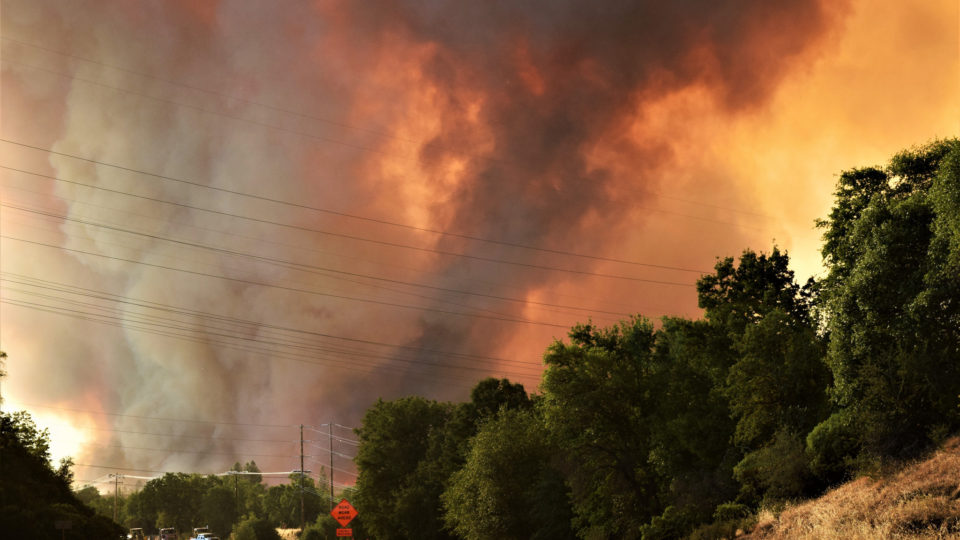
In 2016 and 2017, wildfires in western Canada spawned thunderstorms that ignited additional fires, in some cases tens of miles away from the original fire.  These fire-triggered thunderstorms are technically known as pyrocumulonimbus clouds, or “pyroCb’s”.

The physics of pyroCb’s is complex.  When super-heated updrafts from an intense fire suck smoke, ash, burning materials, and water vapor high into the air, these elements cool and form so-called fire clouds that look and act like the cumulonimbus clouds associated with classic thunderstorms.  What is different is that the heat and particulates in the smoke almost always arrest the ability of the cloud to produce rain.  Instead, what remains is a lightning storm that moves across the landscape, triggering more fires.

These PyroCb events appear to be happening far more often, producing more energy, and erupting in places where they have never been seen before.  As the world warms, wildfires themselves are becoming larger and hotter.  In the past decade, wildfires have been burning more than twice as many acres as they did before the turn of the 21st century.  Along with the growth in wildfire activity, there has been an increase in PyroCb events, and there are now an average of 25 per year in western North America.

Apart from starting new fires, pyroCb’s also have similar effects as moderate-sized volcanic eruptions.  Smoke and aerosols from wildfires can rise high into the stratosphere, where they can linger for months.  Eventually, the particles carried aloft in the atmosphere do come down, dumping dangerous chemicals on far flung regions of the earth.  But unlike volcanic eruptions, which are relatively rare events, pyroCb’s are happening more and more each year.

**********

Web Links

Fire-Induced Storms: A New Danger from the Rise in Wildfires

Photo, posted July 31, 2013, courtesy of Loren Kerns via Flickr.

Earth Wise is a production of WAMC Northeast Public Radio.

Collecting Clean Water From The Air

February 6, 2019 By EarthWise Leave a Comment

Clean water is an essential requirement for human life and there are many places where it is a scarce commodity.   In the world’s deserts, getting water to people requires feats of engineering and irrigation that can be cumbersome and expensive.

Researchers at Ohio State University have produced a couple of new studies that explore options for gathering water from fog and condensation that are based on principles of biomimicry:  copying strategies already in use by plants and animals.

The researchers looked at how cactus, beetles and desert grasses all collect water condensed from nighttime fog, gathering droplets from the air and filtering them to roots or reservoirs.

The cactus they studied collects water on its barbed tips before guiding droplets down conical spines to the base of the plant. They learned that conical shapes gather more water than do cylindrical shapes.  This is because of a physics phenomenon called the Laplace pressure gradient.

The beetles they studied collect drops of water on waxy, water-repellent bumps on their backs.  The water then slides towards the beetle’s mouth on the flat surface between the bumps.  Based on this, the researchers experimented with structures that include multiple hydrophilic cones with spaces in between where water droplets can coalesce.

From grasses, they learned that grooved surfaces move water more quickly than ungrooved surfaces – in fact, about twice as much.

The work so far has been on a laboratory-level, but the researchers envision scaling up to structures in the desert that can gather water from fog or condensation and supplement public systems or wells either on a house-by-house basis or on a community-wide basis.  Copying cacti, beetles and grasses could supply clean water to people in the desert.

**********

Web Links

Collecting clean water from air, inspired by desert life

Photo, posted February 7, 2010, courtesy of Remko van Dokkum via Flickr.

Earth Wise is a production of WAMC Northeast Public Radio.

Rapid Response To Climate Change More Important Than Ever

October 17, 2018 By EarthWise Leave a Comment

https://earthwiseradio.org/wp-content/uploads/2018/10/EW-10-17-18-Rapid-Response-to-Climate-Change.mp3

The Intergovernmental Panel on Climate Change has issued a new report emphasizing the importance of taking rapid action to limit global warming to 1.5 degrees Celsius and examining the consequences of allowing temperatures to rise 2 degrees instead.

[Read more…] about Rapid Response To Climate Change More Important Than Ever

Tipping Points

August 9, 2017 By EarthWise

https://earthwiseradio.org/wp-content/uploads/2017/08/EW-08-09-17-Tipping-Points.mp3

A tipping point is a point in time when a small thing can make a big change happen.  The term was popularized in sociology in recent decades, but really comes from physics where is refers to adding a small amount of weight to a balanced object causing it to topple over.

[Read more…] about Tipping Points

Primary Sidebar

Recent Episodes

  • An uninsurable future
  • Clean energy and jobs
  • Insect declines in remote regions
  • Fossil fuel producing nations ignoring climate goals
  • Trouble for clownfishes

WAMC Northeast Public Radio

WAMC/Northeast Public Radio is a regional public radio network serving parts of seven northeastern states (more...)

Copyright © 2026 ·