• Skip to primary navigation
  • Skip to main content
  • Skip to primary sidebar

Earth Wise

A look at our changing environment.

  • Home
  • About Earth Wise
  • Where to Listen
  • All Articles
  • Show Search
Hide Search
You are here: Home / Archives for culling

culling

Raccoons in Europe

July 25, 2025 By EarthWise Leave a Comment

Raccoons are popular and prevalent in Europe

Tens of thousands of raccoons live in Kassel, a city of 200,000 people in central Germany known for its art scene.  Overall, there are an estimated 1.5 million raccoons in Germany.  The omnivorous mammals are native to North America, but they were brought to Germany in the 1930s for fur farming.  Fur farming ultimately ceased but escaping animals and intentional releases ultimately led to a large wild population of raccoons in the years afterward.

Raccoons have gradually made their way across Europe with animals spotted in France, Denmark, Poland, Italy, Austria, and elsewhere.

The people of Kassel have embraced raccoons.  In fact, the place is often called the raccoon city.  Several sports teams are named after the animals.  Many people feed them, and they are pretty much everywhere.  On the other hand, residents have to lock up their trash receptacles and they have to check under their cars before driving places.

Since 2016, the EU has classified racoons as an invasive species because of the threat they pose to native wildlife.  There are no equivalent species like them in Europe.  So, they are a threat to ground-nesting birds, bats in caves, amphibians, and more.  They are able to eat almost anything. 

What to do about raccoons in Europe is unclear.  Despite their popularity in Germany, 200,000 raccoons were culled last year.  But raccoon supporters argue that minks, which are native to Europe, and especially cats, are responsible for much of the pressure on species racoons are accused of consuming.  Meanwhile, Kassel citizens continue to enjoy their raccoons.

**********

Web Links

Rampaging raccoons: how the American mammals took over a German city – and are heading across Europe

Photo, posted December 20, 2016, courtesy of Big Cypress National Preserve via Flickr.

Earth Wise is a production of WAMC Northeast Public Radio
Too Many Bison | Earth Wise

September 21, 2023 By EarthWise Leave a Comment

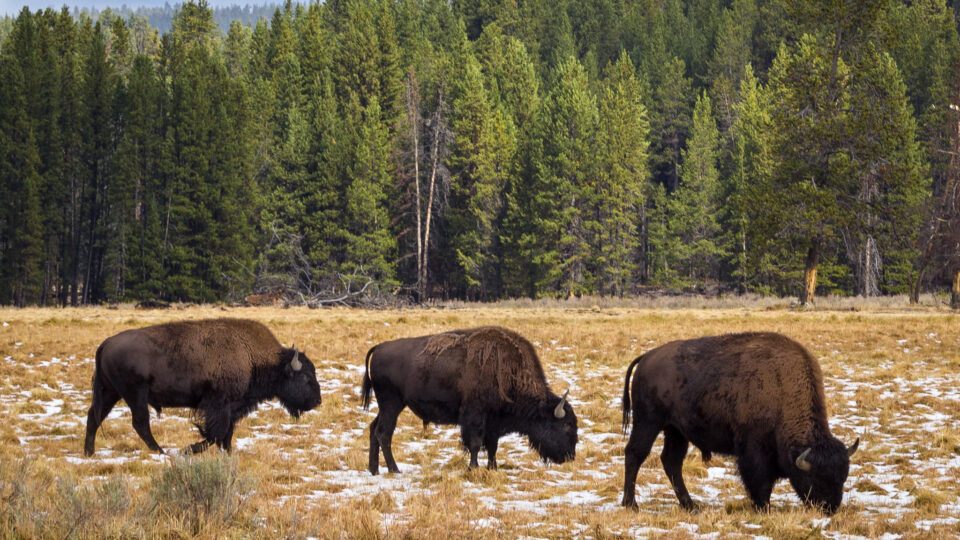
In the northern part of Yellowstone National Park, an historically large bison herd is hampering the comeback of quaking aspen trees, whose numbers were greatly diminished by decades of over-browsing by elk.  Restoring the balance of ecosystems at Yellowstone is proving to be a complicated matter.

Long ago, the bison population in the Great Plains was as much as 30 million.  The population sharply decreased in the 1800s.  By the 1830s, there were no bison east of the Mississippi River.  Fifty years later, the Plains bison was nearly extinct.  Several small herds lived near Yellowstone Park when it was established in 1872, but poachers killed off nearly of them by the turn of the century.  Protective measures were taken and by 1925, Yellowstone’s Lamar Valley herd had grown to more than 750.  After that, occasional culling took place for over 40 years. 

When gray wolves and cougars were removed from the park, elk populations boomed, and the elk gradually decimated the growth of quaking aspen, cottonwood, willow, and berry-producing shrubs.  Both elk and bison were regularly culled until 1968 when public and congressional outcry intervened.

The return of wolves and cougars to the park made some progress in restoring ecosystem balance, particularly with respect to the elk population which has dropped from 20,000 to 5,000.  But bison numbers have grown to over 4,000 over past 20 years and the damage once caused by elk is now continuing from bison.

Park administrators are faced with complex management decisions about how to best preserve the ecosystems at Yellowstone National Park.

**********

Web Links

Bison in northern Yellowstone proving to be too much of a good thing

Photo, posted October 6, 2016, courtesy of Christian Collins via Flickr.

Earth Wise is a production of WAMC Northeast Public Radio
Too Many Bison | Earth Wise

May 8, 2020 By EarthWise Leave a Comment

Bison in Yellowstone

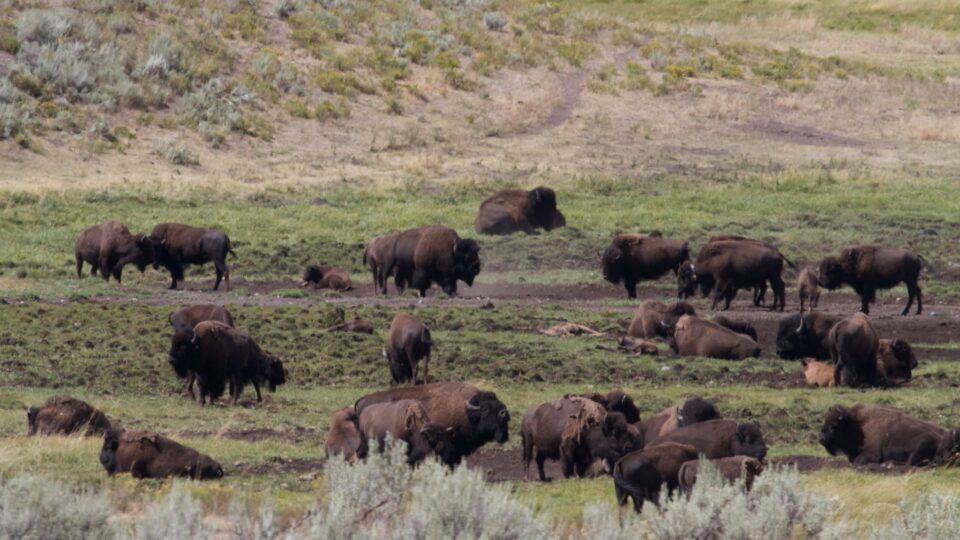
The population of large herbivores in Yellowstone National Park has undergone many dramatic changes over the course of time.  The numbers of both the iconic Rocky Mountain elk and bison have gone up and down as a result of human interactions.

Bison, of course, once were a dominant species from east of the Appalachians to west of the Rocky Mountains, with most of an estimated 30 million living on the Great Plains.  As the west was settled, bison populations plummeted and by the late 1800s, they were nearly extinct.

When Yellowstone was established, there were exactly 22 bison in the park.  By 1925, there were more than 750 in the park and culling of the herd in the park’s Lamar Valley was practiced for the next four decades.

The elimination of predators like grey wolves and cougars in the early 1900s caused both elk and bison populations to mushroom and both underwent culling.  When culling was ended in 1968, there were 4,000 elk and 100 bison.  Within 20 years, those numbers were 20,000 and 1,000.   Reintroducing wolves and cougars reduced the elk population to about 5,000, but bison numbers have continued to grow, now reaching about 4,000.

While the long-term recovery of the Yellowstone bison herd is a major conservation success story, the fact is that bison are powerful ecosystem engineers.  Large numbers of them disrupt species distribution across scrub steppe and grasslands because of what they eat, trample, and rub their horns and bodies on.  They have a tremendous capacity to limit the structure and composition of ecosystems.

Park administrators have complicated management decisions to make to take into account the often wide range of ecological effects that abundant large herbivores can have on ecosystems.

**********

Web Links

Bison in northern Yellowstone proving to be too much of a good thing

Photo, posted August 10, 2016, courtesy of Brian Gratwicke via Flickr.

Earth Wise is a production of WAMC Northeast Public Radio.

The Cockroaches Of The Ocean

December 14, 2018 By EarthWise Leave a Comment

https://earthwiseradio.org/wp-content/uploads/2018/12/EW-12-14-18-The-Cockroaches-of-the-Ocean.mp3

The coast of Northern California is home to underwater forests – huge, sprawling tangles of brown seaweed.  Kelp forests play a similar role in the oceans as the one that ordinary tree forests play on land.  Like trees, kelp absorbs carbon emissions and provides critical habitat and food for a wide range of species.

[Read more…] about The Cockroaches Of The Ocean

Primary Sidebar

Recent Episodes

  • An uninsurable future
  • Clean energy and jobs
  • Insect declines in remote regions
  • Fossil fuel producing nations ignoring climate goals
  • Trouble for clownfishes

WAMC Northeast Public Radio

WAMC/Northeast Public Radio is a regional public radio network serving parts of seven northeastern states (more...)

Copyright © 2026 ·