• Skip to primary navigation
  • Skip to main content
  • Skip to primary sidebar

Earth Wise

A look at our changing environment.

  • Home
  • About Earth Wise
  • Where to Listen
  • All Articles
  • Show Search
Hide Search
You are here: Home / Archives for condensation

condensation

Modeling geoengineering

May 19, 2025 By EarthWise Leave a Comment

Modeling the impacts of geoengineering

As the impacts of climate change continue to mount up, there is increasing interest in radical intervention measures designed to keep a lid on rising global temperatures.  Such measures are fraught with potential dangers and unintended consequences but there is no guarantee that one or another of them might still be attempted in the future.  Increasing international interest in geoengineering as a potential strategy for mitigating climate change has created a pressing need to consider its impact before any potentially irreversible actions are taken.

The Natural Environment Research Council in the UK is funding four research projects aimed at understanding the potential consequences of solar radiation modification (SRM) being deployed in the real world.

SRM consists of methods to reflect some of the Sun’s radiation back into space instead of allowing it to reach and warm the earth. 

One approach is stratospheric aerosol intervention in which particles such as sulfates are introduced into the upper atmosphere to reflect sunlight thereby producing a dimming effect.   The idea is to mimic the effects of large volcanic eruptions, which naturally send sulfates into the atmosphere.

A second approach is marine cloud brightening, which increases the reflectivity of clouds over the ocean by spraying very small droplets of sea water into the air.  The fine particles of sea salt enhance cloud condensation nuclei, producing more cloud droplets and making clouds more reflective.

The research aims to deliver independent risk analyses to inform policymakers about the potential environmental impacts of SRM.

**********

Web Links

Scientists to model the impact of controlling Earth’s temperature by reflecting solar radiation

Photo, posted May 6, 2009, courtesy of Denys Zadorozhnyi via Flickr.

Earth Wise is a production of WAMC Northeast Public Radio
Harvesting Water From Air | Earth Wise

May 17, 2021 By EarthWise Leave a Comment

Solving the water crisis by harvesting it from the air

Developing new technologies that harvest water from the air is a growing field of research driven by the fact that more and more people live in areas where fresh water is in short supply.  Estimates are that roughly half the world’s population lives in regions with severe freshwater shortages for at least one month each year.

We have previously discussed some of the novel approaches that researchers are taking to enhance water harvesting.  The work at UC Berkeley using metalorganic frameworks is a notable example.

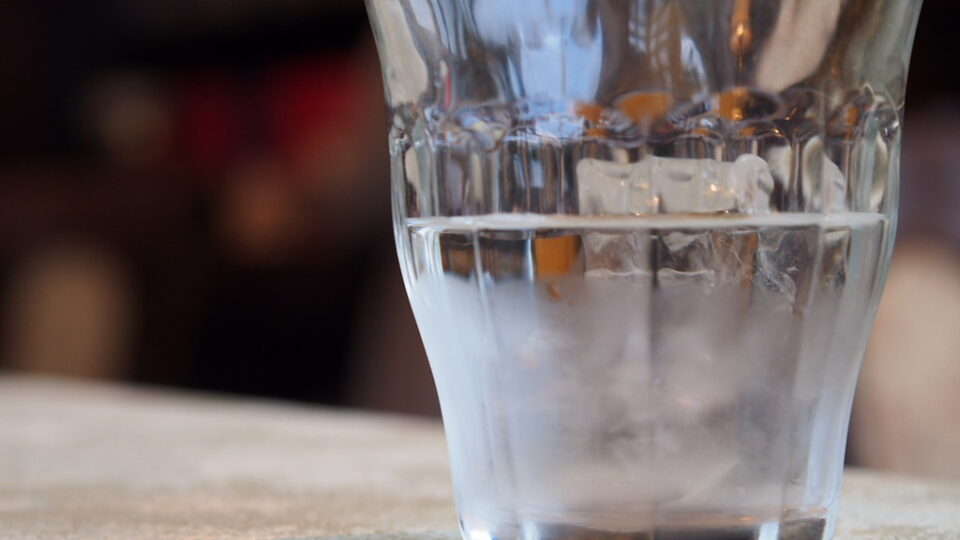
One of the key problems in harvesting water from air is that many droplets that condense from water vapor in the air are too small to be collected and when they cover a surface, they can actually impede further condensation.

University of Texas at Dallas researchers have developed a novel surface that encourages tiny water droplets to move spontaneously into larger droplets.  The droplets actually self-climb along an oil, ramp-shaped meniscus.  The meniscus acts like a bridge along which microdroplets spontaneously climb upward and coalesce with larger water droplets.  They call this the coarsening droplet phenomenon.  It is enabled by a liquid lubricant with a unique hydrophilic nature.  They actually discovered the lubricant’s special properties by accident when in a lubricant test they observed smaller water droplets propel themselves into larger droplets.

Based on experimental data, the coarsening surface enhances the water harvesting rate 200% higher than other techniques.  The team continues to work on ways to use the new lubricant to make sustainable water harvesting systems that are mobile, smaller in size, lower in weight, and less expensive.  If they are successful, they will essentially be able to harvest water anywhere that has air.

**********

Web Links

New Physical Phenomenon Aids Harvest of Water from Air

Photo, posted April 26, 2014, courtesy of Toukou Sousui via Flickr.

Earth Wise is a production of WAMC Northeast Public Radio.

Contrails And Climate Change

September 6, 2019 By EarthWise Leave a Comment

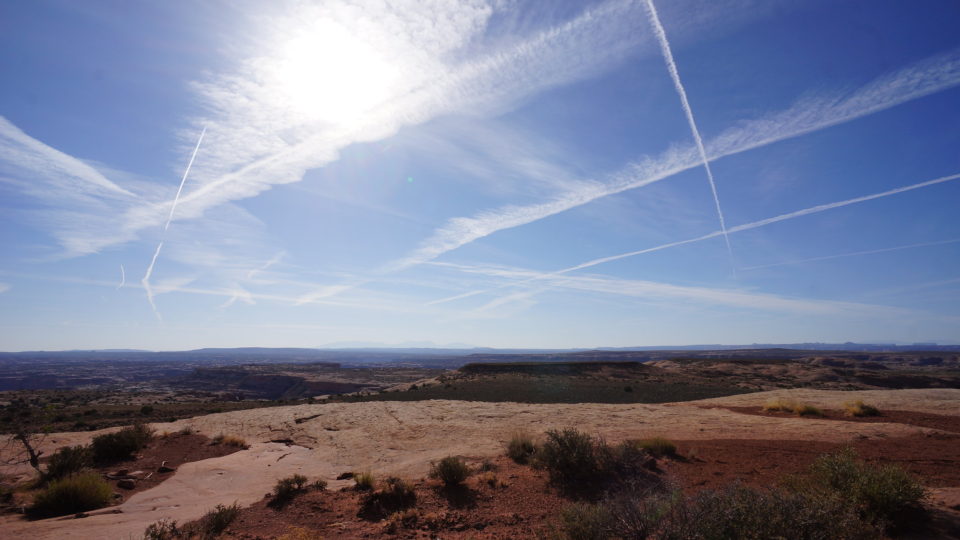
The white wispy trails of condensation produced by the exhaust from aircraft engines have been the subject of a popular conspiracy theory for quite a while.  The story goes that the long-lasting condensation trails are actually “chemtrails” composed of chemical or biological agents left in the sky by aircraft and are intentionally sprayed for a variety of nefarious purposes undisclosed to the general public.  This story, of course, is nonsense.

But while contrails are not deliberate efforts to modify weather, control population, manipulate psychology, or any of the other bizarre things attributed to them, it turns out that they are having unfortunate effects on the climate.

It turns out that contrails are creating an often-invisible thermal blanket of cloud across the planet that has a significant effect on atmospheric temperatures.  Contrails are essentially human-made clouds that form above 25,000 feet where the air is moist and colder than -40 degrees Celsius.  At times, contrails stick around in the sky, either as tight, white lines like chalk marks, or by spreading to create thin layers of ice clouds.  At any one time, contrail-created clouds cover more than half a percent of global skies.

Research has shown that when contrails are around, nighttime temperatures can go up appreciably.  After 9/11, when all U.S. flights were grounded for three days, the difference between daytime and nighttime temperatures actually increased by about 3 degrees Fahrenheit because nights were cooler.

The effects of aviation on climate, both from the CO2 emissions from aircraft engines and from these contrail effects are becoming an increasingly important issue. To complicate matters further, as aircraft engines become more efficient, they will create more, whiter, and longer-lasting contrails.

**********

Web Links

How Airplane Contrails Are Helping Make the Planet Warmer

Photo, posted May 15, 2012, courtesy of Mike Lewinski via Flickr.

Earth Wise is a production of WAMC Northeast Public Radio.

Collecting Clean Water From The Air

February 6, 2019 By EarthWise Leave a Comment

Clean water is an essential requirement for human life and there are many places where it is a scarce commodity.   In the world’s deserts, getting water to people requires feats of engineering and irrigation that can be cumbersome and expensive.

Researchers at Ohio State University have produced a couple of new studies that explore options for gathering water from fog and condensation that are based on principles of biomimicry:  copying strategies already in use by plants and animals.

The researchers looked at how cactus, beetles and desert grasses all collect water condensed from nighttime fog, gathering droplets from the air and filtering them to roots or reservoirs.

The cactus they studied collects water on its barbed tips before guiding droplets down conical spines to the base of the plant. They learned that conical shapes gather more water than do cylindrical shapes.  This is because of a physics phenomenon called the Laplace pressure gradient.

The beetles they studied collect drops of water on waxy, water-repellent bumps on their backs.  The water then slides towards the beetle’s mouth on the flat surface between the bumps.  Based on this, the researchers experimented with structures that include multiple hydrophilic cones with spaces in between where water droplets can coalesce.

From grasses, they learned that grooved surfaces move water more quickly than ungrooved surfaces – in fact, about twice as much.

The work so far has been on a laboratory-level, but the researchers envision scaling up to structures in the desert that can gather water from fog or condensation and supplement public systems or wells either on a house-by-house basis or on a community-wide basis.  Copying cacti, beetles and grasses could supply clean water to people in the desert.

**********

Web Links

Collecting clean water from air, inspired by desert life

Photo, posted February 7, 2010, courtesy of Remko van Dokkum via Flickr.

Earth Wise is a production of WAMC Northeast Public Radio.

A Prize For Water From The Air

December 7, 2018 By EarthWise Leave a Comment

https://earthwiseradio.org/wp-content/uploads/2018/12/EW-12-07-18-A-Prize-for-Water-from-Air.mp3

The XPrize competitions provide monetary incentives to crowdsource solutions to the world’s grand challenges.  Originally started in 1994 to spur the development of private spaceflight, the XPrize program now offers prizes for diverse fields including Oceans, Learning, Health, Energy, Environment, Transportation, Safety and Robotics.

[Read more…] about A Prize For Water From The Air

Primary Sidebar

Recent Episodes

  • An uninsurable future
  • Clean energy and jobs
  • Insect declines in remote regions
  • Fossil fuel producing nations ignoring climate goals
  • Trouble for clownfishes

WAMC Northeast Public Radio

WAMC/Northeast Public Radio is a regional public radio network serving parts of seven northeastern states (more...)

Copyright © 2026 ·