• Skip to primary navigation
  • Skip to main content
  • Skip to primary sidebar

Earth Wise

A look at our changing environment.

  • Home
  • About Earth Wise
  • Where to Listen
  • All Articles
  • Show Search
Hide Search
You are here: Home / Archives for cavendish

cavendish

Bananas and climate change

April 17, 2025 By EarthWise Leave a Comment

Bananas are one of the most widely produced fruits globally, with more than 100 million tons grown every year.  They are a key export crop worth approximately $11 billion annually. Bananas are also a staple food in many tropical countries, playing a vital role in both the economies of these nations and in global food security.

The Cavendish variety of banana dominates commercial exports, accounting for nearly 47% of global production. However, the Cavendish banana is highly susceptible to diseases like Panama disease, prompting ongoing efforts to develop disease-resistant alternatives. The spread of these diseases is exacerbated by climate change, which alters growing conditions and weakens banana plants. Additionally, climate change poses further threats to the banana industry by impacting crop yields and distribution patterns.

In fact, a new study led by researchers from the University of Exeter in the U.K. has found that by 2080, rising temperatures will make growing bananas for export economically unsustainable in many regions of Latin America and the Caribbean.  Colombia and Costa Rica will be among the countries most negatively impacted as they are expected to become too hot for optimal banana cultivation. 

The study, which was recently published in the journal Nature Food, found that 60% of the regions currently producing bananas around the world will struggle to grow the fruit unless there are urgent interventions to tackle climate change.  The researchers propose several adaptation strategies, including expanding irrigation systems, developing heat- and drought-resistant banana varieties, and helping banana producers manage climate-related risks.

**********

Web Links

Climate change threatens future of banana export industry

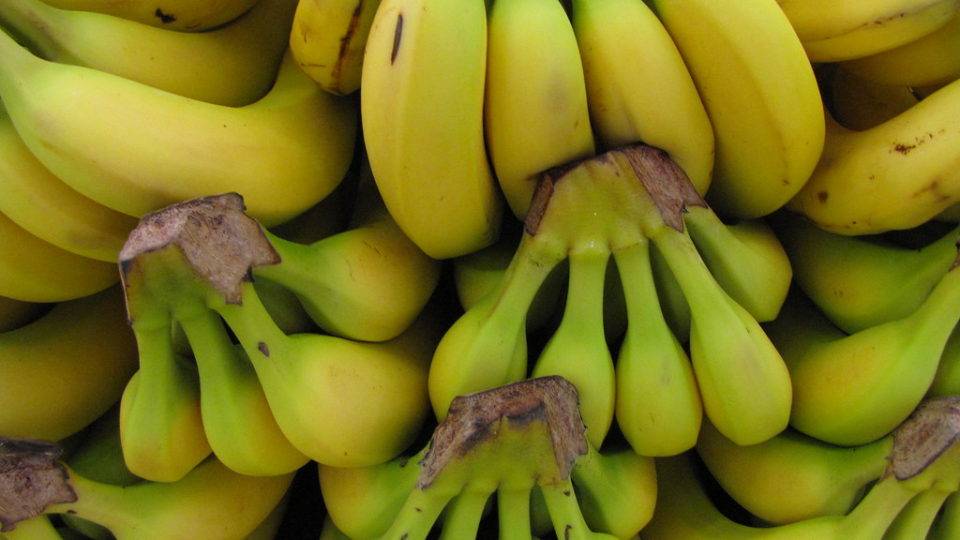
Photo, posted June 26, 2024, courtesy of JJ Musgrove via Flickr.

Earth Wise is a production of WAMC Northeast Public Radio

Fighting Disease in Cavendish Bananas | Earth Wise

January 31, 2022 By EarthWise Leave a Comment

Cavendish bananas account for about half of global banana production and the vast majority of bananas entering international trade.  The plant is unable to reproduce sexually and instead is propagated via identical clones.  So, the genetic diversity of the Cavendish banana is exceedingly low. 

In 2008, Cavendish cultivars in Sumatra and Malaysia started to be attacked by Panama disease, a wilting disease caused by a fungus.  In 2019, Panama disease was discovered on banana farms in the coastal Caribbean region, its first occurrence in the Americas.  In the 1950s, Panama disease wiped out the Gros Michel banana, the commercial predecessor of the Cavendish.

Scientists at the University of Cambridge have found a novel way to combine two species of grass-like plants – which include bananas, rice, and wheat – using embryonic tissue from their seeds.  The technique allows beneficial characteristics, such as disease resistance, to be added to the plants.

Joining the shoot of one plant to the root of another to grow as one plant is known as grafting.  It was thought to be impossible to do with grass-like plants – called monocotyledonous  grasses – because they lack a certain tissue type in their stems.  But the new research, published in the journal Nature, showed it can be done with the plants in their earliest embryonic stages.

Cavendish bananas are sterile, so disease resistance can’t be bred into future generations.  But the grafting technique may provide a way to produce Cavendish banana plants that are resistant to Panama disease.  It may be possible to save an important food crop before it is too late.

**********

Web Links

New grafting technique could combat the disease threatening Cavendish bananas

Photo, posted July 1, 2015, courtesy of Augustus Binu via Flickr.

Earth Wise is a production of WAMC Northeast Public Radio.

Bananas In Danger

October 8, 2019 By EarthWise Leave a Comment

For a few years we have been talking about the precarious position of the global banana crop, which is almost entirely based upon a single cloned cultivar known as the Cavendish banana.  The banana you buy in Rome is identical to the one in Rochester.  And therein lies the danger:  if a fungal blight can kill one banana shrub, it can kill them all.

For decades, a fungal disease known as Panama Disease Tropical Race 4 has been wreaking havoc on banana plantations in the Eastern Hemisphere.   Even though it was first identified in Taiwanese soil samples in the early 1990s, the destructive fungus remained confined to Southeast Asia and Australia until it was confirmed in both the Middle East and Africa in 2013.  Experts continued to fear its eventual appearance in Latin America, which is the epicenter of the global banana export industry.

In August, Colombian agricultural authorities announced that laboratory tests have positively identified the presence of Tropical Race 4 in the Caribbean coastal region and declared a national state of emergency.

The infection of the banana plant does not produce bananas that are unsafe for humans.  What happens is that the infected plants eventually stop bearing fruit.

Cavendish bananas are a prime example of the dangers of growing crops with limited genetic diversity – known as monoculture.  It leaves food systems dangerously vulnerable to disease epidemics.

This has happened to the global banana crop before when the predecessor to the Cavendish banana – the Gros Michel – was mostly eradicated by another fungal outbreak.  At the moment, there is no ready replacement banana to bail out the industry, but scientists are desperately trying to breed one.  In the meantime, the world’s supply of bananas is in real danger.

**********

Web Links

The banana is one step closer to disappearing

Photo, posted July 9, 2009, courtesy of Dabin Lambert via Flickr.

Earth Wise is a production of WAMC Northeast Public Radio.

Saving Chocolate

October 26, 2017 By EarthWise Leave a Comment

https://earthwiseradio.org/wp-content/uploads/2017/10/EW-10-26-17-Saving-Chocolate.mp3

On previous occasions, we have talked about the problems faced by the global banana industry, which is based almost entirely on a single cultivar, the Cavendish banana, which makes the industry extremely vulnerable to a single disease or blight that may arise.

[Read more…] about Saving Chocolate

Saving the Banana

November 14, 2016 By WAMC WEB

https://earthwiseradio.org/wp-content/uploads/2016/11/EW-11-14-16-Saving-the-Banana.mp3

Bananas are the world’s most popular fruit crop, with 130 countries producing over 100 million tons annually. Forty-seven percent of all the bananas grown in the world and ninety-nine percent of all the bananas sold commercially are of one subspecies known as the Cavendish.

[Read more…] about Saving the Banana

Primary Sidebar

Recent Episodes

  • An uninsurable future
  • Clean energy and jobs
  • Insect declines in remote regions
  • Fossil fuel producing nations ignoring climate goals
  • Trouble for clownfishes

WAMC Northeast Public Radio

WAMC/Northeast Public Radio is a regional public radio network serving parts of seven northeastern states (more...)

Copyright © 2026 ·