
• Skip to primary navigation
  • Skip to main content
  • Skip to primary sidebar

Earth Wise

A look at our changing environment.

  • Home
  • About Earth Wise
  • Where to Listen
  • All Articles
  • Show Search
Hide Search
You are here: Home / Archives for biodiesel

biodiesel

Biofuel refineries and toxic pollution

July 5, 2024 By EarthWise Leave a Comment

Toxic pollution from biofuel refineries.

There have been decades of government support for renewable, crop-based fuels – primarily corn ethanol.  In fact, it is a required component of gasoline sold in this country.  The biofuels industry has long claimed ethanol to be a clean, greener alternative to petroleum. 

There have been arguments all along that the environmental benefits of corn ethanol are dubious at best because of the energy required to produce the stuff.  There are also issues related to burning a food crop instead of feeding it to people and that the conversion of grasslands and forests to produce it releases massive amounts of carbon.

Recently, another serious concern has emerged.  A new review of industry data has found that the country’s biofuel refineries, mostly located in the Midwest, produce large amounts of toxic air pollutants, in some cases ever more than from their petroleum counterparts.

Emissions data from the country’s 275 ethanol, biodiesel, and renewable diesel plants revealed that they release carcinogenic formaldehyde as well as other potentially dangerous substances including acetaldehyde, hexane, and acrolein.  In 2022, biofuel refineries released 12.9 million pounds of hazardous air pollutants, compared to 14.9 million pounds emitted by oil refineries, and the biofuel plants actually emitted more of the four chemicals just mentioned than petroleum refineries did.

The broad use of crop ethanol is the result of intensive industry lobbying.  Ethanol plants are even exempt from some air pollution permitting requirements.  Perhaps the time has come to revisit its pervasive and mandated use.

**********

Web Links

Biofuel Refineries Are Releasing Toxic Air Pollutants in Farm Communities Across the US

Photo, posted February 27, 2021, courtesy of Sue Thompson via Flickr.

Earth Wise is a production of WAMC Northeast Public Radio

Fuel From Coffee Grounds | Earth Wise

December 8, 2022 By EarthWise Leave a Comment

Creating fuel from coffee waste

The world drinks a lot of coffee.  Americans alone consume 400 million cups a day.  Each cup of coffee results in about half an ounce of coffee grounds.  Adding that up, this country produces over 6,000 tons of coffee grounds each day.  While coffee grounds are not particularly harmful, that is an awful lot of waste that mostly ends up in landfills or is incinerated.

Researchers at Aston University in the UK have developed a method of producing high-quality biodiesel fuel from coffee grounds.  Their study was published in the journal Renewable and Sustainable Energy Reviews.

The technique consists of growing a particular species of microalgae (Chlorella vulgaris) directly on spent coffee grounds.  The coffee grounds provide both the nutrients for the microalgae and a structure upon which it can grow.   Exposing the algae to light for 20 hours a day and dark for just four hours a day produced the best quality biodiesel.

Microalgae is well-known as a feedstock for biodiesel production.  Previously, it has been grown on materials like polyurethane foam or nylon which don’t provide any nutrients.   Using the coffee grounds as the substrate for growth means that no external nutrients are needed.

The resultant enhanced biodiesel produces minimal emissions and good engine performance and meets both US and European specifications.  This feedstock for producing biodiesel is ideal since it doesn’t require any competition with food crops and instead makes use of a widely available waste product.  The hope is that it may reduce the cutting down of palm trees to extract oil for biofuel.  In southeast Asia, this has been a major source of deforestation and increased greenhouse gas emissions.

**********

Web Links

Aston University researchers ‘feed’ leftover coffee grounds to microalgae to produce low emission biodiesel

Photo, posted October 13, 2007, courtesy of David Joyce via Flickr.

Earth Wise is a production of WAMC Northeast Public Radio
Synthetic Palm Oil | Earth Wise

February 18, 2022 By EarthWise Leave a Comment

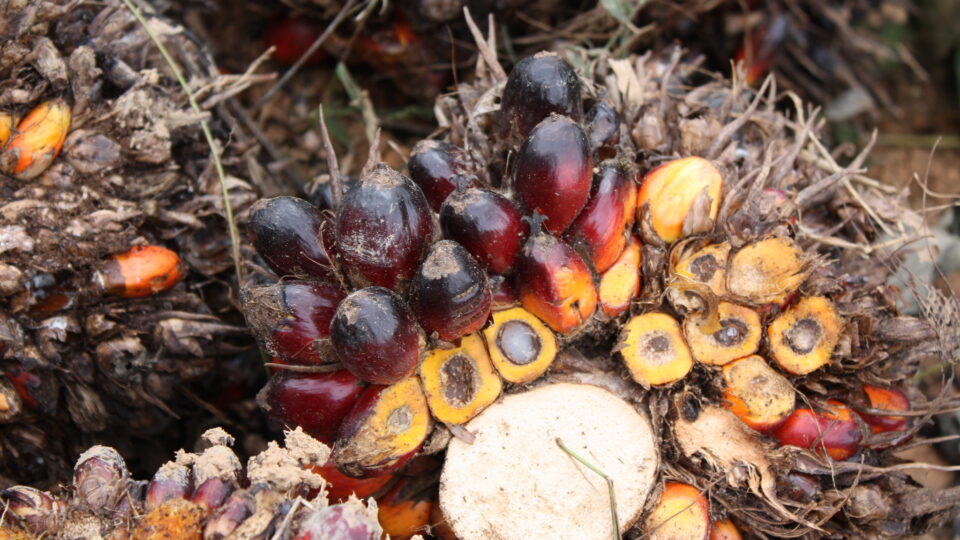
Palm oil is the world’s cheapest and most widely used vegetable oil.  Producing it is a primary driver of deforestation and biodiversity loss in the tropics.  In Borneo, for example, oil palm cultivation has accounted for more than half of all deforestation over the past two decades.   More than one million square miles of biodiversity hotspots could be threatened by oil palm cultivation, which could potentially affect more than 40% of all threatened bird, mammal, and amphibian species.

Today, the world consumes over 70 million tons of palm oil each year, used in products ranging from toothpaste and oat milk to biodiesel and laundry detergent.

Given this situation, there are now multiple companies developing microbial oils that might offer an alternative to palm oil while avoiding its most destructive impacts.

A company called C16 Biosciences is working on the problem in Manhattan, backed by $20 million from a Bill Gates’ climate solutions investment fund.  A California-based startup called Kiverdi is working to manufacture yeast oil using carbon captured from the atmosphere. 

Xylome, a Wisconsin-based startup is working to produce a palm oil alternative that they call “Yoil”, produced by a proprietary strain of yeast.  The oil from the yeast strain is remarkably similar to palm oil. 

The challenge is to be able to produce microbial oils at large scale and at a competitive price.  Unless valuable co-products could be manufactured along with the oil, it may be difficult to compete with palm oil.  Without regulatory pressures and willingness of consumers to pay more, it may be difficult to replace palm oil in many of its applications.

**********

Web Links

Can Synthetic Palm Oil Help Save the World’s Tropical Forests?

Photo, posted December 9, 2008, courtesy of Fitri Agung via Flickr.

Earth Wise is a production of WAMC Northeast Public Radio.

Islands Ditching Diesel

March 31, 2017 By EarthWise

https://earthwiseradio.org/wp-content/uploads/2017/03/EW-03-31-17-Islands-Ditching-Diesel.mp3

Islands around the world have a difficult time developing the infrastructure for electricity generation.  Many are simply too small or too poor for conventional power plants.  The most common electricity source on islands is diesel generators which are not environmentally friendly and result in some of the most expensive electricity in the world.

[Read more…] about Islands Ditching Diesel

Primary Sidebar

Recent Episodes

  • An uninsurable future
  • Clean energy and jobs
  • Insect declines in remote regions
  • Fossil fuel producing nations ignoring climate goals
  • Trouble for clownfishes

WAMC Northeast Public Radio

WAMC/Northeast Public Radio is a regional public radio network serving parts of seven northeastern states (more...)

Copyright © 2026 ·