• Skip to primary navigation
  • Skip to main content
  • Skip to primary sidebar

Earth Wise

A look at our changing environment.

  • Home
  • About Earth Wise
  • Where to Listen
  • All Articles
  • Show Search
Hide Search
You are here: Home / Archives for attractive

attractive

Bees and urban wildflowers

May 23, 2025 By EarthWise Leave a Comment

Urban wildflowers may threaten bees in some cases

Post-industrial cities often have large numbers of vacant lots, left behind as people have moved out of the area.  Local residents are often tempted to plant wildflowers to make these deserted spaces more attractive. 

Wildflowers are an important food source for bees.  Pollinators like bees play a vital role in food production and attracting them with food sources is a good idea.  However, a study by researchers at the University of Cambridge in the UK found that there are dangers associated with planting wildflowers in some urban settings.

Wildflowers growing on land previously used for buildings and factories can accumulate lead, arsenic, and other metal contaminants from the soil.  These metals have previously been shown to damage the health of pollinators that ingest the metals in the nectar as they feed.

The Cambridge study was carried out in Cleveland, Ohio, which has nearly 34,000 vacant lots.  Cleveland was previously the site of iron and steel production, oil refining, and car manufacturing.  The researchers tested the nectar from flowering plants growing on disused land throughout the city.  Lead was the contaminant found in the highest concentrations.  They also found that different species of plants accumulate different amounts and different types of metals.

The goal of the study was not to discourage the planting of wildflowers in towns and cities.  It is to highlight the importance of growing the right species of wildflowers as well as to encourage testing soils for metals before planting wildflowers and to clean up pollution.  Wildflowers are important for pollinators, but it is also important that they don’t contribute to the decline of pollinator populations that has already been happening for a number of reasons.

**********

Web Links

Growing wildflowers on disused urban land can damage bee health

Photo, posted August 26, 2012, courtesy of RJP via Flickr.

Earth Wise is a production of WAMC Northeast Public Radio

The cost of electric vehicle batteries

April 4, 2025 By EarthWise Leave a Comment

The battery pack in an electric car is the most expensive part of the car. Currently, it accounts for as much as 30% of the price.  But EV batteries last a long time.  Most are guaranteed for 8-10 years and are likely to last as long as 20 years.  In practice, only 1.5% of electric cars need battery replacements for one reason or another.

The economics of EV batteries has changed dramatically over time and will continue to do so.  EV battery capacity is measured in kWh, the units you are charged for your home electricity.  An EV with a 300-mile driving range will have a battery pack that holds something like 75 kWh.

In 2008, when electric cars were just starting to enter the market again after earlier false starts, lithium-ion battery packs cost $1,355 per kWh.  When the Tesla Model S was introduced in 2012, packs were about $800. By 2019, packs broke the $200 per kWh barrier. Last year, lithium-ion battery packs reached $115 per kWh.

A combination of technology improvements and strong market competition with growing supplies is driving prices ever lower.  Industry analysts expect battery prices to drop well below $100 this year and reach about $80 next year.

The result of all of this cost reduction is that EVs will be cheaper than equivalent internal combustion vehicles, which in fact is already the case in China. Apart from cost, batteries for cars continue to improve so that the driving range of EVs will continue to increase making the cars more attractive and very practical for nearly all drivers.

**********

Web Links

How Much Do Electric Car Batteries Cost to Replace?

Photo, posted January 22, 2019, courtesy of Steve Rainwater via Flickr.

Earth Wise is a production of WAMC Northeast Public Radio

Companies Promise Climate Action | Earth Wise

March 30, 2020 By EarthWise Leave a Comment

Companies scramble to achieve climate promises

A growing number of major corporations are making promises on climate and the promises are getting more ambitious and for faster action.  More companies are disclosing their carbon emissions and more of those companies have emissions reduction targets. 

There has also been an acceleration in the rate at which companies set so-called science-based targets, which are specific, measurable carbon reduction goals that align the company with the Paris Agreement.  Among the hundreds of companies with such targets are Coca-Cola, Nike, Best Buy, Walmart, and Hilton Hotels.  According to one analysis, the number of Fortune 500 companies with concrete, ambitious carbon targets quadrupled in the past four year to 23%.

Environmental advocates have been pressuring companies for decades, but companies seem to be far more proactive now despite the fact that the U.S. government has largely dropped the ball on climate issues.

The reasons include the fact that the effects of climate change are becoming clearer to companies.  Wildfires, rising sea levels, droughts and other aspects of the crisis both make headlines and affect business operations.

Meanwhile, solar and wind energy have gotten significantly cheaper, making it more attractive for companies to shift away from fossil fuels.

At the same time, investors are increasingly asking companies to act on climate issues.  Consumers, employees, and the general public are increasingly demanding action and even children are adding to the pressure to act.

Making these commitments is one thing; following through on them and sticking to them is another.  There are real concerns that there is a great deal of green-washing going on among companies trying to project a favorable image.  In any case, if companies really want to lead on climate, they need to put their money where their mouths are.

**********

Web Links

Better Late Than Never? Big Companies Scramble To Make Lofty Climate Promises

Photo, posted June 22, 2016, courtesy of Mike Mozart via Flickr.

Earth Wise is a production of WAMC Northeast Public Radio.

Packing With Banana Leaves

July 25, 2019 By EarthWise Leave a Comment

More and more places are instituting bans on single-use plastic bags.  Places like California and Hawaii already have bans in place and New Jersey is considering such a ban.  New York’s law will go into effect next March.  Supermarkets will no longer provide plastic bags at the checkout line.  But the laws have some exceptions, including the plastic bags used to hold produce and to pack up meats.

Banning or reducing single-use plastic bags is a growing trend in Asia as well including places like South Korea, Vietnam and Thailand.

One supermarket in Thailand came up with a novel approach to eco-friendly packaging:  wrapping produce in banana leaves.  The idea quickly became a viral hit on social media and drew the attention of supermarkets in Vietnam.  Several big supermarket chains in that country also began experimenting with banana leaves as a packaging alternative.

Representatives of Vietnam’s Lotte Mart chain said that the banana leaf packaging was still in the testing phase, but they plan to replace plastic with leaves nationwide very soon.  Aside from wrapping vegetables and fruits, the grocery chain intends to also use the leaves for fresh meat products.

Customers seem to be quite positive about the new packaging noting that it is actually quite attractive visually.  The banana leaf packaging also makes people more aware of the need for protecting the environment.

While Vietnam is a relatively small country, it turns out that it ranks number four in the world for the largest amount of plastic waste dumped into the ocean.  The country disposes of about 2,500 tons of plastic waste per day. So, efforts like the banana leaf packaging are not just symbolically important, they are genuinely a major environmental imperative.

**********

Web Links

Supermarkets in Asia are Now Using Banana Leaves Instead of Plastic Packaging

Photo courtesy of Perfect Homes Chiangmai via Facebook.

Earth Wise is a production of WAMC Northeast Public Radio.

Powering Cars With Cactus Juice

June 24, 2019 By EarthWise Leave a Comment

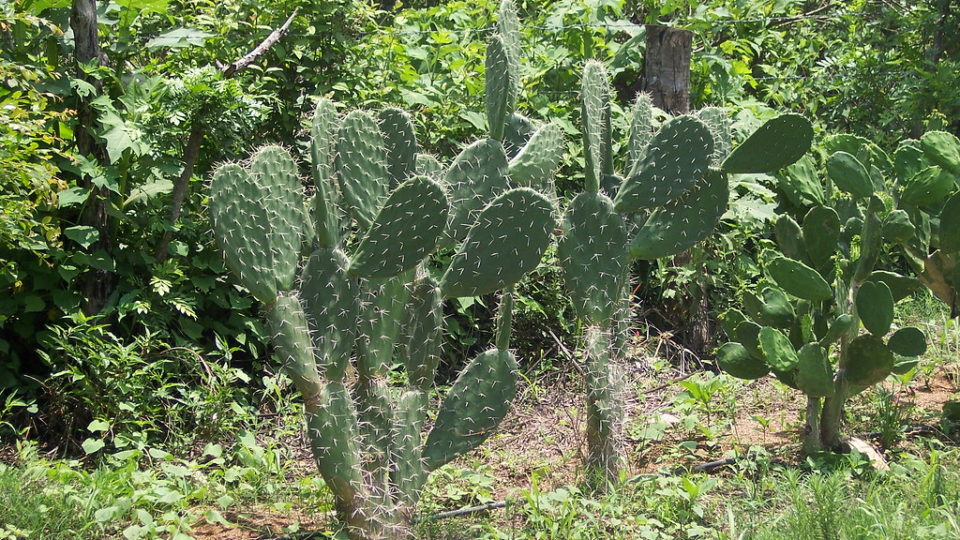
Back in 2016, a company called Nopalimex, located in Micoacan, central Mexico, built the world’s first cactus-powered energy plant.  The facility utilizes a biodigester to make biogas from nopal, also known as prickly pear cactus.  The nopal plant has been called the ‘Green Gold of Mexico’ and is a staple in Mexican diets, medicine and cosmetics.

Nopalimex is now using the cactus to make biofuel for vehicles.

The fruit of the cactus is pureed, mixed with manure, and then left to decompose, producing methane.  The methane produced – about eight tons a day – fuels the biodigester which powers the company’s corn chip and cactus chip production and is being tested in a fleet of government vehicles.

The biogas will cost just 65 cents per liter, which is about a third cheaper than the cost of regular gasoline.  Using prickly pear as a feedstock for biofuel is attractive because it can be grown in places where traditional energy crops cannot.  One can imagine vast fields of cacti in remote, arid areas of the country where normal crops cannot grow.  It would not suck up the resources or space needed to feed people, which is an ongoing criticism of current bioenergy crops.

As long as the nopals are regularly replanted, the process is almost entirely sustainable, producing only water and nopal waste, which can be used to fertilize other crops.

Finding sustainable ways to produce fuel while doing minimal damage to the environment is an important challenge for countries around the world.  In Mexico, harnessing the power of the prickly pear cactus is a unique and clever solution.

**********

Web Links

Mexico’s ‘green gold’: The company powering cars with cactus juice

Photo, posted July 8, 2006, courtesy of Christian Frausto Bernal via Flickr.

Earth Wise is a production of WAMC Northeast Public Radio.

New Ocean Energy Technologies

December 26, 2018 By EarthWise Leave a Comment

https://earthwiseradio.org/wp-content/uploads/2018/12/EW-12-26-18-New-Ocean-Energy-Technologies.mp3

The ocean energy sector is still at an early stage of development.  Despite the fact that the ocean is permanently in motion, extracting energy from that motion on a major scale continues to be a challenge.  But the potential benefits of ocean technologies are compelling enough that many approaches continue to be pursued.

[Read more…] about New Ocean Energy Technologies

Natural Mosquito Repellents

June 20, 2017 By EarthWise

https://earthwiseradio.org/wp-content/uploads/2017/06/EW-06-20-17-Natural-Mosquito-Repellents.mp3

With summer comes mosquitoes and our desire to keep them away from us.  The most common repellents are based on the chemical DEET, which unfortunately has been found to have several health and safety problems.   Up to 15% of DEET is absorbed through the skin directly into the bloodstream.  Diethyl-meta-toluamide, the chemical name for DEET, has been shown to have a variety of toxic effects.  Fortunately, it turns out that there are some natural alternatives which may be as effective as DEET, or possibly even more effective than DEET in keeping mosquitoes away from us.

[Read more…] about Natural Mosquito Repellents

Primary Sidebar

Recent Episodes

  • An uninsurable future
  • Clean energy and jobs
  • Insect declines in remote regions
  • Fossil fuel producing nations ignoring climate goals
  • Trouble for clownfishes

WAMC Northeast Public Radio

WAMC/Northeast Public Radio is a regional public radio network serving parts of seven northeastern states (more...)

Copyright © 2025 ·