• Skip to primary navigation
  • Skip to main content
  • Skip to primary sidebar

Earth Wise

A look at our changing environment.

  • Home
  • About Earth Wise
  • Where to Listen
  • All Articles
  • Show Search
Hide Search
You are here: Home / Archives for thermal

thermal

Thermal batteries for heavy industry

January 3, 2025 By EarthWise Leave a Comment

Researchers are developing thermal batteries for heavy industry

Heavy industries like cement, steel, chemicals, and paper require large amounts of heat and, for the most part, that heat comes from burning fossil fuels.  Other sectors of the economy have been making progress in reducing carbon emissions, but heavy industry has not found easy answers for supplying the heat it needs for manufacturing.

Researchers at MIT have developed a way to supply heat that only uses electricity, which in principle can come from carbon-free sources.  The idea is to use thermal batteries.  These are basically an electrically conductive equivalent of ceramic firebricks, which have been used to store heat for centuries in fireplaces and ovens.

A spinout company called Electrified Thermal Solutions has demonstrated that its firebricks can store heat efficiently for hours and release it by heating air or gas up to 3,272 degrees Fahrenheit. 

The firebrick arrays are contained in insulated, off-the-shelf metal boxes.  The standard system can collect and release about 5 megawatts of energy and store about 25 megawatt-hours.  The thermal battery can run hotter and last longer than any other electric heating solution on the market.

Using this technology can be a way to take advantage of the low cost of electricity in off-peak hours.  In the so-called wind belt in the middle of the U.S., electricity prices can even be negative at times.  Using the firebrick technology – called the Joule Hive Thermal Battery – it can be possible to provide industrial heating capability at very competitive prices, and that doesn’t even factor in the positive climate impact.

**********

Web Links

Decarbonizing heavy industry with thermal batteries

Photo, posted April 19, 2019, courtesy of Hans M. via Flickr.

Earth Wise is a production of WAMC Northeast Public Radio

Geological thermal energy storage

August 7, 2024 By EarthWise Leave a Comment

The electricity grid is increasingly using solar and wind power.  Depending on those two sources requires the ability to store energy to have on hand when the sun isn’t shining and the wind isn’t blowing.   Energy needs to be stored away to be used hours, days, or even weeks after it is produced.

Energy storage is booming.  California has increased its energy storage capacity tenfold in recent times.  One day in April, storage batteries were the largest source of electricity in the state for a period of two hours.  But batteries are not the only way to store energy.  There are chemical, electrochemical, mechanical, and thermal methods that each has potential advantages and unique features.

A project in Kern County, California, is making use of an abandoned oil field to create a long-term energy storage installation.  The plan is to retrofit depleted oil wells to store concentrated solar energy in superheated groundwater for long periods of time.  The stored heat can then be used to drive turbines when electricity is needed.

Some 1,200 feet below the surface of the oil field are pockets of permeable sandstone that have been emptied of the oil they previously contained.   An array of parabolic mirrors will gather solar energy that will heat silicon oil in an underground loop to 700 degrees Fahrenheit.  The oil pipeline will heat up groundwater down below.  When electricity is needed, the heated groundwater will be brought to the surface to operate turbines.

There is no new technology involved.  The individual aspects have never all been combined before, but the likelihood of success is high.  There are lots of depleted oil fields that could be used this way in the future.

**********

Web Links

Can a California Oilfield Be Retrofitted to Store Solar Energy?

Photo, posted July 18, 2017, courtesy of John Ciccarelli / BLM via Flickr.

Earth Wise is a production of WAMC Northeast Public Radio
Around-the-clock clean energy

June 14, 2024 By EarthWise Leave a Comment

Using solar and wind power can go a long way toward replacing fossil fuel-generated electricity, particularly with the addition of battery energy storage.  But because of the intermittent nature of both sun and wind, other sources are still needed.  There is also the need for ways to produce high temperature for industrial processes.  Complete decarbonization will require a host of complementary technologies.

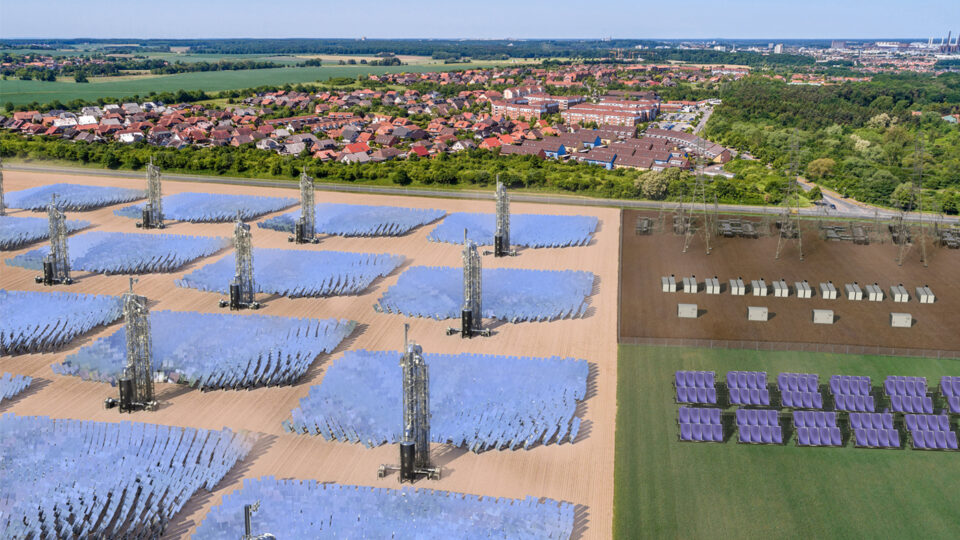
A spinout company from MIT called 247Solar is building high-temperature concentrated solar power systems that make use of overnight thermal energy storage to provide electric power around the clock as well as industrial-grade heat.

The system uses a field of sun-tracking mirrors to reflect sunlight to the top of a central tower.  A proprietary solar receiver heats air to over 1,800 degrees Fahrenheit.  The heated air drives turbines that generate 400 kilowatts of electricity and produces 600 kilowatts of heat.  Some of the hot air is routed through a long-duration thermal energy storage system and the stored heat is then used to drive the turbines when the sun isn’t shining.  The unique part of the technology is not the concentrated solar power; it is the solar receiver.

The modular systems can be used as standalone microgrids for communities, or to provide power in remote places.  They can also be used in conjunction with conventional wind and solar farms to enable around-the-clock renewable power.

The first deployment will be with a large utility in India.  If it is successful, 247Solar hopes to scale up rapidly with other utilities, companies, and communities around the globe.

**********

Web Links

Offering clean energy around the clock

Photo credit: 247Solar.

Earth Wise is a production of WAMC Northeast Public Radio

Biodegradable microplastics

April 10, 2024 By EarthWise Leave a Comment

Researchers are developing biodegradable microplastics

Ordinary plastics are not biodegradable, but they are also not indestructible.  Plastics in the environment can break down into tiny fragments – microplastics – and those, unfortunately, are nearly indestructible.  Microplastics have been documented in the oceans and in soil virtually everywhere on Earth including remote frozen wastelands and on top of high mountains.  More recently, they have been found in our own arteries, lungs, and even in placentas.  Microplastic pollution is a very serious problem.

There is considerable ongoing effort to develop biodegradable plastics from non-petroleum sources.  There has been progress but it has not necessarily been aimed at creating bioplastics that do not create microplastic when they break down.

Researchers at the University of California San Diego have developed algae-based polymers that they have shown to degrade when composted.  Recently, in work published in the journal Nature Scientific Reports, they have shown that even fine microparticles of their bioplastic are digested by microbes when placed in a compost.  What remains are the starting plant materials from which the plastic was made.  Products made from this sort of plastic would not only be sustainable beyond their useful lifetime but would also not represent a potential danger to human life.

Creating this eco-friendly alternative to petroleum-based plastic is only the first step toward creating a viable replacement for existing plastics.  It is necessary to be able to use the new material on existing manufacturing equipment and for it to have the same mechanical and thermal properties as the materials it is replacing.  But the researchers are optimistic that this could be a potential solution to an increasingly serious problem.

**********

Web Links

Say Hello to Biodegradable Microplastics

Photo, posted January 17, 2018, courtesy of Bo Eide via Flickr.

Earth Wise is a production of WAMC Northeast Public Radio

A Smart Window | Earth Wise

March 31, 2022 By EarthWise Leave a Comment

New smart window technology to reduce energy consumption

Researchers at Oxford University have developed a new adaptable smart window technology that has the potential of reducing the energy usage of the average home by a third.

The technology uses a spectrally tunable low-emissivity coating that can control the amount of heat that comes into a room without affecting the quality of the light that enters.

The thermal energy from the sun’s infrared rays is absorbed by the glass and then is re-emitted as heat.  That heat can either be used to warm the room using transparent electrical heaters embedded in the glass or can be reflected away to cool the room.  The windows can change according to seasonal needs.

The researchers built a prototype using a material called an active chalcogenide-based phase change material.  When it is cold, the infrared rays from the sunlight are harvested and used to heat the building.  When it is warm, the new glass can switch state to reflect the heat and reduce the need for air conditioning.  The active phase change material is adjustable so that the amount of heat absorbed or reflected can be tuned for precise temperature control.  There is essentially no effect on visible light passing through the window.  Current low-emissivity glass for windows can reduce heat transfer, but its properties cannot be altered according to seasonal needs.

The researchers estimate that using windows fitted with the new prototype glass – including the energy required to control the film – would save 20 to 34% in energy usage annually compared to double-glazed windows found in many modern homes.

A spinout company from Oxford called Bodle Technologies is collaborating with two existing industrial partners to develop the technology further.

**********

Web Links

New adaptable smart window coating could help heat or cool a home and save energy

Photo, posted April 26, 2008, courtesy of Lima Andruska via Flickr.

Earth Wise is a production of WAMC Northeast Public Radio.

Cutting The Cost Of Energy Storage | Earth Wise

September 9, 2021 By EarthWise Leave a Comment

Energy storage is the solution to the problem of intermittency with renewables

The cost of both solar and wind power continues to drop making the two renewable energy sources the cheapest way to make electricity in more and more places.  Given the virtually inexhaustible supply of both wind and sun power, these clean electricity sources can in principle meet all our energy needs.  The hang up is that both of them are intermittent sources – the wind doesn’t blow all the time and the sun doesn’t shine all the time.

The solution to the intermittency problem is energy storage.  If energy produced by wind and sun can be stored so it can be made available for use at any time, then the goal of having 100% clean energy can be realized.

Energy storage technology has continued to improve over time and to get cheaper.  The Department of Energy recently announced a new initiative aimed at accelerating both of these trends.

The new program – called Long Duration Storage Shot –  has the goal of reducing the cost of grid-scale, long-duration energy storage by 90% within this decade.

Long-duration energy storage is defined as systems that can store energy for more than ten hours at a time.  Such systems can support a low-cost, reliable, carbon-free electric grid that can supply power even when energy generation is unavailable or lower than demand.  With long-duration storage, solar-generated power can be used at night.

The program will consider multiple types of storage technologies – electrochemical (that is: batteries), mechanical, thermal, chemical carriers, and various combinations thereof.  Any technology that has the potential to meet the necessary duration and cost targets for long-term grid storage are fair game for the program.

**********

Web Links

DOE announces goal to cut costs of long-duration energy storage by 90%

Photo, posted October 16, 2017, courtesy of UC Davis College of Engineering via Flickr.

Earth Wise is a production of WAMC Northeast Public Radio.

A Supermaterial From Plastic Waste

December 13, 2018 By EarthWise Leave a Comment

https://earthwiseradio.org/wp-content/uploads/2018/12/EW-12-13-18-A-Supermaterial-From-Plastic-Waste.mp3

Researchers at the National University of Singapore have created a way to convert plastic bottle waste into an ultralight aerogel material that has multiple potential applications.

[Read more…] about A Supermaterial From Plastic Waste

Mass Production Of Biodegradable Plastic  

October 17, 2017 By EarthWise 1 Comment

https://earthwiseradio.org/wp-content/uploads/2017/10/EW-10-17-17-Mass-Production-of-Biodegradable-Plastic.mp3

Plastic pollution is a major problem for the world’s oceans and non-biodegradable plastics continue to fill the planet’s landfills and litter the landscape.   There are many approaches to making plant-derived, biodegradable plastics but most of these materials do not offer the resistance to heat and moisture that is characteristic of petroleum-based plastics.

[Read more…] about Mass Production Of Biodegradable Plastic  

Primary Sidebar

Recent Episodes

  • An uninsurable future
  • Clean energy and jobs
  • Insect declines in remote regions
  • Fossil fuel producing nations ignoring climate goals
  • Trouble for clownfishes

WAMC Northeast Public Radio

WAMC/Northeast Public Radio is a regional public radio network serving parts of seven northeastern states (more...)

Copyright © 2026 ·