• Skip to primary navigation
  • Skip to main content
  • Skip to primary sidebar

Earth Wise

A look at our changing environment.

  • Home
  • About Earth Wise
  • Where to Listen
  • All Articles
  • Show Search
Hide Search
You are here: Home / Archives for pigment

pigment

Why Do Trees Change Color? | Earth Wise

December 24, 2020 By EarthWise Leave a Comment

Explaining the magnificent spectacle of fall foliage

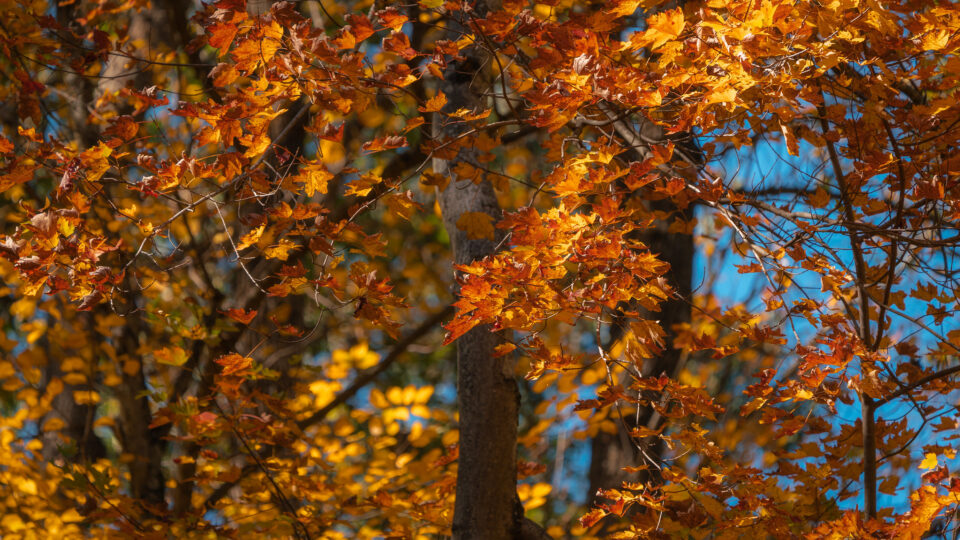
We had a particularly colorful fall in the Northeast this year.  Almost everywhere you looked, there were brilliant displays of yellow, orange, and red.  The colors of fall are a result of chemistry and environmental events that may have taken place many months in the past.

The color of leaves comes from 4 pigments whose effects are governed by photosynthesis.  The one that is actually used in photosynthesis is chlorophyll and it causes leaves to be green.  But when a tree begins to prepare for dormancy, it stops producing chlorophyll, the green pigmentation fades, and the other pigments that were already in the leaves become visible.

There are xanthoplylls, which are the yellow pigments that are seen the most in fall trees.  They are the same pigments that color egg yolks and sometimes parts of the human eye.  They are only produced by plants and appear in humans and animals only through consumption.

There are carotenes, which are the orange pigments found in fruits and vegetables, such as carrots, oranges, some bell peppers and squashes.

And there is anthocyanin, which is the pigment found in blueberries, blackberries, and red or violet roses.  Its color depends on the pH level of the plant; higher pH leads to darker color.  This is the pigment seen in red maples, black cherry trees, Shumard oaks, and more.  Only 10% of trees in temperate climates produce anthocyanin and its red pigmentation and most of those trees are in New England.

All these pigments serve purposes.  They help trees absorb light energy, prevent sun damage, and even regulate how much energy chlorophyll produces.

There are complicated chemical and environmental factors at play in fall foliage but when they come together like they did this year, it’s a magnificent spectacle.

**********

Web Links

Why Do Trees Change Color?

Photo, posted October 17, 2020, courtesy of John Brighenti via Flickr.

Earth Wise is a production of WAMC Northeast Public Radio.

Safer Ways To Be Blue | Earth Wise

May 5, 2020 By EarthWise Leave a Comment

A safer way to create blue

Creating blue fabric has always been desirable for people.  It has never been easy, but the original way to do it – by using indigo from plants – has been around for 6,000 years.  Natural indigo is a rare commodity, often referred to as blue gold.  In the 19th century, synthetic indigo was developed and ultimately replaced the natural substance.

Synthetic indigo dye is not an environmentally friendly substance.  In order to get it to adhere to fabrics, substances called mordants are required.  These are commonly made from metals like chromium and aluminum, are generally toxic, and kill off plants exposed to factory wastewater, destroy ecosystems, and poison drinking water.   The dye itself is slow to decompose and is bad for the environment. 

Recently, an organic chemist in Brazil named Erick Bastos has figured out a new way to produce blue dye using, of all things, a pigment from beets.  By extracting the pigment and tweaking its molecular pattern, he has managed to transform the red color of the pigment to a brilliant blue.

Beet roots contain pigments called betalains and just a tiny amount of beetroot juice can render a lot of dye.  By mixing these pigments with a couple of ingredients, a chemical reaction occurred, and the color transformed from red, to yellow, then green, and finally blue.

Testing so far on human liver cells, retinal cells, and developing zebrafish has revealed no toxicity.  The results suggest that the new dye – dubbed BeetBlue – is safe.  Further testing is needed to know if it is truly safe and whether it will last in the wash.  Meanwhile, Professor Bastos is not patenting the dye and hopes it will provide a better way to be blue.

**********

Web Links

How Do You Make a Less Toxic Blue Dye? Start With Red Beets

Photo, posted November 7, 2005, courtesy of Lain Buchanan via Flickr.

Earth Wise is a production of WAMC Northeast Public Radio.

Primary Sidebar

Recent Episodes

  • An uninsurable future
  • Clean energy and jobs
  • Insect declines in remote regions
  • Fossil fuel producing nations ignoring climate goals
  • Trouble for clownfishes

WAMC Northeast Public Radio

WAMC/Northeast Public Radio is a regional public radio network serving parts of seven northeastern states (more...)

Copyright © 2026 ·