• Skip to primary navigation
  • Skip to main content
  • Skip to primary sidebar

Earth Wise

A look at our changing environment.

  • Home
  • About Earth Wise
  • Where to Listen
  • All Articles
  • Show Search
Hide Search
You are here: Home / Archives for penguin

penguin

Microplastics in Antarctica

March 3, 2025 By EarthWise Leave a Comment

Microplastics are small plastic pieces less than five millimeters long and typically far smaller than that.  They come from a variety of sources, often from larger plastic debris that degrades into smaller and smaller pieces.  There are also microbeads, which are tiny pieces of manufactured polyethylene plastic that are added to various health and beauty products.  Tiny bits of plastic easily pass through filtration systems and end up in the ocean and other bodies of water.

Microplastics are a pervasive problem for which nowhere on Earth is truly untouched.  Despite stringent regulations on materials entering Antarctica, scientists have discovered microplastics in the snow near some of the deep field camps there.

A study by the British Antarctic Survey made use of a new and advanced technique that can detect microplastics as small as 11 microns – about the size of a red blood cell.

The research team found microplastics at concentrations ranging from 73 to 3,099 particles per liter of snow. 

Snow samples from three different sites identified polyamide (used in textiles), polyethylene terephthalate (found in bottles and packaging), polyethylene, and synthetic rubber.  The results suggest that at least the polyamide, which accounted for half the microplastics found, came from local sources.

Additional research is needed to fully understand the sources of microplastic pollution in Antarctica and to understand the broader implications of microplastics in that frozen wilderness. Microplastics have already been detected in several penguin, seal, and fish species.

**********

Web Links

Microplastics discovered in Antarctica

Photo, posted February 3, 2015, courtesy of Christian Stangl via Flickr.

Earth Wise is a production of WAMC Northeast Public Radio
Penguin detectives

June 5, 2024 By EarthWise Leave a Comment

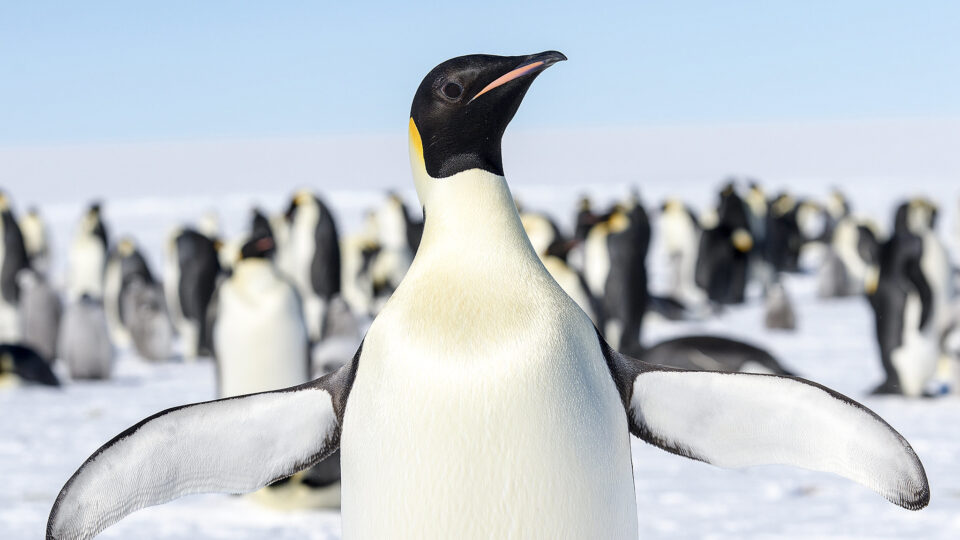
Researchers need aspiring conservationists to help them count emperor penguins

Emperor penguins, the tallest and heaviest of all living penguins, are also the most famous, being the subject of a very popular documentary film.  The ongoing loss of sea ice in Antarctica has led to unprecedented breeding failures in emperor penguin colonies. 

Since 2016, Antarctica has seen the four years with the lowest sea ice extent on record.  Between 2018 and 2022, 30% of the 62 known emperor penguin colonies were affected by partial or total sea ice loss.  Current predictions suggest that the population of emperor penguins will fall by 99% by the end of the century.

To monitor remote emperor penguin colonies, researchers use satellite images in which the brown stains of the birds’ guano stand out against the white ice and snow.

Researchers at the British Antarctic Survey have launched the ‘Polar Observatory’ on the online citizen science website Zooniverse to recruit ‘penguin detectives’ to help validate the accuracy of satellite images in assessing penguin populations.

The online app contains drone photos taken over the Snow Hill penguin colony.  The images have been split into more than 300 10-meter squares.  Volunteers are asked to identify any adult and chick penguins in a given picture.  The results will be fed into machine learning algorithms to train the AI systems in automatically counting penguins in future surveys.

The project is a fun opportunity for aspiring conservationists and penguin lovers in general to help learn more about the future of the species.  Interested people can learn more on the Zooniverse website.

**********

Web Links

‘Penguin detectives’ required for new counting app

Polar Observatory

Photo, posted October 7, 2017, courtesy of Christopher Michel via Flickr.

Earth Wise is a production of WAMC Northeast Public Radio

Why Do Woodpeckers Peck? | Earth Wise

October 21, 2022 By EarthWise Leave a Comment

Scientists understand why woodpeckers peck

Most of us have heard the sound of a woodpecker drumming on a nearby tree, or unfortunately, on the walls of our house where it can be very destructive.  We were often told that the birds were hunting for insects inside the wood, or perhaps trying to open up a nest. But a new study at Brown University has found evidence that woodpeckers are just additional musicians in the bird orchestra who happen to be percussionists.

The researchers studied the forebrains of birds and found characteristic gene expression specializations in songbirds.  Songbirds sing to communicate for various reasons – such as staking out territory or seeking mates.  The study looked at birds that are not known to sing, such as the emu, penguin, flamingo, and woodpeckers.  It turns out that among these, only woodpeckers had forebrains that anatomically resembled those of songbirds.  The study is the first time a neural basis has been identified for the communication activities of animals other than primates.

There are over 200 species of woodpeckers around the world and each species has its own characteristic drumming speed and rhythms.  Woodpecker drumming may well have evolved through a form of vocal learning, which is the way songbirds learn to make their own melodious sounds.  And like the calls of songbirds, these drumming patterns change depending on what the birds want to communicate and to whom.

So, the little downy woodpecker that is poking holes in your walls is probably not hunting for insects.  It is more likely to be telling another woodpecker to get out of its territory.

**********

Web Links

Why do woodpeckers peck? New discovery about bird brains sheds light on intriguing question

Photo, posted June 15, 2021, courtesy of Tony Oldroyd via Flickr.

Earth Wise is a production of WAMC Northeast Public Radio

visit site by the doctor who prescribed the drug. Prescription. If the drug is sold in Russia without a prescription, it is necessary to make sure that the drug will also be sold abroad without it. You can find out in advance and, for example, write a letter to a specific pharmacy abroad, or you can be reinsured and ask to make a prescription form for the drug from your doctor.

Primary Sidebar

Recent Episodes

  • An uninsurable future
  • Clean energy and jobs
  • Insect declines in remote regions
  • Fossil fuel producing nations ignoring climate goals
  • Trouble for clownfishes

WAMC Northeast Public Radio

WAMC/Northeast Public Radio is a regional public radio network serving parts of seven northeastern states (more...)

Copyright © 2026 ·