• Skip to primary navigation
  • Skip to main content
  • Skip to primary sidebar

Earth Wise

A look at our changing environment.

  • Home
  • About Earth Wise
  • Where to Listen
  • All Articles
  • Show Search
Hide Search
You are here: Home / Archives for ocean chemistry

ocean chemistry

Ocean acidification and sharks

September 26, 2025 By EarthWise Leave a Comment

Ocean acidification threatens sharks and other marine wildlife

Carbon dioxide emissions from human activities are altering the chemistry of oceans.  As more CO2 is released into the atmosphere, a significant portion of it is absorbed by seawater. This reduces the ocean’s pH, driving greater acidity, and disrupts marine ecosystems – a process known as ocean acidification.  The acidifying oceans pose problems for many organisms, including sharks. 

Sharks are one of the top marine predators. Their teeth are their weapons.  Razor-sharp and constantly replaced, their teeth are essential for their survival. But new research, recently published in the journal Frontiers in Marine Science, has found that sharks may lose their edge as the oceans become more acidic.

Scientists in Germany examined the teeth of Blacktip reef sharks under current and future ocean acidification scenarios. Today, the ocean’s average pH is about 8.1. By the year 2300, it could fall to 7.3, making seawater nearly ten times more acidic than it is now.

Shark teeth, though made of tough mineralized phosphate, are not immune to corrosion. The researchers incubated discarded shark teeth in tanks with different pH levels. After just eight weeks, the teeth exposed to more acidic water showed visible damage, including cracks, holes, weakened roots, and appeared structurally more fragile.

Since species like Blacktip reef sharks swim with mouths open to breathe, their teeth are constantly exposed to seawater and at continuous risk of damage.

Protecting ocean chemistry may be critical to protecting the top marine predators themselves.

**********

Web Links

‘Built for cutting flesh, not resisting acidity’: sharks may be losing deadly teeth to ocean acidification

Photo, posted June 16, 2023, courtesy of Ryan Hagerty / USFWS via Flickr.

Earth Wise is a production of WAMC Northeast Public Radio
The World’s Largest Harmful Algal Bloom | Earth Wise

July 1, 2021 By EarthWise Leave a Comment

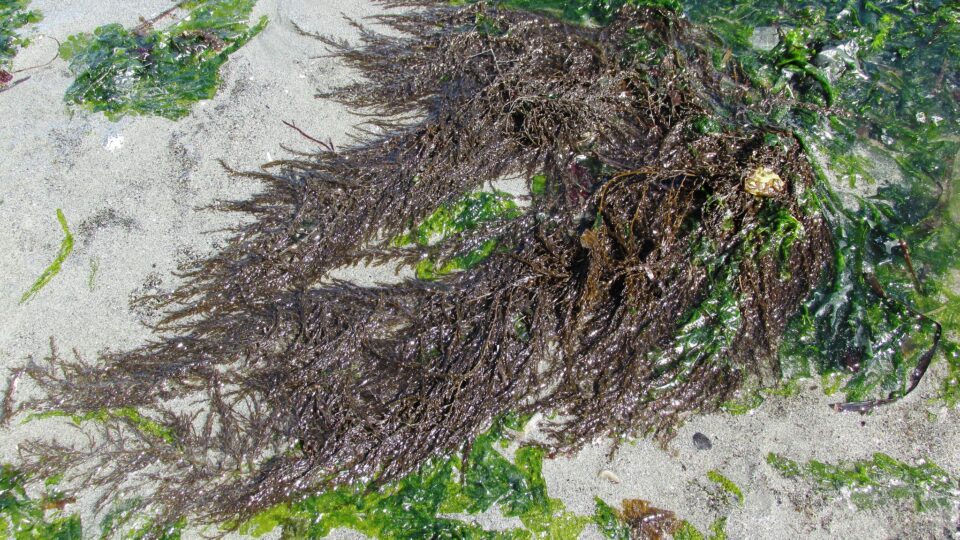
Increase in nitrogen is leading to an explosion of brown sargassum seaweed

Brown sargassum seaweed floats in surface water in a bloom that stretches all the way from West Africa to the Gulf of Mexico.  Sargassum provides habitat for turtles, crabs, fish, and birds.

The stuff carpets beaches along the tropical Atlantic, the Caribbean Sea, the Gulf of Mexico, and the east coast of Florida disrupting tourism.  Florida’s Miami-Dade County alone spends $45 million a year cleaning up sargassum.  Annual Caribbean clean-up is in excess of $120 million.

A study by Florida Atlantic University has discovered dramatic changes in the chemistry and composition of sargassum which has transformed the so-called Great Atlantic Sargassum Belt into a toxic dead zone.

The findings of the study suggest that increased nitrogen availability from both natural and human-generated sources, including sewage, is supporting blooms of sargassum and turning a critical marine nursery habitat into harmful algal blooms with catastrophic impacts on coastal ecosystems, economies, and human health.

The study found that today’s sargassum tissues compared with those of the 1980s have 35% more nitrogen content and 42% less phosphorus.  Much of the nitrogen increase is a result of agricultural and industrial runoff from the Congo, Amazon, and Mississippi Rivers. 

The fact that the bloom itself has expanded so tremendously was already suspected to be the result of significant changes in the ocean’s chemistry.  Given the negative effect that the Great Atlantic Sargassum Belt is having on the coastal communities, additional research is essential to guide mitigation and adaptation efforts.

**********

Web Links

Sargassum now world’s largest harmful algal bloom due to nitrogen

Photo, posted June 5, 2016, courtesy of J Brew via Flickr.

Earth Wise is a production of WAMC Northeast Public Radio.

Primary Sidebar

Recent Episodes

  • An uninsurable future
  • Clean energy and jobs
  • Insect declines in remote regions
  • Fossil fuel producing nations ignoring climate goals
  • Trouble for clownfishes

WAMC Northeast Public Radio

WAMC/Northeast Public Radio is a regional public radio network serving parts of seven northeastern states (more...)

Copyright © 2026 ·