
• Skip to primary navigation
  • Skip to main content
  • Skip to primary sidebar

Earth Wise

A look at our changing environment.

  • Home
  • About Earth Wise
  • Where to Listen
  • All Articles
  • Show Search
Hide Search
You are here: Home / Archives for more intense

more intense

Industrial heat and solar power

July 2, 2024 By EarthWise Leave a Comment

Generating industrial heat and power from renewable energy

Many industrial processes require extremely high temperatures, typically more than 1,800 degrees Fahrenheit.  This heat is generally produced by burning fossil fuels – either coal or natural gas – which emits large amounts of greenhouse gases. This level of heat cannot be economically produced using renewable electricity.  As a consequence, decarbonizing these industrial processes is very difficult.

Researchers at ETH Zurich in Switzerland have recently demonstrated a new method of obtaining high-temperature heat based on solar radiation.  They have engineered a device called a thermal trap.  It consists of a quartz rod coupled to a ceramic absorber that can efficiently absorb sunlight and convert it to heat.

In laboratory-scale experiments, they exposed a foot-long quartz rod to artificial light 135 times more intensive than sunlight and were able to produce temperatures as high as 1,900 degrees.  The artificial light source was needed to mimic the effects of concentrated solar energy plants that typically make use of large numbers of mirrors to direct intense solar energy onto a small area.

There are already concentrated solar power plants that operate at temperatures as high as 1,100 degrees and use the heat to operate turbines to generate electricity.  These plants lose efficiency at higher temperatures because of radiative heat losses.  The Zurich thermal trap minimizes these losses and permits higher temperature operation.

The hope is that at a large scale, the new approach may make it possible to use solar energy to decarbonize energy-intensive industrial processes.

**********

Web Links

Using solar energy to generate heat at high temperatures

Photo courtesy of ETH Zurich / Emiliano Casati.

Earth Wise is a production of WAMC Northeast Public Radio

Europe Is Warming Very Quickly | Earth Wise

July 13, 2023 By EarthWise Leave a Comment

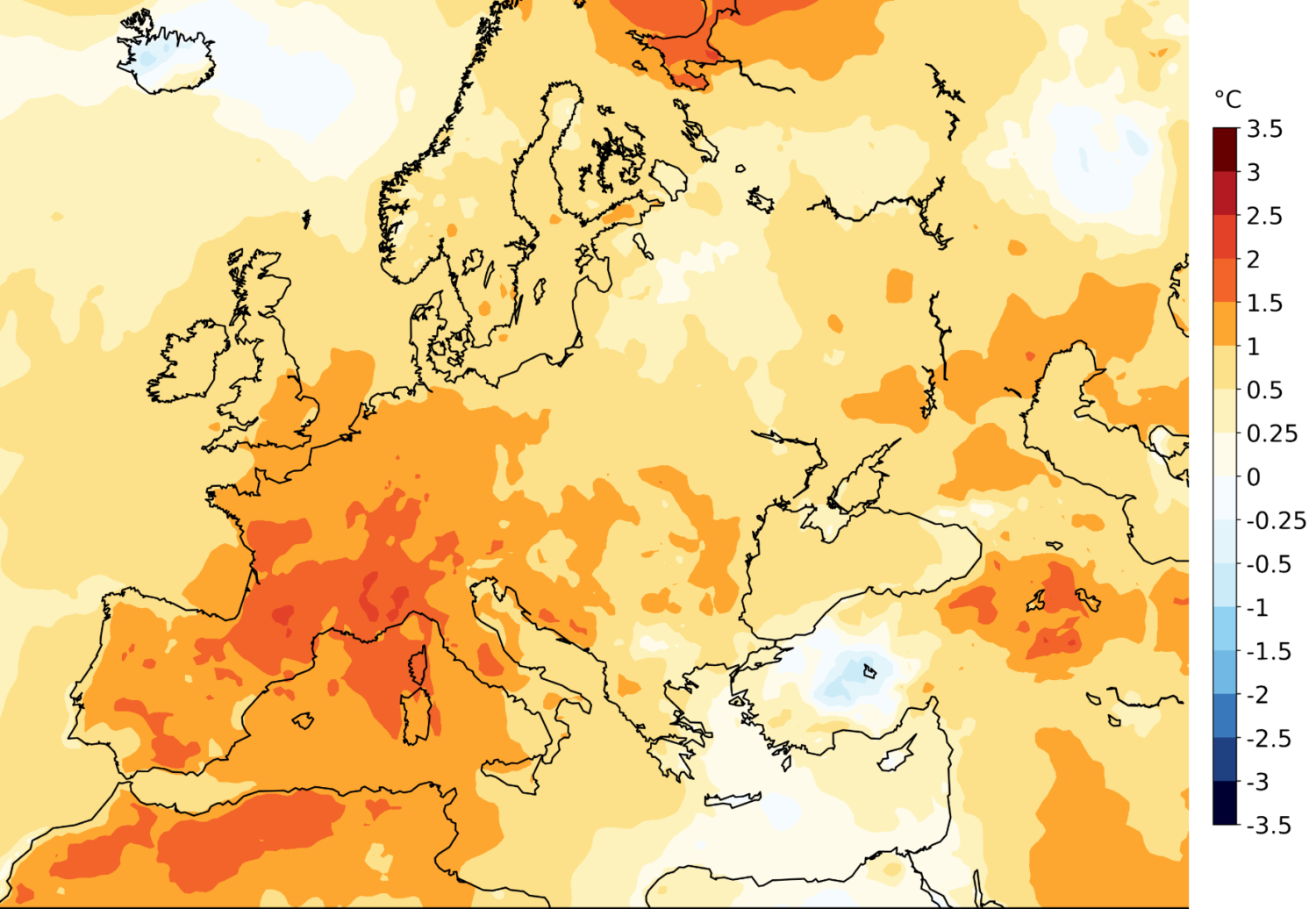
Europe is warming faster than most of the world

According to a new report from the World Meteorological Organization, Europe is warming faster than any other inhabited continent.  The result of the rising temperatures has been increasingly severe heat waves, flood, and wildfires.

The Paris Climate Agreement has set a goal of limiting warming to no more than 2 degrees Celsius above pre-industrial levels and, if at all possible, to no more than 1.5 degrees.  To date, the planet has warmed by 1.2 degrees and, with greenhouse gas emissions continuing at record levels, the temperature keeps going up.

These numbers refer to the global average.  Some places have warmed more and others less.  The Arctic has been warming four times quicker than the rest of the world.  In terms of direct impact on large populations, Europe has already surpassed the 2-degree mark, having reached 2.3 degrees last year.  In 2022, many countries in western and southwestern Europe had their warmest year on record. Weather-related economic damages totaled $2 billion, mostly as a result of storms and floods.

Europe is trying to do its part in mitigating climate change by making major gains on clean energy.  Wind and solar generated 22% of Europe’s power in 2022, which is more than either natural gas or coal produced.  Europe is trying to do its share, but the warming climate is a global phenomenon and will require a global effort to mitigate its effects.

The record-breaking heat stress experienced by Europeans last year cannot be considered a one-off occurrence.  It is part of a pattern that will make weather extremes more frequent and more intense over time.

**********

Web Links

The Fastest-Warming Continent, Europe Has Already Heated by More Than 2 Degrees C

Photo, posted September 26, 2011, courtesy of Ben Ramirez via Flickr.

Earth Wise is a production of WAMC Northeast Public Radio

Insects In A Changing Climate | Earth Wise

October 27, 2022 By EarthWise Leave a Comment

Insects can be found in every environment on Earth and are critical components of many ecosystems.  They perform countless important functions, including aerating and fertilizing soil as well as pollinating flowers.  In fact, according to the USDA, 75% of the world’s flowering plants and about 35% of the world’s food crops depend on animal pollinators, the majority of which are insects, to reproduce.

According to a study published in the journal Nature earlier this year, the combination of climate change and intensive agriculture is having a profound impact on both the abundance and diversity of insects.  In regions where substantial warming had occurred and where land had been converted for intensive farming, insects were nearly 50% less abundant and more than 25% fewer species were observed.  Tropical regions were among those most at risk for heavy losses.

According to a new study recently published in the journal Global Change Biology, tropical insects will be even more susceptible to climate change than previously thought.  In a five-year study conducted in Peru, researchers from the Florida Museum of Natural History found that insect populations declined 50% following short periods of drought and following short periods of heavy rainfall.  Insect populations decreased after three months of dry weather, but also decreased after three months of exceptionally wet weather.   

Researchers have known that tropical insects don’t tend to do well when their habitats dry out.  But the researchers were surprised to discover that these insects were equally averse to increased precipitation.  Alarmingly, precipitation is expected to become more frequent and more intense as a consequence of the changing climate. 

***********

Web Links

Tropical insects are extremely sensitive to changing climates

Photo, posted June 11, 2016, courtesy of Z. Leng via Flickr.

Earth Wise is a production of WAMC Northeast Public Radio
Primary Sidebar

Recent Episodes

  • An uninsurable future
  • Clean energy and jobs
  • Insect declines in remote regions
  • Fossil fuel producing nations ignoring climate goals
  • Trouble for clownfishes

WAMC Northeast Public Radio

WAMC/Northeast Public Radio is a regional public radio network serving parts of seven northeastern states (more...)

Copyright © 2026 ·