• Skip to primary navigation
  • Skip to main content
  • Skip to primary sidebar

Earth Wise

A look at our changing environment.

  • Home
  • About Earth Wise
  • Where to Listen
  • All Articles
  • Show Search
Hide Search
You are here: Home / Archives for membranes

membranes

More eco-friendly desalination

May 14, 2025 By EarthWise Leave a Comment

There are about 16,000 operational desalination plants, located across 177 countries, which generate an estimated 25 billion gallons of fresh water daily.

For every gallon of drinking water produced at a typical desalination plant, one and a half gallons of brine are produced.  Much of it is stored in ponds until the water evaporates, leaving behind solid salt or concentrated brine for further treatment.  There are various other techniques for concentrating brines, but they are energy-intensive and environmentally problematic.  The process called electrodialysis uses electrified membranes to concentrate salts. 

Water flows into many channels separated by membranes, each of which has the opposite electrical charge of its neighbors.  Positive salt ions move towards negatively charged electrodes and negative ions move toward positive electrodes.  Two streams result, one containing purified water and one containing concentrated brine.

This eliminates the need for evaporation ponds, but existing electrodialysis membranes either result in leakage of salts into the environment or are too slow, making the process impractical for large-scale use.

Researchers at the University of Michigan have developed a new kind of membrane for electrodialysis.  The new membranes don’t leak and are ten times more conductive than those on the market today which means that they can move more salt using less power.  The membranes can be customized to suit a broad range of water types, which may help make desalination a more sustainable solution to the world’s growing water crisis.

**********

Web Links

Making desalination more eco-friendly: New membranes could help eliminate brine waste

Photo, posted February 4, 2012, courtesy of David Martinez Vicente via Flickr.

Earth Wise is a production of WAMC Northeast Public Radio

A new way to help purify water

February 27, 2025 By EarthWise Leave a Comment

Engineers at the University of Michigan and Rice University have developed a new technology for removing boron from seawater, an important step in turning seawater into safe drinking water.

Boron is a natural component of seawater that remains a toxic contaminant in drinking water after conventional filters remove salts from seawater.  The boron levels in seawater are about twice as high as the World Health Organization’s most lenient limits for safe drinking water and 5 to 12 times higher than what many agricultural plants can tolerate.

Boron passes through the reverse osmosis membranes used in desalination plants in the form of boric acid.  To remove it, the desalination plants normally add a base to the treated water that causes the boric acid to become negatively charged.  An additional membrane then removes the charged boron, and an acid is then added to neutralize the water.  All of this is expensive and complicated.

The new technology uses electrodes that remove boron by trapping it inside pores studded with oxygen-containing structures that bind with boron but let other ions pass through.  Capturing boron with electrodes enables treatment plants to avoid the need for a second stage of reverse osmosis.

Global desalination capacity reached 95 million cubic meters a day in 2019.  The new membranes could save nearly $7 billion a year.  Such savings could make seawater a more accessible source of drinking water for a thirsty world.  Freshwater supplies are expected to meet only 40% of the world’s demand by 2030.

**********

Web Links

New water purification technology helps turn seawater into drinking water without tons of chemicals

Photo, posted August 21, 2018, courtesy of Alachua County via Flickr.

Earth Wise is a production of WAMC Northeast Public Radio

Pulling Carbon Dioxide Out Of Seawater | Earth Wise

April 17, 2023 By EarthWise Leave a Comment

Researchers are developing method to pull CO2 out of seawater

The world’s largest sink for carbon dioxide from the atmosphere is the ocean.  The world’s oceans soak up 30-40% of all the gas produced by human activities.  Dissolving carbon dioxide in water produces carbonic acid.   This is the reason that oceans are becoming increasingly acidic, which is causing serious damage to ocean ecosystems.

There are many efforts underway aimed at directly removing carbon dioxide from the air as a way to mitigate the effects of ongoing emissions.  But another possibility is to remove CO2 directly from ocean water.  Existing methods for doing it involve the use of expensive membranes and complex chemicals. The economics of such methods are quite unfavorable.

Recently, a team of researchers at MIT has identified what they claim is a truly efficient and inexpensive removal mechanism. It involves a reversible process based on membrane-free electrochemical cells.  Electrodes in the cells release protons that are introduced to seawater which drive the release of carbon dioxide dissolved in the water. The carbon dioxide can be collected and the processed water ends up being alkaline.

Running this process at a site that is already collecting seawater – such as at a desalination plant – would be an effective way to collect carbon dioxide as well as help mitigate ocean acidification.

Once the carbon dioxide is removed from the water, it still needs to be disposed of, just as is the case for other carbon removal processes.  It could be turned into useful chemicals or it could be stored in underground caverns.  But this approach is fairly unique in that the carbon dioxide has already been captured by the ocean.  The issue remains what to do with it.

**********

Web Links

How to pull carbon dioxide out of seawater

Photo, posted January 19, 2016, courtesy of Judy Dean via Flickr.

Earth Wise is a production of WAMC Northeast Public Radio
Understanding How To Enhance Desalination | Earth Wise

February 16, 2021 By EarthWise Leave a Comment

How to improve desalination

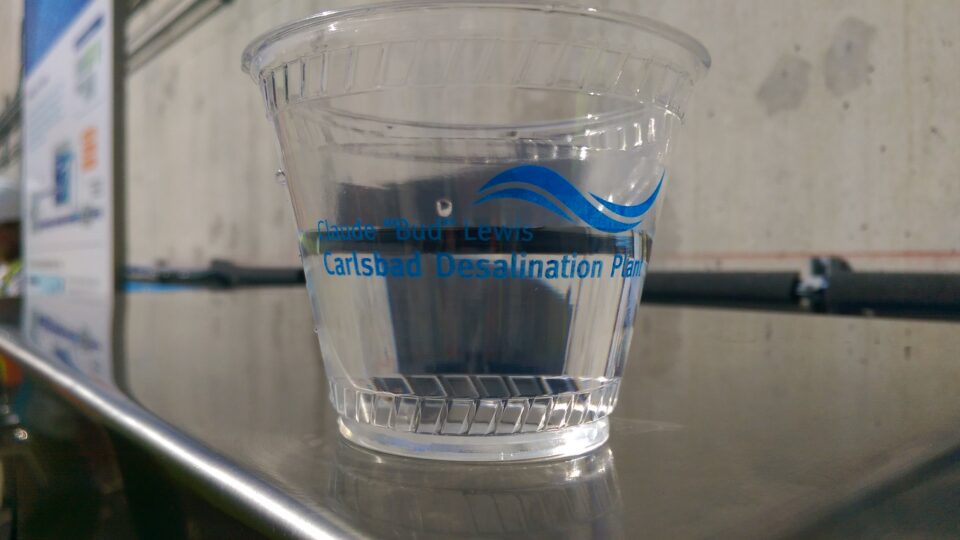
Desalination is the process of removing mineral components – notably salt – from saline water, generally seawater.  Over 16,000 desalination plants operate across 177 countries, generating 25 billion gallons of fresh water each year.  Currently, desalination accounts for about 1% of the world’s drinking water.

The leading process for desalination in terms of installed capacity as well as new installations is reverse osmosis that makes use of a thin-film composite membrane based on ultra-thin polyamide.

Despite the fact that these membranes are widely used for desalination, they are actually rather poorly understood.  It has not been known exactly how water moves through them.  As a result, much of the progress made on the technology over the decades has been essentially based on guesswork.

A team of researchers at the University of Texas, Austin has used advanced microscopy techniques to solve some of the mysteries of reverse osmosis membranes.  By mapping membranes at very high resolution – less than half the diameter of a DNA strand – they gained a much better understanding of what makes a membrane better at reverse osmosis.

They found that desalination membranes are inconsistent in mass distribution and density and that these inconsistencies can impair membrane performance.  It turns out that inconsistencies and dead zones in membranes play a bigger role than membrane thickness.  By making the membranes more uniform in density at the nanoscale, they were able to increase desalination efficiency 30 to 40 percent, therefore cleaning more water with less energy and at lower cost.

Producing fresh water is not just essential for public health, it is also crucial for use in agriculture and energy production.

**********

Web Links

Nanoscale control of internal inhomogeneity enhances water transport in desalination membranes

Photo, posted February 13, 2017, courtesy of Jacob Vanderheyden via Flickr.

Earth Wise is a production of WAMC Northeast Public Radio.

New Membranes For Carbon Capture

October 2, 2019 By EarthWise Leave a Comment

Drastically reducing the amount of carbon dioxide being emitted into the atmosphere is an essential goal in the effort to mitigate the effects of climate change.  While the ultimate solution is to avoid combustion of fossil fuels by the use of clean alternative energy sources, that transition will take time – possibly more time than we have.  As a result, there is a great deal of effort underway to develop techniques for capturing the carbon emitted by fossil fuel combustion and either recycling it or storing it.

There are multiple ways to capture carbon emissions, but the ultimate goal is to find a technique that is both inexpensive and scalable.  One promising technique involves the use of high-performance membranes, which are filters that can specifically pick out CO2 from a mix of gases, such as those coming out of a factory smokestack.

Scientists at a Swiss laboratory have now developed a new class of high-performance membranes that exceeds the targeted performance for carbon capture by a significant margin.  The membranes are based on single-layer graphene with a selective layer thinner than 20 nanometers – only about 40 atoms thick. The membranes are highly tunable in terms of chemistry, meaning that they can be designed to capture specific molecules.

The membranes are highly permeable – meaning that they don’t impede gas flow too much – but highly selective.  The CO2/N2 separation factor is 22.5, which means that 22.5 times more nitrogen can get through the membrane than carbon dioxide.

The work is just at the laboratory stage at this point, but it is a very promising step towards developing a practical scheme for keeping carbon dioxide from escaping from power-plant and factory smokestacks.

**********

Web Links

Next-gen membranes for carbon capture

Photo, posted December 28, 2010, courtesy of Emilian Robert Vicol via Flickr.

Earth Wise is a production of WAMC Northeast Public Radio.

Primary Sidebar

Recent Episodes

  • An uninsurable future
  • Clean energy and jobs
  • Insect declines in remote regions
  • Fossil fuel producing nations ignoring climate goals
  • Trouble for clownfishes

WAMC Northeast Public Radio

WAMC/Northeast Public Radio is a regional public radio network serving parts of seven northeastern states (more...)

Copyright © 2026 ·