• Skip to primary navigation
  • Skip to main content
  • Skip to primary sidebar

Earth Wise

A look at our changing environment.

  • Home
  • About Earth Wise
  • Where to Listen
  • All Articles
  • Show Search
Hide Search
You are here: Home / Archives for marine predators

marine predators

Ocean acidification and sharks

September 26, 2025 By EarthWise Leave a Comment

Ocean acidification threatens sharks and other marine wildlife

Carbon dioxide emissions from human activities are altering the chemistry of oceans.  As more CO2 is released into the atmosphere, a significant portion of it is absorbed by seawater. This reduces the ocean’s pH, driving greater acidity, and disrupts marine ecosystems – a process known as ocean acidification.  The acidifying oceans pose problems for many organisms, including sharks. 

Sharks are one of the top marine predators. Their teeth are their weapons.  Razor-sharp and constantly replaced, their teeth are essential for their survival. But new research, recently published in the journal Frontiers in Marine Science, has found that sharks may lose their edge as the oceans become more acidic.

Scientists in Germany examined the teeth of Blacktip reef sharks under current and future ocean acidification scenarios. Today, the ocean’s average pH is about 8.1. By the year 2300, it could fall to 7.3, making seawater nearly ten times more acidic than it is now.

Shark teeth, though made of tough mineralized phosphate, are not immune to corrosion. The researchers incubated discarded shark teeth in tanks with different pH levels. After just eight weeks, the teeth exposed to more acidic water showed visible damage, including cracks, holes, weakened roots, and appeared structurally more fragile.

Since species like Blacktip reef sharks swim with mouths open to breathe, their teeth are constantly exposed to seawater and at continuous risk of damage.

Protecting ocean chemistry may be critical to protecting the top marine predators themselves.

**********

Web Links

‘Built for cutting flesh, not resisting acidity’: sharks may be losing deadly teeth to ocean acidification

Photo, posted June 16, 2023, courtesy of Ryan Hagerty / USFWS via Flickr.

Earth Wise is a production of WAMC Northeast Public Radio
Artificial Reefs As Havens For Marine Predators | Earth Wise

October 28, 2020 By EarthWise Leave a Comment

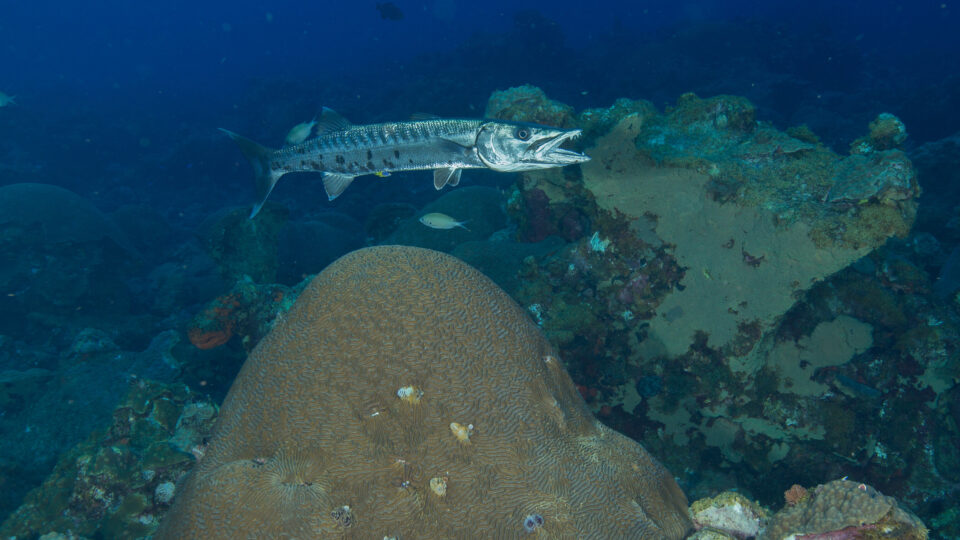
Artificial reefs as habitat for marine predators

Climate change, pollution, development and other stresses have accelerated the decline of reef ecosystems across much of the world’s oceans in recent years.  Large predators such as sharks, mackerels, barracudas, jacks and others that formerly fed around reefs have had to venture outside their normal migratory routes in search of suitable alternatives.

According to a new study by Duke University, marine predators have taken up residence at shipwrecks and other artificial reefs.  The study surveyed 30 sites along the North Carolina coast and found that predator densities were up to five times larger at the 14 artificial reefs surveyed than at the 16 natural reefs in the survey.

Shipwrecks, particularly those that rose between 4 and 10 meters up into the water column, were a big favorite of the fishes.  Some of those sites supported predator densities up to 11 times larger than natural reefs or low-profile artificial reefs.  The shipwrecks are basically high-rise timeshares in the sea.

The findings of the survey show that artificial reefs can support large predators, supplementing natural reefs if the design and placement of the artificial reefs are appropriate.  In addition, when it comes to designing artificial reefs, there appears to be a height advantage.  So, reefs either made from sunken ships or at least made to resemble them would be desirable.

Because undersea predators help maintain healthy and sustainable populations of species lower in the food web, providing suitable habitat for the predators is extremely important.  Based on the study, it appears that the strategic use of artificial reefs can be an effective way to help counter the increasing loss of natural habitat on the ocean bottom.

**********

Web Links

Artificial Reefs Take on a Towering Presence as Havens for Marine Predators

Photo, posted July 29, 2014, courtesy of NOAA Photo Library via Flickr. Photo credit: Flower Garden Banks National Marine Sanctuary

Earth Wise is a production of WAMC Northeast Public Radio.

Primary Sidebar

Recent Episodes

  • An uninsurable future
  • Clean energy and jobs
  • Insect declines in remote regions
  • Fossil fuel producing nations ignoring climate goals
  • Trouble for clownfishes

WAMC Northeast Public Radio

WAMC/Northeast Public Radio is a regional public radio network serving parts of seven northeastern states (more...)

Copyright © 2025 ·