• Skip to primary navigation
  • Skip to main content
  • Skip to primary sidebar

Earth Wise

A look at our changing environment.

  • Home
  • About Earth Wise
  • Where to Listen
  • All Articles
  • Show Search
Hide Search
You are here: Home / Archives for indigenous knowledge

indigenous knowledge

Migratory bison in Yellowstone

September 30, 2025 By EarthWise Leave a Comment

How bison impact the environment inside Yellowstone National Park

Tens of millions of bison once migrated across the United States in enormous herds; tribal oral histories speak of it taking days for an entire herd to pass by.  These herds shaped the landscape and performed many ecosystem functions.  By the 1890s, the bison population had plummeted to fewer than 1,000 individuals.  Since then, dedicated conservation efforts – establishing protected areas and breeding programs – have led to the recovery of the species.  There are now about 400,000 bison, mostly existing in small, privately owned herds.

Yellowstone National Park is home to the last significant migratory bison herd.  Yellowstone was established as a national park in 1872 providing scientists with a unique opportunity to study how large grazing herbivores affect the landscape.  More than 5,000 bison live in the 3,500 square miles of the park. 

A 7-year study by researchers examined how bison change the soil and vegetation along their migratory route.  What looked like overgrazing turns out to allow plants to keep growing.  The bison graze and move on, increasing the density of microbes and nitrogen in the soil and significantly improving the nutrition for other herbivores.

The research validated what Indigenous peoples have known for many generations:  that bison helped shape this continent and having large numbers of them improve ecosystems for other animals as well.  Native American tribes would like to restore bison to their lands.  Whether some of the park fences might be removed to permit migration beyond official borders is under consideration.

**********

Web Links

In Yellowstone, Migratory Bison Reawaken a Landscape

Photo, posted August 17, 2017, courtesy of Jacob W. Frank / NPS via Flickr.

Earth Wise is a production of WAMC Northeast Public Radio
Mexico’s Wonder Plant

September 13, 2019 By EarthWise Leave a Comment

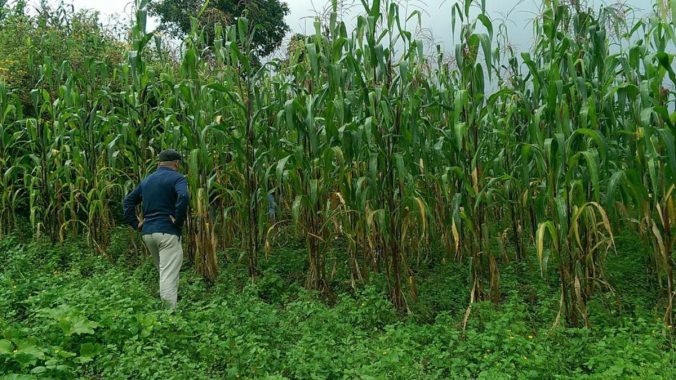
In 1979, an American naturalist named Thomas Hallberg visiting a small town in Oaxaca, Mexico was amazed to find a type of local maize – or corn – that grew nearly 20 feet high in poor-quality soil even though the local farmers did not use any fertilizer.

The unique corn plant had aerial roots that grew a mucous-like gel just before harvest season.  It seemed totally implausible, but the plant seemed to be fixing its own nitrogen:  extracting it from the air and somehow making it useful to the plant.

In 1992, Hallberg returned with a group of Mexican scientists and collected samples to study in his lab.  His research showed that the maize indeed received nitrogen from the air through its aerial roots.  It took over 20 years to figure out what was going on in the plants.  It turns out that bacteria that thrive in the low-oxygen environment of the maize’s mucus pulls nitrogen from the air and feeds it to the plant.

Scientists will probably spend years figuring out if a commercial application of this indigenous maize is viable.  It isn’t guaranteed that the self-fertilizing trait of the plant can be bred into a commercial crop.  But if it can, the payoff would be huge.  Farmers spend more than $3 billion a year on corn fertilizer in the US alone.

A vexing problem is who should reap the financial benefits of the maize.  The isolated village where the plant is grown has already signed an agreement to share in any such benefits.   But there are other Oaxacan villages that also grow the plant. 

Mexico’s wonder plant is likely to be caught up in the growing issue of biopiracy, which is the exploitation of indigenous knowledge and biological resources without permission.

**********

Web Links

Indigenous Maize: Who Owns the Rights to Mexico’s ‘Wonder’ Plant?

Photo credit: ALLEN VAN DEYNZE/UC DAVIS

Earth Wise is a production of WAMC Northeast Public Radio.

Primary Sidebar

Recent Episodes

  • An uninsurable future
  • Clean energy and jobs
  • Insect declines in remote regions
  • Fossil fuel producing nations ignoring climate goals
  • Trouble for clownfishes

WAMC Northeast Public Radio

WAMC/Northeast Public Radio is a regional public radio network serving parts of seven northeastern states (more...)

Copyright © 2026 ·