• Skip to primary navigation
  • Skip to main content
  • Skip to primary sidebar

Earth Wise

A look at our changing environment.

  • Home
  • About Earth Wise
  • Where to Listen
  • All Articles
  • Show Search
Hide Search
You are here: Home / Archives for idea

idea

A recycling lottery

July 18, 2025 By EarthWise Leave a Comment

Getting people to recycle isn’t always easy.  The bottled beverages we buy at the supermarket often require a small deposit that we can get back by recycling the bottle, but often, we just don’t.

Researchers from the University of British Columbia tested the idea of giving people returning bottles a small chance of winning a big cash prize instead of a 10-cent deposit return.  The result was that people recycled 47% more bottles.

Changing how we reward recycling made a big difference.  When given a choice between a guaranteed return and a possible large reward, many chose the lottery option.  When people were randomly assigned to one type of reward or the other, those in the lottery group brought in almost three bottles for every two returned by the other group.

This isn’t a new idea.  Norway has a recycling lottery, and their bottle return rate is close to 100 percent.  The way it works there is there are reverse vending machines in grocery stores all over the country.  The revenues generated by the machines is split in four ways:  34.5% of the gross revenue goes to the Red Cross; 35% goes to the people who bring in their bottles in the form of winnings in the lottery; 9.75% goes to the stores for managing the machines and the lottery; and 10.75% goes to the operating company of the Recycling Lottery.

The Canadian experiments demonstrate that a recycling lottery could be effective in more places than Norway.  However, it shouldn’t completely replace the guaranteed refund option, since some people depend on it for income.

**********

Web Links

How lottery-style bottle returns could transform recycling

Photo, posted July 9, 2011, courtesy of Mr.TinMD via Flickr.

Earth Wise is a production of WAMC Northeast Public Radio

Almost a dire wolf

April 22, 2025 By EarthWise Leave a Comment

Researchers around the world are working on what some call the ‘de-extinction’ of iconic animals of the past such as the wooly mammoth, the dodo, and the Tasmanian tiger.  The idea is to decipher the genome from DNA of preserved specimens and, using the tools of modern genetic engineering and cloning technology, alter the DNA of closely related modern species to recreate the extinct species.

A company called Colossal Biosciences recently announced that it has brought back the dire wolf, a species that has been extinct for 10,000 years.  Dire wolves have white coats and are larger than modern wolves, have more powerful shoulders, a wider head, and larger teeth and jaws.  Colossal is now raising three wolves they have engineered at a 2,000-acre site at an undisclosed location.

 The wolves were created by taking the DNA of modern grey wolves and editing 14 genes substituting ones from ancient dire wolf specimens.  Wolves have about 19,000 genes, so the changes from the grey wolf genome are very minor but enough to produce an animal that looks just like a dire wolf.  But is it a dire wolf?

It really isn’t.  Ancient DNA is always greatly damaged.  Only parts of it survive.  We don’t actually have the complete genome of the dire wolf.  What we have is bits and pieces that, thanks to modern technology, allow us to produce a phenotype of a dire wolf; that is, an animal with the same observable features. 

Whether this accomplishment is a worthwhile and appropriate thing to do is a question that continues to be debated.

**********

Web Links

The Return of the Dire Wolf

Photo courtesy of Colossal Laboratories & Biosciences.

Earth Wise is a production of WAMC Northeast Public Radio
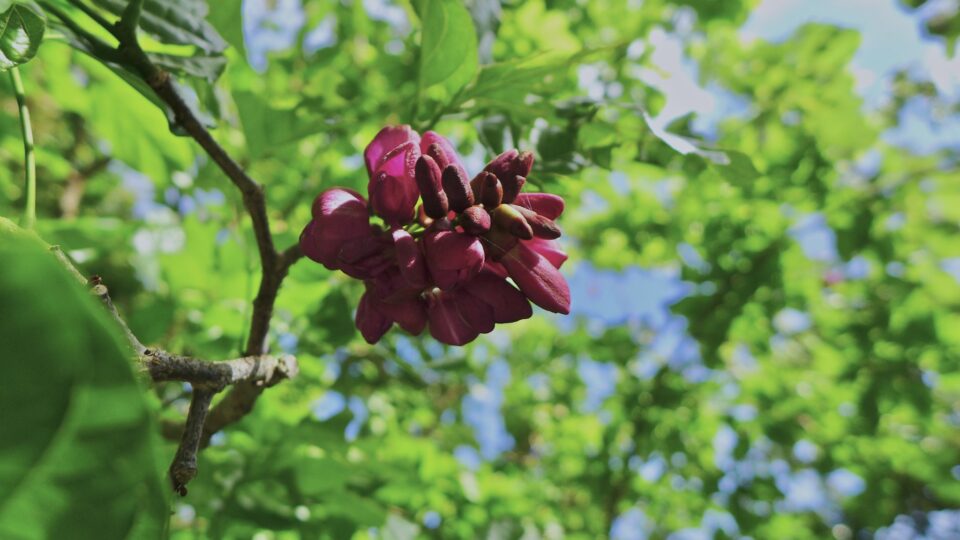
A Miracle Tree | Earth Wise

September 27, 2022 By EarthWise Leave a Comment

Pongamia could be a miracle tree

The world needs to be fed without destroying the environment.   We need to grow more trees to store more carbon on earth and reduce the amount in the atmosphere.  But meanwhile, we decimate rainforests to produce palm oil and grow soybeans.

A startup company in California called Terviva thinks they have a solution.  It’s called pongamia, which is an ordinary looking tropical tree.  It produces beans packed with protein and oil, much like soybeans.  However, it has the potential to produce much more nutrition per acre than soybeans and it is hardy enough to grow on pretty much any kind of land without the use of pesticides, fertilizers, or irrigation.  In short, it is a miracle crop for a hot and hungry planet that is running out of fertile farmland and fresh water.

Pongamia is not a new or rare tree.  It is common in India but grows all over the world.  It is often planted as an ornamental here in the U.S.

The initial idea for making use of the hardy tree was to use its oil as a biofuel.  The seeds of pongamia are known to have a bitter taste and disagreeable odor, which is why the seeds or oil were never used for human or animal feed.  However, Terviva has developed a way to de-bitter pongamia oil.  Once this is done, it becomes a golden-colored substitute for olive oil. It also has enormous potential as a protein for plant-based milks and meats, since it contains all nine essential amino acids.

Terviva has raised more than $100 million to further develop pongamia and is now partnering with Danone, a $25 billion multinational food company, to develop pongamia as a climate-friendly, climate-resilient, non-GMO alternative to soy and palm oil.

***********

Web Links

This super-tree could help feed the world and fight climate change

Photo, posted December 15, 2015, courtesy of Lauren Gutierrez via Flickr.

Earth Wise is a production of WAMC Northeast Public Radio

Solar Windows | Earth Wise

September 1, 2022 By EarthWise Leave a Comment

Solar windows offer massive potential

Solar windows are an attractive idea.  It is very appealing to have the vertical surfaces on the outside of almost any building generate electricity.  The challenge is to have a transparent window be able to function as an efficient-enough solar panel.

Most conventional solar panels use silicon solar cell technology, which is not based on a transparent material.  Transparent solar cells use dye-sensitized technology, which has been the subject of research for decades but has yet to achieve widespread use.

Researchers at the University of Michigan have recently published work on a new process to manufacture solar windows that can be large (over six feet in each dimension) and efficient at electricity production.

The windows make use of dye-sensitized cells which are connected to lines of metal so small that they are invisible to the naked eye.  The individual cells are fairly small but the connection technology allows the construction of large windows.

The solar window has an efficiency of 7%, meaning 7% of incoming sunlight energy is converted to electricity.  The researchers believe that 10% efficiency should be attainable with their technology.  Conventional solar panels have efficiencies of 15% or more.

However, the goal is not necessarily to compete with silicon solar panels.  The real opportunity is to be able to generate electricity when rooftop solar is not practical or to produce additional electricity even when there is already a solar roof.

Going forward, the goals of solar window development are to increase efficiency and to reduce costs to where installing the windows is economically attractive.  Estimates are that the windows currently would cost about twice as much as a conventional window but would pay for the difference in two to six years depending on such things as the level of sun exposure.

**********

Web Links

Inside Clean Energy: What’s Hotter than Solar Panels? Solar Windows.

Photo, posted April 17, 2017, courtesy of Shelby Bell via Flickr.

Earth Wise is a production of WAMC Northeast Public Radio.

Primary Sidebar

Recent Episodes

  • An uninsurable future
  • Clean energy and jobs
  • Insect declines in remote regions
  • Fossil fuel producing nations ignoring climate goals
  • Trouble for clownfishes

WAMC Northeast Public Radio

WAMC/Northeast Public Radio is a regional public radio network serving parts of seven northeastern states (more...)

Copyright © 2026 ·