• Skip to primary navigation
  • Skip to main content
  • Skip to primary sidebar

Earth Wise

A look at our changing environment.

  • Home
  • About Earth Wise
  • Where to Listen
  • All Articles
  • Show Search
Hide Search
You are here: Home / Archives for fire risk

fire risk

Tree plantings and climate impact

October 1, 2025 By EarthWise Leave a Comment

Assessing the climate impact of tree plantings

Planting trees is a key strategy in the fight against climate change.  Trees absorb carbon dioxide, regulate temperature, support biodiversity, and improve air and water quality, offering benefits that extend well beyond their boundaries.

But according to a new study by researchers from University of California – Riverside, where those trees are planted makes a big difference.  The study, which was recently published in the journal Climate and Atmospheric Science, found that tree plantings are almost always a net positive for the climate because trees pull CO2 out of the atmosphere. But the impact of trees on temperature varies a lot by region.

In tropical regions, trees deliver the biggest cooling benefits.  They not only absorb carbon but also cool the air through a process called evapotranspiration.  Roots draw water from the soil, and when it evaporates from the leaves, it cools both the tree and the air around it.  This also raises humidity, which can lead to more clouds.  Both effects block some sunlight from reaching the ground, which adds to the cooling.

The researchers estimated that tropical tree plantings could cool regions like central Africa by as much as eight-tenths of a degree Fahrenheit. 

In contrast, planting trees at higher latitudes may have a slight warming effect.  Darker tree canopies absorb more sunlight, which can offset some of the cooling.  In some places, such as Canada and the northeastern U.S., trees may even increase fire risk.  But this does not mean trees in those regions are unhelpful.  They provide many other benefits for biodiversity, ecosystems, and the environment. 

But one thing is clear: planting trees in the tropics offers the strongest returns for the climate.

**********

Web Links

Trees in the tropics cool more, burn less

Photo, posted September 15, 2024, courtesy of Jan Helebrant via Flickr.

Earth Wise is a production of WAMC Northeast Public Radio

Solid-state batteries for cars

September 19, 2024 By EarthWise Leave a Comment

Battery-powered electric vehicles have historically faced the challenges of limited driving range and long charging time.  In recent years, both of these limitations have been largely overcome for many if not most drivers.  Popular EVs on the market can go 300 miles and more on a charge and today’s fastest charging networks can add 200 miles of range in 20 minutes.  But many people want even more range and even faster charging.  Both of these things will happen in the not-too-distant future.

Multiple companies are working on solid-state batteries, which hold more energy in a given volume than current batteries.  The lithium-ion batteries that power today’s EVs (as well as our phones and computers) have a liquid or gel electrolyte.  Solid-state batteries use a solid ceramic or polymer electrolyte that provides higher energy density, faster charging times, and reduced fire risk as well.

Samsung announced that it will produce solid-state batteries for vehicles by 2027.  Toyota says it is on track to develop a solid-state battery by 2027 or 2028.  California-based QuantumScape has an agreement to supply solid-state batteries to Volkswagen for mass production.  Tesla has not said what it is doing with regard to solid-state batteries, but it is likely that it’s also pursuing the technology.

The upshot of all of this is that EV ranges are likely to increase dramatically over the next several years leading to the availability of vehicles that can go 600 miles or more on a charge.  Given that the cost of EVs is already rapidly becoming at least competitive with if not lower than that of gasoline-powered cars, the days of internal combustion are becoming numbered.

**********

Web Links

Want an EV With 600 Miles of Range? It’s Coming

Photo, posted August 17, 2024, courtesy of Bill Abbott via Flickr.

Earth Wise is a production of WAMC Northeast Public Radio
Turning Dead Trees Into Biomass Energy | Earth Wise

July 1, 2020 By EarthWise Leave a Comment

Biomass energy from dead trees

California has suffered from numerous large wildfires in recent years.  The two largest in the past century took place in 2017 and 2018, and just these two alone burned nearly 750,000 acres, destroyed over 1,200 structures, and killed 24 people.

Apart from the fires, drought, the warming climate, and bark-beetle infestations have killed 147 million California trees since 2013, most of them along the spine of the Sierra mountains.  These dead trees represent a significant danger in forthcoming fire seasons as they threaten to burn with enormous intensity.

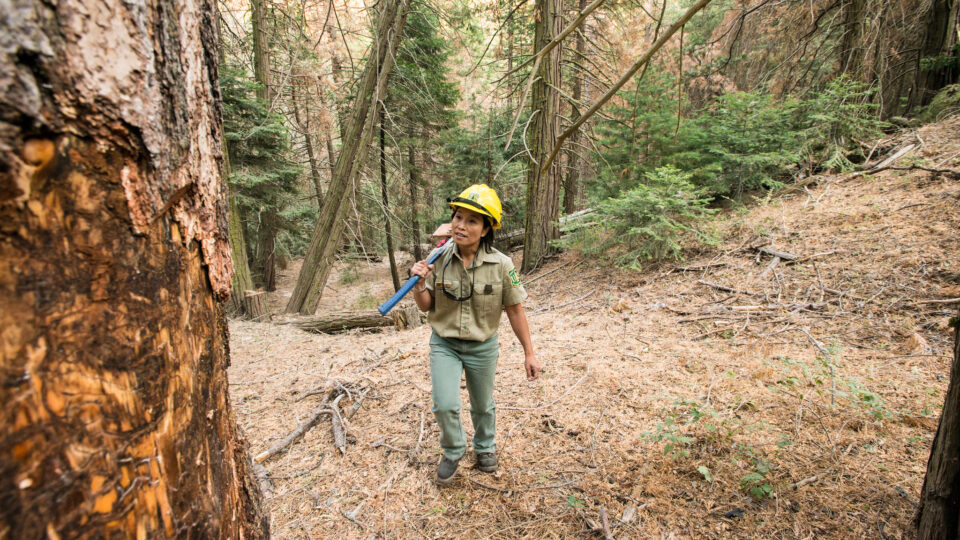
There are now biomass projects in California that thin trees in overcrowded forests and remove dead and diseased trees and turn them into wood chips to supply community biomass facilities that burn them to produce heat and electricity.

Proponents say these projects help rebuild rural communities by creating jobs, while at the same time reducing fire risk. 

There are critics of these programs who claim that they are damaging and destroying ecosystems.    They also point out that burning forest fuels emits 50% more carbon than burning coal and three times as much as burning natural gas.  This is true of biomass in general but is mitigated by the fact that it in principle the carbon can be recaptured by new forest growth.

However, the dominant argument about emissions is that wildfires emit far more carbon dioxide than biomass plants, or much of anything else, for that matter.  In 2018 alone, California wildfires released 50% more carbon dioxide than California’s entire industrial sector.  So, reducing the extent of wildfires is a big deal for many reasons.

**********

Web Links

In California, A Push Grows to Turn Dead Trees into Biomass Energy

Photo, posted August 24, 2016, courtesy of the USDA via Flickr.

Earth Wise is a production of WAMC Northeast Public Radio.

Primary Sidebar

Recent Episodes

  • An uninsurable future
  • Clean energy and jobs
  • Insect declines in remote regions
  • Fossil fuel producing nations ignoring climate goals
  • Trouble for clownfishes

WAMC Northeast Public Radio

WAMC/Northeast Public Radio is a regional public radio network serving parts of seven northeastern states (more...)

Copyright © 2026 ·