• Skip to primary navigation
  • Skip to main content
  • Skip to primary sidebar

Earth Wise

A look at our changing environment.

  • Home
  • About Earth Wise
  • Where to Listen
  • All Articles
  • Show Search
Hide Search
You are here: Home / Archives for brackish

brackish

Solar-powered desalination

November 7, 2024 By EarthWise Leave a Comment

People in remote, low-income regions far from the ocean often need to meet their water needs from groundwater and groundwater is becoming increasingly saline due to climate change.  Desalination of brackish groundwater is a huge and largely untapped source of drinking water, but there are challenges in making the process efficient and reliable.

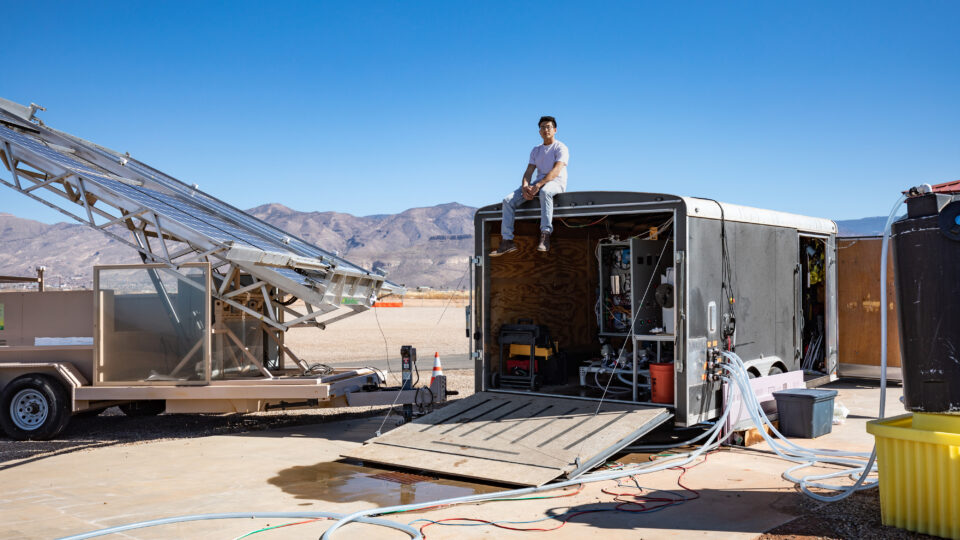
Engineers at MIT have developed a solar-powered desalination system that requires no batteries or external power sources and is capable of producing large quantities of clean water despite the variations of sunshine throughout the day.

The system is based on the process of electrodialysis and consists of water pumps, an ion-exchange membrane stack, and a solar panel array.  What is unique about it is that it makes use of sensors and a control system that predicts the optimal rate at which to pump water through the system based on the output of the solar panels.  As a result, it uses nearly all of the electricity generated to produce clean water and does not need stored or grid-based energy.

The MIT engineers tested a community-scale prototype on groundwater wells in New Mexico over a six-month period.  The system harnessed on average over 94% of the electricity generated by its solar panels and produced as much as 5,000 liters of water per day despite large variations in weather and sunlight.

The new renewable-powered, battery-free system could provide much-needed drinking water at low cost, especially for communities where access to seawater and to grid power are limited.  The team plans to further test and scale up the system so it can supply larger communities and even whole municipalities with low-cost drinking water.

**********

Web Links

Solar-powered desalination system requires no extra batteries

Photo courtesy of Shane Pratt.

Earth Wise is a production of WAMC Northeast Public Radio
The Value Of Seagrass | Earth Wise

August 7, 2023 By EarthWise Leave a Comment

Seagrasses provide enormous amounts of value to society each year

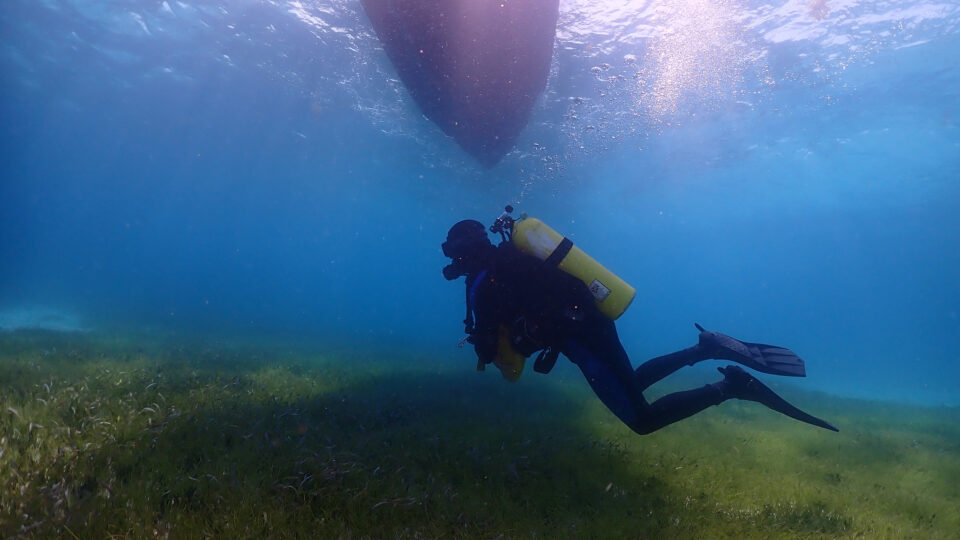
Seagrasses are found in shallow salty and brackish waters in many places around the world, from the tropics to the Arctic Circle.  They get their name from their long green, grass-like leaves.  They are not seaweeds at all but are more closely related to flowering plants on land. 

We hear a lot about threatened ocean ecosystems and most of the attention is on coral reefs and coastal mangrove forests.  Seagrass meadows get much less press, but they in fact provide wide-ranging services to society and store a great deal of carbon.

A new study by the University of Michigan demonstrates that seagrass ecosystems should be high up on the global conservation agenda.  The study puts a dollar value on the many services – which include storm protection, fish habitat, and carbon storage – provided by seagrasses in the Caribbean.  The numbers are enormous.

The researchers estimate that the Caribbean holds up to half of the world’s seagrass meadows by surface area, and it contains about a third of the global carbon storage by seagrasses.  They calculated that the Caribbean seagrasses provide about $255 billion in services to society each year, which includes $88 billion in carbon storage.

In the Bahamas alone, ecosystems services provided by seagrasses are valued at more than 15 times the country’s 2020 gross domestic product.

Blue carbon is the name used to describe carbon stored in coastal and open-ocean ecosystems.  The idea of selling blue carbon offset credits, which monetize the carbon stored in this way, is gaining traction.  For many Caribbean nations, this is likely to provide impetus for protecting seagrass ecosystems from human impacts, including nutrient pollution and overfishing.

**********

Web Links

Caribbean seagrasses provide services worth $255B annually, including vast carbon storage, study shows

Photo, posted June 27, 2023, courtesy of Daniel Eidsmoe via Flickr.

Earth Wise is a production of WAMC Northeast Public Radio

A Better Solar Evaporator | Earth Wise

May 21, 2021 By EarthWise Leave a Comment

Technology breakthrough to help reduce water stress

Water security is a serious global problem.  Nearly 1.5 billion people – including almost half a billion children – live in areas of high or extremely high water vulnerability.  Less than 3% of the world’s water is fresh and demand for it is rising with increasing population growth, urbanization, and growing water needs from a range of sectors.

Researchers at the University of South Australia have developed a promising new technique that could help reduce or eliminate water stress for millions of people.  The technique uses highly efficient solar evaporation to obtain fresh water from seawater, brackish water, or even contaminated water.   According to the researchers, their technique can deliver enough daily fresh drinking water for a family of four from just one square meter of source water.

Solar evaporation has been the focus of a great deal of effort in recent years, but it has generally been found to be too inefficient to be practically useful.  The new technique overcomes those inefficiencies and can deliver fresh water at a fraction of the cost of existing technologies like reverse osmosis.

The system utilizes a highly efficient photothermal structure that sits on the surface of a water source and converts sunlight to heat, focusing energy precisely on the surface to rapidly evaporate the uppermost portion of the liquid.  The technique prevents any loss of solar energy and even draws additional energy from the bulk water and surrounding environment.

The system is built entirely from simple, everyday materials that are low cost, sustainable, and easily obtainable.

The technology has the potential to provide a long-term clean water solution to people who can’t afford other systems, and these are the places where such solutions are most needed.

**********

Web Links

Sunlight to solve the world’s clean water crisis

Photo, posted November 13, 2016, courtesy of Steve Austin via Flickr.

Earth Wise is a production of WAMC Northeast Public Radio.

Mangrove Trees And Climate Change | Earth Wise

July 7, 2020 By EarthWise Leave a Comment

climate change threatens mangrove trees

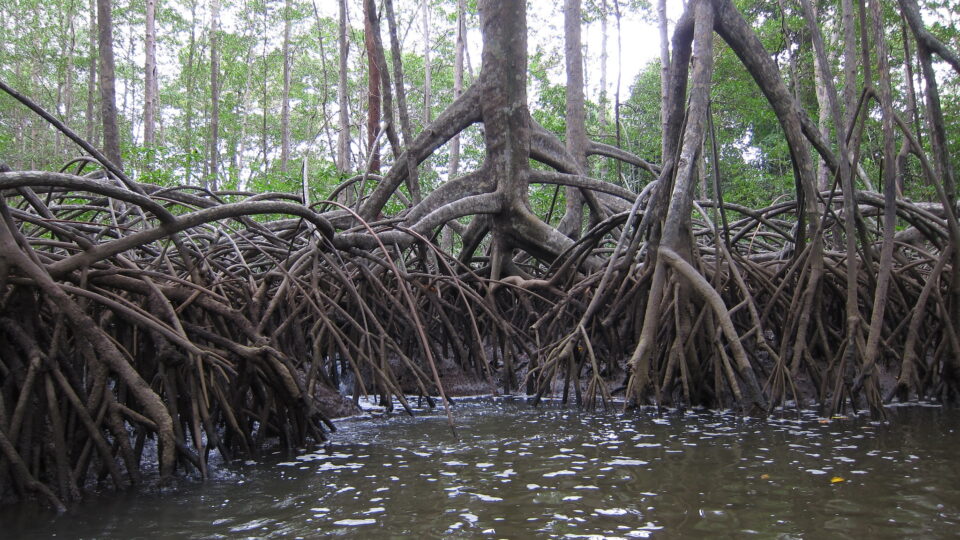
Mangrove trees are small trees that grow in coastal saline or brackish water at tropical and subtropical latitudes.  Many mangrove trees can be identified by their dense tangle of prop roots.  These roots make the trees appear as if they are standing on stilts above the water.  The tangle of roots allows mangrove trees to handle the daily rise and fall of tides and to slow the movement of tidal waters.  

Mangrove forests provide many ecosystem services, including stabilizing the coastline by reducing erosion from storm surges, waves, and tides.  The intricate root system of mangrove trees are attractive to fish and other species seeking food and shelter from predators.  Mangrove forests also store large amounts of carbon.     

But according to a new study recently published in the journal Science, mangrove trees won’t survive sea level rise by 2050 if greenhouse gas emissions aren’t reduced.  

Using sediment data from 78 locations over the last 10,000 years, an international team of scientists led by Macquarie University in Australia estimated the chances of mangrove trees survival based on the projected rates of future sea-level rise.

When sea level rise rates exceeded 6 millimeters per year, which is similar to estimates under high-emissions scenarios for 2050, researchers found that mangrove trees were unlikely to keep pace with the rising water levels.  But when the annual increase was 5 millimeters or less – which is the projected low-emissions scenario this century – mangrove trees are much more likely to survive. 

These findings underscore the importance of reducing greenhouse gas emissions to mitigate rapid sea level rise.  The future of mangrove trees may depend on it.  

**********

Web Links

Mangrove trees won’t survive sea-level rise by 2050 if emissions aren’t cut

Photo, posted December 17, 2012, courtesy of Edward Stojakovic via Flickr.

Earth Wise is a production of WAMC Northeast Public Radio.

Primary Sidebar

Recent Episodes

  • An uninsurable future
  • Clean energy and jobs
  • Insect declines in remote regions
  • Fossil fuel producing nations ignoring climate goals
  • Trouble for clownfishes

WAMC Northeast Public Radio

WAMC/Northeast Public Radio is a regional public radio network serving parts of seven northeastern states (more...)

Copyright © 2025 ·