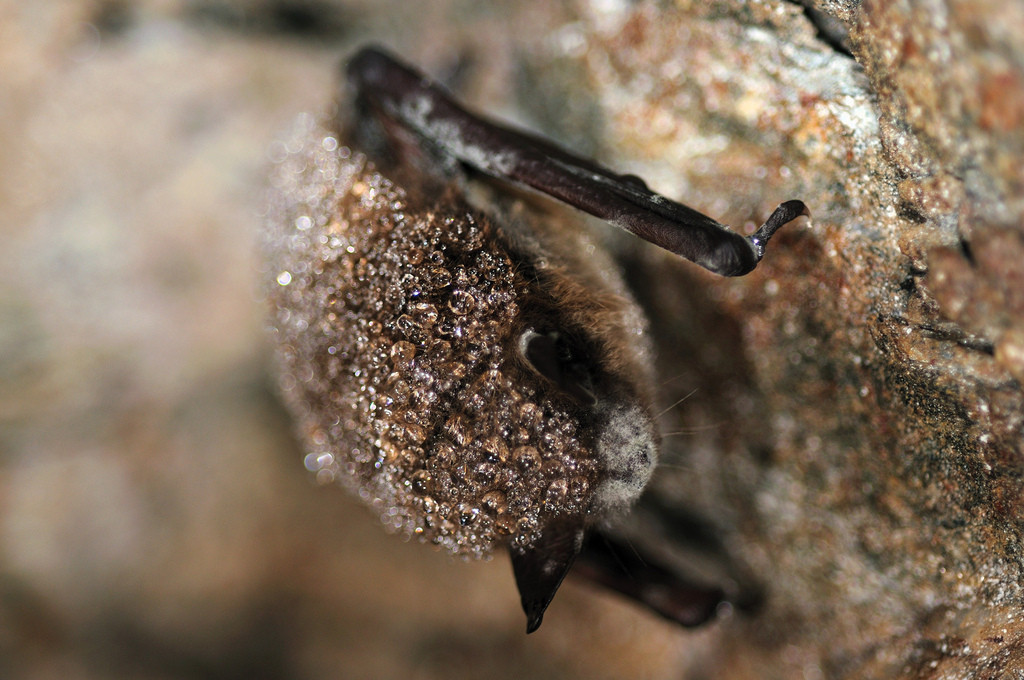
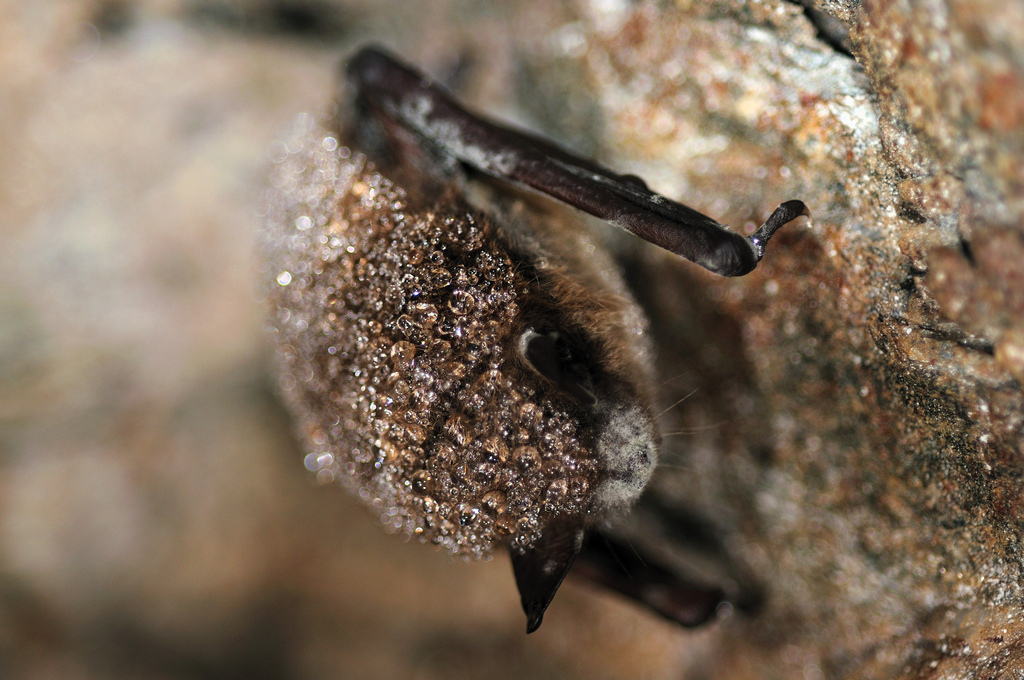
Common throughout North America, little brown bats keep insect populations in check. Anyone who has spent dusk near a lake has seen the little browns performing acrobatics on the wing as they feast on mosquitoes, midges, and gnats. Each bat can eat thousands of bugs each night.
When the weather cools, little brown bats look for sheltered places to overwinter. Animals roost in groups, preferring areas with above freezing temperatures and high humidity, such as abandoned mines and caves. To conserve fat reserves, bats enter ‘winter torpor,’ dropping their body temperature, respiration, and heart rate.
If all goes well, bats emerge in the spring, ready to form nursery colonies and continue their insect-eradication services. Unfortunately, since 2006, all has not been going well. A fungus has become widespread in the caves where many bats overwinter, with devastating effects.
‘White nose syndrome’ has killed more than 5 million bats in North America. Little brown bats have been hard hit, with some populations declining by 90-100%. Impacted animals have white lesions on their muzzles and wings, and act erratic — waking from their winter torpor and flying about in the cold.
A model developed by the University of Wisconsin and the U.S. Geological Survey has shed light on how the fungus attacks little brown bats. Researchers were surprised to find physiological effects occuring before visible signs or behaviors. Newly infected bats burned twice the normal rate of energy during hibernation and suffered from dehydration.
Findings confirm previous studies, and will the development of inform recover strategies.
*********
.
Web Links
Photo, posted September 20, 2011, courtesy of USFWSMidwest via Flickr.
.
Earth Wise is a production of WAMC Northeast Public Radio, with script contribution from the Cary Institute of Ecosystem Studies.
Excellent information on our bug fighters, our friends- BATS!