• Skip to primary navigation
  • Skip to main content
  • Skip to primary sidebar

Earth Wise

A look at our changing environment.

  • Home
  • About Earth Wise
  • Where to Listen
  • All Articles
  • Show Search
Hide Search
You are here: Home / Archives for vacant lots

vacant lots

Bees and urban wildflowers

May 23, 2025 By EarthWise Leave a Comment

Urban wildflowers may threaten bees in some cases

Post-industrial cities often have large numbers of vacant lots, left behind as people have moved out of the area.  Local residents are often tempted to plant wildflowers to make these deserted spaces more attractive. 

Wildflowers are an important food source for bees.  Pollinators like bees play a vital role in food production and attracting them with food sources is a good idea.  However, a study by researchers at the University of Cambridge in the UK found that there are dangers associated with planting wildflowers in some urban settings.

Wildflowers growing on land previously used for buildings and factories can accumulate lead, arsenic, and other metal contaminants from the soil.  These metals have previously been shown to damage the health of pollinators that ingest the metals in the nectar as they feed.

The Cambridge study was carried out in Cleveland, Ohio, which has nearly 34,000 vacant lots.  Cleveland was previously the site of iron and steel production, oil refining, and car manufacturing.  The researchers tested the nectar from flowering plants growing on disused land throughout the city.  Lead was the contaminant found in the highest concentrations.  They also found that different species of plants accumulate different amounts and different types of metals.

The goal of the study was not to discourage the planting of wildflowers in towns and cities.  It is to highlight the importance of growing the right species of wildflowers as well as to encourage testing soils for metals before planting wildflowers and to clean up pollution.  Wildflowers are important for pollinators, but it is also important that they don’t contribute to the decline of pollinator populations that has already been happening for a number of reasons.

**********

Web Links

Growing wildflowers on disused urban land can damage bee health

Photo, posted August 26, 2012, courtesy of RJP via Flickr.

Earth Wise is a production of WAMC Northeast Public Radio
Solar Parking Lots In France | Earth Wise

January 6, 2023 By EarthWise Leave a Comment

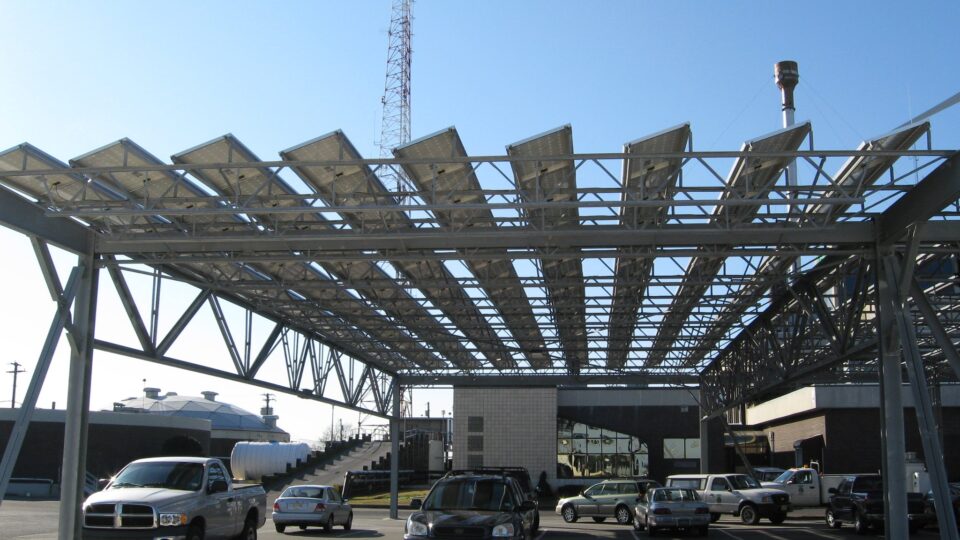
France has passed legislation that will require all parking lots with more than 80 spaces to be covered over by solar panels.  This is part of a broader effort to put solar panels on vacant lots, empty land alongside roadways and train tracks, and even some farmland.  The overall program would add 11 gigawatts of solar power to the French electricity grid.

The legislation applies to both new and existing parking lots.  Owners of parking lots with more than 400 spaces would have 3 years to comply, while owners of lots with 80 to 400 spaces would have five years.

To produce 11 gigawatts of solar output, about half a percent of France’s urban land would need to be covered with solar panels.  This is quite a bit, but not an insurmountable obstacle.  Parking lots, however, could only provide a fraction of what is needed.  It would take something like 8 million parking spaces covered with solar panels to produce that much power.  That is probably at least twice as many as France has.

Several countries, most notably Germany, already have mandates for new construction to incorporate renewable energy.  This includes solar panels, biomass boilers, heat pumps, and wind turbines.  Many parking lots in southern Europe already have sunshades over them, which would make it pretty easy to install solar panels.  This is much rarer in cooler countries.

France is pursuing this policy to reduce its dependence on nuclear power, which currently provides 70% of the country’s electricity.  Apart from the general trend of opposition to nuclear power, reliance upon it during increasingly common droughts is problematic as the power plants require significant amounts of water to operate.

**********

Web Links

France’s plan for solar panels on all car parks is just the start of an urban renewable revolution

Photo, posted February 11, 2008, courtesy of Armando Jimenez / U.S. Army Environmental Command via Flickr.

Earth Wise is a production of WAMC Northeast Public Radio.

Urban Agriculture And Sustainability Goals

November 12, 2019 By EarthWise Leave a Comment

In 2016, the City Council of Phoenix, Arizona adopted eight Environmental Sustainability goals for 2050 that lay out the desired long term requirements in order to become a Sustainable Desert City.  Recently, a group of researchers from Arizona State University assessed how urban agriculture can help Phoenix, a desert city of 1.6 million people, meet those sustainability goals.  

Using public records and high-resolution satellite imagery, researchers analyzed the potential benefits of growing crops in three types of urban areas in Phoenix: vacant lots, rooftops, and building facades.  The study, which was supported by the National Science Foundation and the USDA, estimated that there are 28 square miles (or 5.4% of city space) available for urban agriculture.  The data-driven analysis found that 71% of the available areas for urban agriculture would come from existing buildings as opposed to vacant lots. 

All this available space for urban agriculture in Phoenix could supply the city with nearly 183,000 tons of fresh produce annually, which would allow for the delivery of fresh fruits and vegetables to all of the city’s existing food deserts. In fact, the city’s own urban-agriculture output could meet 90% of the fresh produce demand that currently exists in Phoenix. 

In addition to producing food, rooftop agriculture could also reduce the energy use in buildings by 3% per building per year, and displace more than 55,000 tons of CO2 annually.  The use of vacant lots could increase the total Phoenix green space by 17%, and reduce the number of areas lacking green space by 60%.   

This study demonstrates the many different ways that urban agriculture can benefit a city. 

**********

Web Links

Urban agriculture can push the sustainability

Photo, posted May 10, 2011, courtesy of Stephen Zank via Flickr.

Earth Wise is a production of WAMC Northeast Public Radio.

Cities Can Help Bees

December 14, 2017 By EarthWise Leave a Comment

https://earthwiseradio.org/wp-content/uploads/2017/12/EW-12-14-17-Cities-Can-Help-Bees.mp3

Global bee populations have been drastically declining as a result of habitat loss, pesticides and climate change.  But studies are showing that planting flower patches in urban gardens and green spaces can make a real difference in restoring natural pollinators.   There are already positive results in cities from Chicago to London to Melbourne.

[Read more…] about Cities Can Help Bees

Primary Sidebar

Recent Episodes

  • An uninsurable future
  • Clean energy and jobs
  • Insect declines in remote regions
  • Fossil fuel producing nations ignoring climate goals
  • Trouble for clownfishes

WAMC Northeast Public Radio

WAMC/Northeast Public Radio is a regional public radio network serving parts of seven northeastern states (more...)

Copyright © 2026 ·