• Skip to primary navigation
  • Skip to main content
  • Skip to primary sidebar

Earth Wise

A look at our changing environment.

  • Home
  • About Earth Wise
  • Where to Listen
  • All Articles
  • Show Search
Hide Search
You are here: Home / Archives for tech

tech

Soda can hydrogen

August 15, 2025 By EarthWise Leave a Comment

Produce green hydrogen from soda cans

Hydrogen is an ideal climate-friendly fuel because it doesn’t release carbon dioxide when it is used.  But most hydrogen is produced in ways that result in significant carbon emissions. Thus, the search for green hydrogen goes on. 

Last year, engineers at MIT developed a new process for making hydrogen that significantly reduces the carbon footprint of its production.  The recipe uses seawater and recycled soda cans. 

Pure aluminum reacts with water, breaking up the water molecules to produce aluminum oxide and pure hydrogen.  But when aluminum is exposed to oxygen, it forms a shield-like layer that prevents the reaction.

The MIT researchers found that the shield can be removed by treating aluminum with a small amount of gallium-indium alloy.  Mixing the pure aluminum with seawater not only produces hydrogen, but the salt in the seawater precipitates out the gallium-indium, making it available for reuse.

The research team carried out a “cradle-to-grave” life cycle assessment of the process, taking into account every step in using the hydrogen-production process at an industrial scale.  They found that using recycled aluminum – chopped-up soda cans – is environmentally and economically superior to using “primary” aluminum, mined from the earth. The cans would be shredded into pellet and treated with the gallium-indium alloy.  The pellets would be processed near a source of seawater where they would be combined to generate hydrogen on demand.

According to their analysis, the hydrogen produced would be at least competitive economically and environmentally with other potential methods of producing green hydrogen.

**********

Web Links

Study shows making hydrogen with soda cans and seawater is scalable and sustainable

Photo, posted July 29, 2020, courtesy of Bruce Dupree via Flickr.

Earth Wise is a production of WAMC Northeast Public Radio

Reducing emissions from ocean shipping

August 13, 2025 By EarthWise Leave a Comment

A new process could help reduce emissions from ocean shipping

Ocean shipping is a significant contributor to global carbon emissions, accounting for about 3% of the total.  It is a key part of international trade, moving goods like electronics, automobiles, and oil.  It relies on fossil fuels, and, without significant changes, shipping’s emissions could more than double by 2050.  Ocean shipping is one of the world’s most difficult to decarbonize industrial sectors.

Scientists at the University of Southern California and Caltech, collaborating with a startup company called Calcarea, have developed a shipboard system that could remove up to half of the carbon dioxide emitted by shipping vessels. The system is fairly simple and scalable.

The process mimics a natural chemical reaction that takes place in the ocean.  As a cargo ship moves through seawater, the CO2 from the ship’s exhaust is absorbed into water that is pumped onboard.  This makes the water more acidic.  The treated water is then passed through a bed of limestone, where it reacts with the rock to form bicarbonate, which is a stable compound that already exists naturally in seawater.  The treated seawater, now stripped of the carbon dioxide, is dumped back into the ocean.

Sophisticated ocean modeling examined what would happen when the bicarbonate-rich water is released back into the sea over a hypothetical 10-year period.  The model showed a negligible impact on ocean pH and chemistry.

The researchers estimate that widespread adoption of the technique could reduce shipping-related carbon dioxide emissions by 50%.  The startup company Calcarea is working to bring the technology to market and is in early discussions with commercial shippers.

**********

Web Links

USC technology may reduce shipping emissions by half

Photo, posted November 14, 2017, courtesy of Bernard Spragg via Flickr.

Earth Wise is a production of WAMC Northeast Public Radio

Geothermal energy may be safe

August 4, 2025 By EarthWise Leave a Comment

The Trump Administration is outwardly hostile to renewable energy, especially solar and wind power.  Federal support for these energy sources that are by far the most rapidly growing energy sources across the globe is being gutted while fossil fuels are being propped up.

There is also renewed enthusiasm for nuclear power and, somewhat surprisingly, geothermal heat.   Geothermal is a renewable and clean energy source that has long been mostly overlooked and underfunded.  The main reasons are its expense and the fact that its large-scale use is unproven. 

Historically, geothermal energy has relied upon naturally occurring features such as hot springs and shallow underground heat sources.  However, technological breakthroughs that began in 2013 have led to enhanced geothermal systems, or EGS.  EGS makes use of the fact that if you drill deep enough into the earth pretty much anywhere, you will encounter substantial amounts of heat.  EGS plants pump water three miles down or more where it encounters rock that reaches over 500 degrees.  The piping hot water is then brought to the surface where it spins turbines to generate electricity.

Several companies are developing EGS in the U.S.  financed by tech companies seeking power for their AI activities, the Defense Department, and even by fossil fuel companies who use comparable drilling technology for fracking.

The so-called Big Beautiful Bill passed by Congress in July that eliminates tax credits for wind and solar energy preserves tax credits for geothermal projects.

**********

Web Links

Why U.S. Geothermal May Advance, Despite Political Headwinds

Photo, posted September 30, 2019, courtesy of Stephen D Strowes via Flickr.

Earth Wise is a production of WAMC Northeast Public Radio

How much nanoplastic is in the oceans?

August 1, 2025 By EarthWise Leave a Comment

There is a shocking amount of nanoplastics in the world's oceans

It is unfortunately well-known that microplastics are pretty much everywhere on Earth.  They are also increasingly found in living things like birds and dolphins as well as in human brains and placentas.  The oceans are polluted with plastic, and for the first time, there is now an estimate for the volume of nanoplastics – which are even smaller than microplastics and invisible to the human eye – found in the North Atlantic.

According to a study published in the journal Nature by the microplastics and nanoplastics research group at the Helmholtz Center for Environmental Research in Germany, there are at least 30 million tons of nanoplastics in the North Atlantic, which is more than the weight of all wild land mammals on Earth.

The same researchers have analyzed plastic in lakes, urban air, and even the air in very remote places, but the new study reveals a missing part of the plastics story.

Nanoplastics are microscopic fragments smaller than one micron, about the size of small bacteria.  There has been ongoing concern about nanoplastics in ocean water, but there wasn’t the technology available to really investigate it.  While nanoplastics were expected to be found in the ocean, the sheer amount of it was surprising.

The average concentration of nanoplastics near coastlines is about 25 milligrams per cubic meter of water, about the weight of a single large bird feather.   Nanoplastics are tiny enough that they can easily infiltrate the bodies of living creatures.  For fish and other ocean animals, that means constant exposure that builds up over time.

It is highly unlikely that plastic pollution is going to stop any time soon, but there is a United Nations meeting on the subject in August in Geneva.

**********

Web Links

Tons of Invisible Plastic Pieces Lurk in Ocean Water

Photo, posted June 24, 2020, courtesy of G.P. Schmal / NOAA via Flickr.

Earth Wise is a production of WAMC Northeast Public Radio

More efficient cooling for data centers

July 22, 2025 By EarthWise Leave a Comment

Engineers are working on a more efficient method to cool data centers

Increasing reliance on digital technologies in general and artificial intelligence in particular are dramatically increasing the energy consumption of data centers.  Data centers consume far more energy per square foot than other commercial buildings.  By the year 2030, data center energy consumption in the US is projected to reach 9% of the country’s electricity generation. 

Computing hardware consumes large amounts of energy and generates large amounts of heat in the process.  Currently, cooling the equipment so it doesn’t burn out accounts for as much as 40% of a data center’s total energy use. 

Engineers at the University of California San Diego have developed a new cooling technology that could significantly improve the energy efficiency of data centers.  The technology makes use of a specially engineered fiber membrane that passively removes heat through evaporation.

The membrane has a network of tiny, interconnected pores that draw cooling liquid across the membrane surface using capillary action.  As the liquid evaporates, it removes heat from the electronics underneath.  No extra energy is required.

Tests of the membrane demonstrated record-breaking performance in removing heat from electronics and being able to withstand very high levels of heat flux.

The researchers say that the technology is still operating well below its theoretical limit, and with additional work, can lead to optimized performance.  The membranes will be integrated into cold plates, which are components that attach to power-hungry computing components to dissipate heat.  The team is also launching a startup company to commercialize the new cooling technology.

**********

Web Links

New Cooling Tech Could Curb Data Centers’ Rising Energy Demands

Photo, posted January 23, 2023, courtesy of Jefferson Lab via Flickr.

Earth Wise is a production of WAMC Northeast Public Radio

Wasting less wastewater

July 17, 2025 By EarthWise Leave a Comment

Developing technologies to waste less wastewater

Ultra-pure water is essential for multiple industries, for example semiconductors, batteries, and pharmaceuticals, as well as food and beverage companies.  Such water is produced by various processes including desalination plants that use reverse osmosis.  The byproduct of the processing is industrial brine:  salty wastewater.

The brine produced by desalination is generally dumped into the ocean if the desalination plant is located at the seashore, but if the plant is inland, such as in places like Arizona, that isn’t an option.

Nestle runs a water desalinating plant near Phoenix that generates more than 50,000 gallons of brine every day.  Concentrated brines must be carefully managed and disposed of. 

Researchers at Arizona State University are developing a mobile, closed-loop water recovery demonstration system that aims to recover 50%-90% of previously unusable water from industrial brine and reduce the remainder to solid salt. 

The team’s approach involves pretreating Nestle’s brine to remove larger particles.  It then goes through a reverse osmosis process that results in a stream of high-quality water and a salty concentrate.  The salty concentrate goes through a special membrane that recovers even more pure water.  The highly concentrated brine is then dried and crystalized into a solid salt product.  Atmospheric water harvesters capture any remaining water vapor during the drying process.

In places like Arizona where freshwater is a scarce commodity, finding sustainable ways to separate water from salt is both a scientific challenge and an economic necessity.

**********

Web Links

Squeezing every last drop out of wastewater

Photo courtesy of the Global Center for Water Technology.

Earth Wise is a production of WAMC Northeast Public Radio

New nuclear power for New York

July 9, 2025 By EarthWise Leave a Comment

New nuclear power plant is coming in New York

Nuclear power has been around since the 1950s, but it has fallen out of favor in recent decades, in part due to a couple of traumatic disasters at nuclear power plants.  In fact, only two new nuclear power plants have been built in the US in the past 30 years, and they took a very long time and an enormous amount of money to build.

However, in recent times there has been a great deal of developmental work on nuclear power.  Such newer technologies as small modular reactors, molten salt reactors, light water reactors, and more hold promise for safer, less expensive, and higher performance nuclear power.

In late June, New York Governor Kathy Hochul announced that she has instructed the New York Power Authority to develop and construct a zero-emission advanced nuclear power plant in Upstate New York.  The plant is to produce 1 GW of power, about half of what the decommissioned Indian Point Power Plant produced when it provided significant amounts of power to New York City residents.

Renewed interest in nuclear power has emerged in part because of the soaring electricity demand from AI data centers.  Companies like Amazon, Google, and Microsoft have all begun investing in nuclear power for this reason.

NYPA is instructed to begin evaluating technologies, business models, and locations for the new power plant and will seek to secure key partnerships needed for the project.  As things stand, it is not known what technology the plant will use, where in Upstate New York it will be located, how much it will cost to build, who will pay for it, and how long it will take to build. 

**********

Web Links

New York Again Embraces Nuclear Power With Plans to Build New Plant

Photo courtesy of Constellation Energy.

Earth Wise is a production of WAMC Northeast Public Radio

Sun powered carbon capture

June 30, 2025 By EarthWise Leave a Comment

Using solar power to help capture carbon

As the world struggles to implement technologies and find the political will to reduce carbon emissions, there are also ongoing efforts to find ways to capture carbon from emitting sources and from the atmosphere itself.  After capturing carbon dioxide, there is then the need to safely store it or make use of it.

Current methods for capturing and then releasing carbon dioxide are expensive and energy intensive.  In fact, some methods even require the use of fossil fuels.  Recently, researchers at Cornell University have developed a method for capturing carbon dioxide that is powered by sunlight.

The Cornell method mimics the mechanisms that plants use to store carbon which involves using sunlight to make a reactive enol molecule that grabs carbon dioxide.  

Existing chemical-based carbon capture techniques make use of amines, which are organic ammonia-derived compounds that react selectively with carbon dioxide.  But amines are not stable in the presence of oxygen and don’t last, which necessitates the energy-intensive production of more and more amines.

The Cornell method uses the same method that the plant enzyme RuBisCo uses in photosynthesis.  It is based on an inexpensive sorbent material that is capable of a high rate of carbon capture.

The researchers tested the system using flue samples from Cornell’s Combined Heat and Power Building, an on-campus power plant that burns natural gas.  The system was successful in isolating carbon dioxide.

Ultimately, they would like to stage the reaction on what looks like a solar panel, but one that would capture carbon instead of generating electricity.

**********

Web Links

In a first, system uses sunlight to power carbon capture

Photo, posted August 8, 2015, courtesy of Holly Victoria Norval via Flickr.

Earth Wise is a production of WAMC Northeast Public Radio

Volcano monitoring

May 16, 2025 By EarthWise Leave a Comment

Researchers develop a new method to monitor volcanoes

Researchers at the University of Alaska Fairbanks and the U.S. Geological Survey have developed a radar-based volcano monitoring system.  The purpose is to provide situational awareness of volcano behavior and identify volcanoes that are becoming restless before other more obvious indications like earthquake activity occur.

The system is called VolcSARvatory and makes use of interferometric synthetic aperture radar to detect ground movement changes as small as one centimeter.  It utilizes two or more radar images from satellites taken at different times.  The images are used to create a time series of data from a single location.

The system has been in operation since early 2022 and proved to be valuable in studying the unexpected activity at the long-quiet Mount Edgecumbe volcano near Sitka, Alaska where conventional monitoring was not taking place.

According to the researchers, the technology has evolved to the point where it can be operational at a national level.  The goal is to provide a consistent approach to monitoring active volcanoes.

Volcanoes are not a rare and unlikely source of potential danger in this country.  The volcanoes of Hawaii are the best-known active volcanoes in the United States, but Alaska has about 140 volcanoes that are technically classified as active, with more than 50 that have been active within the past 300 years.  In total, 169 U.S. volcanoes are classified as active including ones in Arizona, California, Colorado, Idaho, Nevada, New Mexico, Oregon, Utah, Washington and Wyoming.

**********

Web Links

Alaska-developed volcano monitoring system will expand across U.S.

Photo, posted March 18, 2013, courtesy of Jeffrey Wickett / USFS via Flickr.

Earth Wise is a production of WAMC Northeast Public Radio

Repurposing used tires

April 29, 2025 By EarthWise Leave a Comment

Every year, millions of tires from cars and trucks end up in landfills.  Just in the U.S., more than 270 million tires were scrapped in 2021 and more than 50 million of them ended up in landfills.  Discarded tires take up huge amounts of space but, more importantly, create environmental hazards.  They leach chemicals into the environment and are a serious fire hazard.

Some tires are chemically recycled via pyrolysis, which is a high-temperature process to decompose the materials in the tire.  But that process introduces harmful byproducts like benzene and dioxins. 

Researchers at the University of North Carolina Chapel Hill have introduced a new chemical method for breaking down rubber waste.  The process transforms discarded rubber into valuable precursors for epoxy resins.

Rubber – either natural rubber or the synthetic kind used in tires – is made of polymers cross-linked together to form a tough, flexible, and durable material.  These very desirable properties make it difficult to break down rubber.

The new research has led to a two-step chemical process that breaks down the rubber into functional materials that be used to produce epoxy resins.  The method does not require extremely high temperatures, uses aqueous media, and takes only six hours.   It represents an efficient, scalable solution for repurposing rubber waste which, even as many other aspects of motor vehicle are changing for the better, remains a continuing environmental problem associated with driving.

This new research marks a significant step towards greener recycling technologies.

**********

Web Links

A Cleaner Future for Tires: Scientists Pioneer Chemical Process to Repurpose Rubber Waste

Photo, posted May 5, 2011, courtesy of TireZoo via Flickr.

Earth Wise is a production of WAMC Northeast Public Radio
Clean energy in New York

March 14, 2025 By EarthWise Leave a Comment

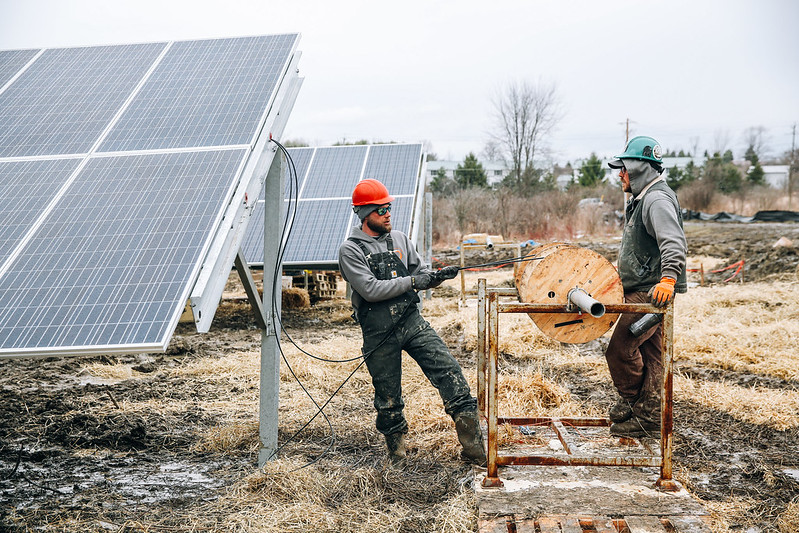
The New York State Energy Research and Development Authority – NYSERDA – recently issued a report on clean energy progress in the state during 2024.  The report highlighted continued and increased growth in heat pumps, electric vehicles, and solar energy.

Heat pumps, which provide both heating and cooling, have outsold gas furnaces countrywide for three straight years.  Air source heat pumps outsold gas furnaces by 37%.  This does not include ground source heat pumps, also known as geothermal heat pumps. New York offers Clean Heat rebates to offset the cost of installing heat pumps.

2024 was a good year for electric vehicles in New York with 90,221 new registrations.  More than 60 car models are eligible for New York’s Drive Clean state rebates.

New York achieved its Climate Act goal of having 6,000 MW of distributed solar power in October.  The state is expected to have more than 10,000 MW of distributed solar by 2030.

Nationwide, solar energy represented 64% of all the new electricity generation capacity installed in 2024, up from 55.5% in 2023.  Utility-scale solar generation in the lower 48 states was 36% higher in the summer of 2024 than in summer 2023.

NYSERDA’s report points out that converting to clean energy technologies can bring multiple benefits that include energy efficiency, cost savings, and reduced greenhouse gas emissions and air pollution.

**********

Web Links

Heat Pumps, Electric Vehicles, and Solar Scale Up Through 2024

Photo, posted April 6, 2017, courtesy of Stephen Yang / The Solutions Project via Flickr.

Earth Wise is a production of WAMC Northeast Public Radio

Wave energy in LA

March 6, 2025 By EarthWise Leave a Comment

Ocean waves form as wind blows over the surface of open water.  Globally, waves contain tremendous amounts of energy.  Theoretically, the energy generating potential of waves off the coasts of the U.S. would meet more than 60% of the country’s electricity needs.  There are a variety of methods and technologies for tapping into this energy source, but none have reached the point of commercial adoption to date.  There are many problems that remain to be solved.

Eco Wave Power, a wave energy company, announced that it has received the necessary permit from the U.S. Army Corps of Engineers to operate the first onshore wave energy installation in the United States.  The installation will be at the Port of Los Angeles at the facilities of AltaSea, a public-private ocean institute that conducts research on food and energy supply, climate change, and ocean exploration.

The system will utilize eight of Eco Wave Power’s energy floaters that will be installed on the piles of an existing concrete wharf structure on Municipal Pier One.  The system will also include an energy conversion unit enclosed in two shipping containers and connected to the floaters.  The installation is expected to be completed by the end of the first quarter of this year.

Floaters draw energy from waves by using their rising and falling motion to generate electricity. The bobbing motion of the floaters compresses and decompresses hydraulic pistons.  These transmit hydraulic fluid into land-based accumulators that build up pressure.  The pressure rotates a hydraulic motor, which then operates a generator, producing electricity.

The project is a collaboration on the development of wave energy in the Port of Los Angeles between Eco Wave Power and Shell Marine Renewable Program.

**********

Web Links

Eco Wave Power secures final USACE permit for its first U.S. wave energy project

Photo courtesy of Eco Wave Power.

Earth Wise is a production of WAMC Northeast Public Radio

Electricity demand from data centers

February 17, 2025 By EarthWise Leave a Comment

Data centers are dedicated facilities containing computers and their related hardware equipment such as servers, data storage drives, and network equipment; they are the physical facilities that store digital data.  Data centers are one of the most energy-intensive building types, consuming 10 to 50 times more energy per floor space than a typical commercial office building.  With the explosive growth of artificial intelligence technology, data center energy use is expanding rapidly.

A new report by the Department of Energy’s Lawrence Berkeley National Laboratory outlines the energy use of data centers from 2014 to 2028.  The report estimates that data center load growth has tripled over the past decade and is likely to double or triple again by 2028.

Data centers consumed about 4.4% of total U.S. electricity in 2023 and are projected to consume between 6.7% and 12% of total U.S. electricity by 2028. Most of the increased power demand of data centers is due to the growth in AI servers.  Artificial intelligence requires increasingly powerful chips and intense, power-hungry cooling systems.

There have been revolutionary changes in artificial intelligence technology in just the past couple of years and its role in society has dramatically expanded.  With that expansion has come a dramatic change in the energy usage by the data industry and innovative solutions are needed to allow data centers to meet their growing demand for energy.

**********

Web Links

Berkeley Lab Report Evaluates Increase in Electricity Demand from Data Centers

Photo, posted August 31, 2024, courtesy of Aileen Devlin / Jefferson Lab via Flickr.

Earth Wise is a production of WAMC Northeast Public Radio

Primary Sidebar

Recent Episodes

  • An uninsurable future
  • Clean energy and jobs
  • Insect declines in remote regions
  • Fossil fuel producing nations ignoring climate goals
  • Trouble for clownfishes

WAMC Northeast Public Radio

WAMC/Northeast Public Radio is a regional public radio network serving parts of seven northeastern states (more...)

Copyright © 2025 ·