• Skip to primary navigation
  • Skip to main content
  • Skip to primary sidebar

Earth Wise

A look at our changing environment.

  • Home
  • About Earth Wise
  • Where to Listen
  • All Articles
  • Show Search
Hide Search
You are here: Home / Archives for satellite imagery

satellite imagery

The last days of a giant iceberg

October 23, 2025 By EarthWise Leave a Comment

A-23A

A colossal iceberg known as A-23A broke off from the Filchner Iceshelf in Antarctica in 1986.  At that time, it was 1,418 square miles in area, slightly larger than the state of Rhode Island, or roughly twice the size of greater London.  It weighed about a trillion tons.  It was the largest iceberg ever observed.

After breaking off from the iceshelf, it lodged on the seafloor of the southern Weddell Sea for decades.  It finally broke free in the early 2020s and began drifting northward.  Last year, it got caught up in a rotating ocean vortex in the Drake Passage, and then became lodged on a shallow coastal shelf south of South Georgia Island.  More recently, satellite imagery has shown A-23A to be on the move again.

Like other large icebergs that have found their way into the so-called “iceberg alley”, it is gradually succumbing to the effects of warmer air and water.  Two large fragments of A-23A have already calved from it.  These are huge in their own right:  A-23G and A-23I are each over 125 square miles in area.  The remaining main body of A-23A is still 580 square miles in area, making it the second largest freely floating iceberg in the world as of September.  It had already lost much of its area since it began drifting north.

As it continues to drift northward, A-23A will continue to break apart.  Many smaller pieces are littering the sea in its vicinity, but even these are large enough to threaten ships.  The 40-year saga of iceberg A-23A is coming to an end.

**********

Web Links

A Giant Iceberg’s Final Drift

Photo courtesy of the Earth Observatory at NASA.

Earth Wise is a production of WAMC Northeast Public Radio
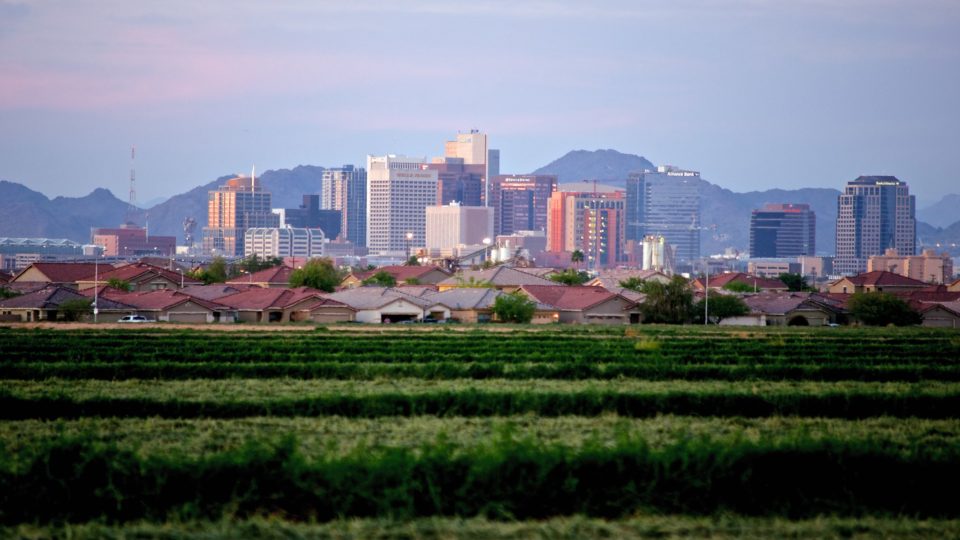
Urban Agriculture And Sustainability Goals

November 12, 2019 By EarthWise Leave a Comment

In 2016, the City Council of Phoenix, Arizona adopted eight Environmental Sustainability goals for 2050 that lay out the desired long term requirements in order to become a Sustainable Desert City.  Recently, a group of researchers from Arizona State University assessed how urban agriculture can help Phoenix, a desert city of 1.6 million people, meet those sustainability goals.  

Using public records and high-resolution satellite imagery, researchers analyzed the potential benefits of growing crops in three types of urban areas in Phoenix: vacant lots, rooftops, and building facades.  The study, which was supported by the National Science Foundation and the USDA, estimated that there are 28 square miles (or 5.4% of city space) available for urban agriculture.  The data-driven analysis found that 71% of the available areas for urban agriculture would come from existing buildings as opposed to vacant lots. 

All this available space for urban agriculture in Phoenix could supply the city with nearly 183,000 tons of fresh produce annually, which would allow for the delivery of fresh fruits and vegetables to all of the city’s existing food deserts. In fact, the city’s own urban-agriculture output could meet 90% of the fresh produce demand that currently exists in Phoenix. 

In addition to producing food, rooftop agriculture could also reduce the energy use in buildings by 3% per building per year, and displace more than 55,000 tons of CO2 annually.  The use of vacant lots could increase the total Phoenix green space by 17%, and reduce the number of areas lacking green space by 60%.   

This study demonstrates the many different ways that urban agriculture can benefit a city. 

**********

Web Links

Urban agriculture can push the sustainability

Photo, posted May 10, 2011, courtesy of Stephen Zank via Flickr.

Earth Wise is a production of WAMC Northeast Public Radio.

Primary Sidebar

Recent Episodes

  • An uninsurable future
  • Clean energy and jobs
  • Insect declines in remote regions
  • Fossil fuel producing nations ignoring climate goals
  • Trouble for clownfishes

WAMC Northeast Public Radio

WAMC/Northeast Public Radio is a regional public radio network serving parts of seven northeastern states (more...)

Copyright © 2026 ·