• Skip to primary navigation
  • Skip to main content
  • Skip to primary sidebar

Earth Wise

A look at our changing environment.

  • Home
  • About Earth Wise
  • Where to Listen
  • All Articles
  • Show Search
Hide Search
You are here: Home / Archives for quicker

quicker

Engineering plants to consume more carbon dioxide

January 23, 2025 By EarthWise Leave a Comment

The most abundant protein on the planet is an enzyme called ribulose-1,5-bisphosphate carboxylase/oxygenase, better known as RuBisCO.  Its critical role in photosynthesis makes life as we know it on earth possible.  What it does is convert carbon dioxide from the atmosphere into the organic matter contained in plants.

Getting plants to take up more carbon dioxide from the atmosphere is a key strategy for mitigating climate change.  Planting lots of trees is one way to do it.  Another is to get individual plants to capture more carbon dioxide.

Scientists at the University of Illinois have focused on getting plants to produce more RuBisCO which allows them to grow faster, consuming more carbon dioxide in the process.

Some plants are better than others at taking advantage of the earth’s rising carbon dioxide levels.  Among these are food crops like corn, sugarcane, and sorghum.  Such plants’ growth is not primarily limited by how much carbon dioxide is in the atmosphere but rather by how much RuBisCO is in their leaves.  The Illinois scientists tweaked genes in corn and sorghum to produce plants containing more RuBisCO.  Laboratory experiments on corn demonstrated faster corn growth.  Recent outdoor field experiments on sorghum demonstrated a 16% boost in its growth rate. 

Improving photosynthesis in this way is not only a potential strategy for increasing plants’ ability to combat climate change.  It is also a way to cope with the world’s increasing demand for food by producing crops that can grow larger and more quickly.

**********

Web Links

Scientists Engineer Crops to Consume More Carbon Dioxide

Photo, posted April 12, 2016, courtesy of K-State Research and Extension via Flickr.

Earth Wise is a production of WAMC Northeast Public Radio
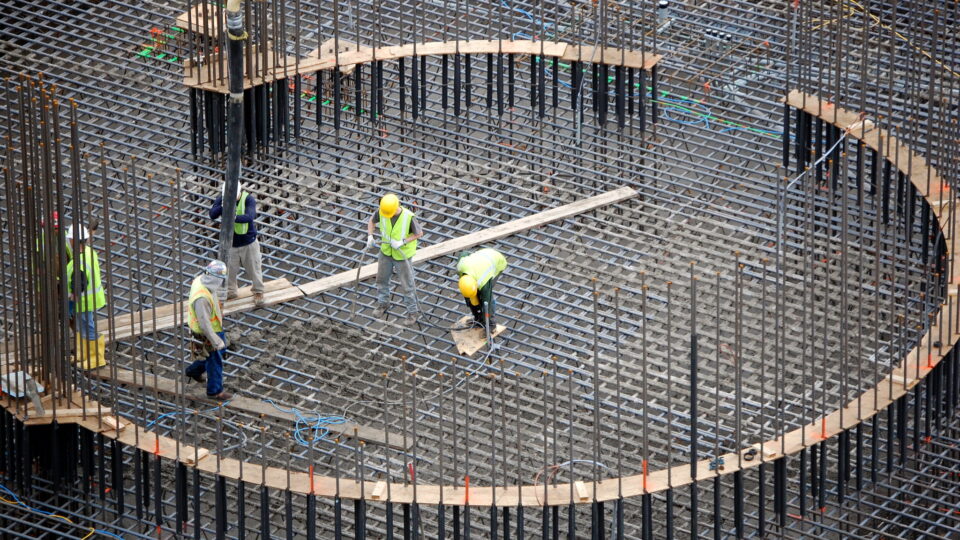
Concrete And Carbon | Earth Wise

May 8, 2023 By EarthWise Leave a Comment

How to reduce the carbon emissions associated with concrete

After water, concrete is the world’s second most consumed material.  It is the cornerstone of modern infrastructure.  Its production accounts for 8% of global carbon dioxide emissions.  The carbon dioxide is a result of chemical reactions in its manufacture and from the energy required to fuel the reactions.

About half of the emissions associated with concrete come from burning fossil fuels to heat up the mixture of limestone and clay that ultimately becomes ordinary Portland cement.  These emissions could eventually be eliminated by using renewable-generated electricity to provide the necessary heat.  However, the other half of the emissions is inherent in the chemical process.

When the minerals are heated to temperatures above 2500 degrees Fahrenheit, a chemical reaction occurs producing a substance called clinker (which is mostly calcium silicates) and carbon dioxide.  The carbon dioxide escapes into the air.

Portland cement is then mixed with water, sand, and gravel to produce concrete.  The concrete is somewhat alkaline and naturally absorbs carbon dioxide albeit slowly.  Over time, these reactions weaken the concrete and corrode reinforcing rebar.

Researchers at MIT have discovered that the simple addition of sodium bicarbonate (aka baking soda) to the concrete mixture accelerates the early-stage mineralization of carbon dioxide, enough to make a real dent in concrete’s carbon footprint.  In addition, the resulting concrete sets much more quickly.  It forms a new composite phase that doubles the mechanical performance of early-stage concrete.

The goal is to provide much greener, and possibly even carbon-negative construction materials, turning concrete from being a problem to part of a solution.

**********

Web Links

New additives could turn concrete into an effective carbon sink

Photo, posted April 4, 2009, courtesy of PSNH via Flickr.

Earth Wise is a production of WAMC Northeast Public Radio

Primary Sidebar

Recent Episodes

  • An uninsurable future
  • Clean energy and jobs
  • Insect declines in remote regions
  • Fossil fuel producing nations ignoring climate goals
  • Trouble for clownfishes

WAMC Northeast Public Radio

WAMC/Northeast Public Radio is a regional public radio network serving parts of seven northeastern states (more...)

Copyright © 2026 ·