• Skip to primary navigation
  • Skip to main content
  • Skip to primary sidebar

Earth Wise

A look at our changing environment.

  • Home
  • About Earth Wise
  • Where to Listen
  • All Articles
  • Show Search
Hide Search
You are here: Home / Archives for passive

passive

Help from elephants in cooling buildings

September 15, 2025 By EarthWise Leave a Comment

Elephant ears play a crucial role in keep the giant animals cool.  Elephants don’t have significant sweat glands.  Instead, they rely on their large ears to regulate body temperature.  Their ears make up 20% of their body’s surface area.  The ears act like a natural air conditioner, making use of a network of blood vessels close to the surface that help dissipate heat when it’s hot and absorb heat when it’s cold.

Researchers at Drexel University have developed a new approach to passive heating and cooling that has the potential to make buildings more energy efficient.  The idea, published in the Journal of Building Engineering, embeds the equivalent of a vascular network within cement-based building materials.  The network, when filled with paraffin-based material, can help passively regulate the surface temperature of walls, floors, and ceilings.

Building energy demand contributes almost 40% of the production of greenhouse gas from energy use, and about half of building energy use is spent maintaining comfortable temperatures.

The new temperature regulation method puts a grid of paraffin-filled channels in the surface of building concrete.  When temperatures drop, the paraffin transitions from liquid to solid and releases heat energy.  When ambient temperatures rise, the paraffin absorbs heat energy, producing a cooler surface.  This is essentially the same way elephants as well as jack rabbits regulate their temperatures with their large ears.

The Drexel study was a proof-of-concept effort, but the results are promising enough to warrant further work.  With additional testing and scaling, it has the potential to make a significant contribution to ongoing efforts to improve the energy efficiency of buildings.

**********

Web Links

Drexel Engineers Want to Make Buildings More Energy Efficient by Making Walls, Floors and Ceilings More Like Elephant Ears

Photo, posted September 1, 2016, courtesy of Nane Kratzke via Flickr.

Earth Wise is a production of WAMC Northeast Public Radio
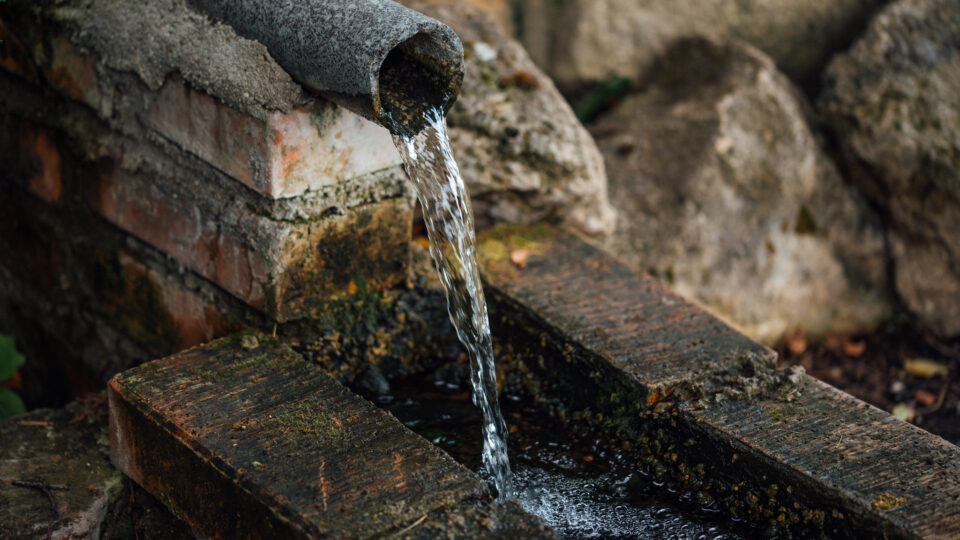
Harvesting Water From The Air | Earth Wise

August 11, 2023 By EarthWise Leave a Comment

Researchers developing method to harvest water from air

Engineers at MIT have created a superabsorbent material that can soak up significant amounts of moisture from the air, even in desert-like conditions.

The material is a transparent, rubbery substance made from hydrogel, which is a naturally absorbent material that is already widely used in disposable diapers.  The MIT researchers enhanced the absorbency of hydrogel by infusing it with lithium chloride, which is a type of salt that is a powerful desiccant.

They found that they could infuse hydrogel with more salt than was possible in previous studies.  Earlier studies soaked hydrogels in salty water and waited 24 to 48 hours for the salt to infuse into the gels.  Not much salt ended up in the gels and the material’s ability to absorb water vapor didn’t change much.  In contrast, the MIT researchers let the hydrogels soak up the salt for 30 days and found that far more salt was absorbed into the gel.  The result was that the salt-laden gel could then absorb and retain unprecedented amounts of moisture, even under very dry conditions.

Under very dry conditions of 30% relative humidity, the gels captured 1.79 grams of water per gram of material.  Deserts at night have those levels of relative humidity, so the material is capable of generating water in the desert.

The new material can be made quickly and at large scale.  It could be used as a passive water harvester, particularly in desert and drought-prone regions.  It could continuously absorb water vapor from the air which could then be condensed into drinking water.  The material could also be used in air conditioners as an energy-saving, dehumidifying element.

**********

Web Links

This salty gel could harvest water from desert air

Photo, posted July 26, 2021, courtesy of Ivan Radic via Flickr.

Earth Wise is a production of WAMC Northeast Public Radio
Solar-Powered Desalination | Earth Wise

March 20, 2020 By EarthWise Leave a Comment

simple desalination using solar power

About 1% of the world’s population is dependent on desalinated water to meet daily needs, but water scarcity is a growing problem that experts believe will affect 14% of the world’s population within the next five years.

Desalination takes much more energy than, for example, transporting fresh water over large distances.  In general, desalination costs are much higher than those associated with fresh water, but beyond costs, freshwater is simply not always available.

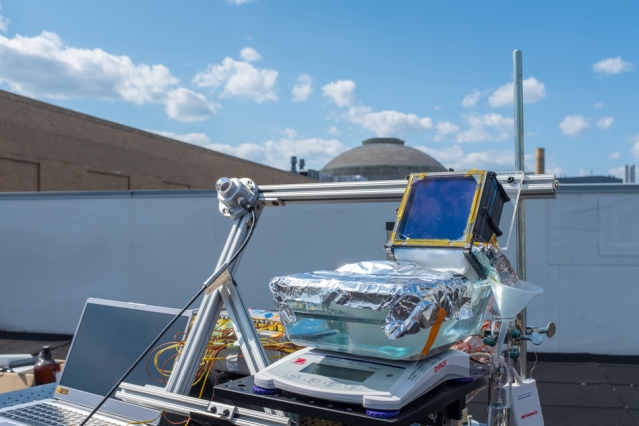
Researchers at MIT and Shanghai Jiao Tong University in China have developed a completely passive solar-powered desalination system that could provide more than 1.5 gallons of fresh drinking water per hour for every square meter of solar collecting area.   Such a system could provide an efficient, low-cost water source for coastal areas that are off the grid.

The system uses multiple layers of flat solar evaporators and condensers topped with transparent aerogel insulation.  The key to its efficiency is the way it uses each of its multiple stages to desalinate water.  At each stage, heat released by the previous stage is harnessed instead of wasted.  The proof-of-concept device, which was tested on an MIT building rooftop, produced more than twice as much water as the record amount produced by any previous passive solar-powered desalination system.

The researchers plan further experiments aimed at optimizing the choice of materials and configurations and to test the system under realistic conditions.  The hope is to have a technology that can play a role in alleviating water scarcity in parts of the world where electricity is scarce, but seawater and sunlight are abundant.

**********

Web Links

Simple, solar-powered water desalination

Photo courtesy of MIT/researchers.

Earth Wise is a production of WAMC Northeast Public Radio.

Using The Sun To Remove Ice

October 3, 2018 By EarthWise Leave a Comment

https://earthwiseradio.org/wp-content/uploads/2018/09/EW-10-03-18-Using-the-Sun-to-Remove-Ice.mp3

Ice buildup can cause all sorts of problems ranging from performance issues to catastrophic failures.  For example, ice buildup can negatively impact things like airplanes, power lines, wind turbines, and the like.  Preventing this ice buildup typically requires energy-intensive heating systems or environmentally-harmful chemical sprays.

[Read more…] about Using The Sun To Remove Ice

Primary Sidebar

Recent Episodes

  • An uninsurable future
  • Clean energy and jobs
  • Insect declines in remote regions
  • Fossil fuel producing nations ignoring climate goals
  • Trouble for clownfishes

WAMC Northeast Public Radio

WAMC/Northeast Public Radio is a regional public radio network serving parts of seven northeastern states (more...)

Copyright © 2026 ·