• Skip to primary navigation
  • Skip to main content
  • Skip to primary sidebar

Earth Wise

A look at our changing environment.

  • Home
  • About Earth Wise
  • Where to Listen
  • All Articles
  • Show Search
Hide Search
You are here: Home / Archives for modular

modular

AI and energy

August 20, 2025 By EarthWise Leave a Comment

AI is consuming vast amounts of energy

MIT recently hosted a symposium on the subject of artificial intelligence being both a problem and a solution for the clean energy transition.

AI-powered computing centers are expanding rapidly, creating an unprecedented surge in electricity demand.  Electricity demand in the US had been relatively flat for decades but now these computing centers consume about 4% of the nation’s electricity.  Some projections say that this demand could rise to 12-15% in the next five years. 

The power required for sustaining some of the AI large-language models is doubling every three months.  The amount of electricity used by a single ChatGPT conversation is as much as it takes to charge a phone and consumes the equivalent of a bottle of water for cooling. 

The MIT symposium focused on the challenges of meeting these growing energy needs but also on the potential for AI to dramatically improve power systems and reduce carbon emissions. 

Research shows regional variations in the cost of powering computing centers with clean electricity.  The central United States offers lower costs due to complementary solar and wind resources but would require massive battery deployments to provide uninterrupted power.

Because of data center demand, there is renewed interest in nuclear power, often in the form of small modular reactors, as well as efforts in long-duration storage technologies, geothermal power, or hybrid approaches.

Artificial intelligence offers both great promise and great peril.  It will take real intelligence to steer it in the right direction.

**********

Web Links

Confronting the AI/energy conundrum

Photo, posted August 31, 2024, courtesy of Jefferson Lab via Flickr.

Earth Wise is a production of WAMC Northeast Public Radio

New nuclear power for New York

July 9, 2025 By EarthWise Leave a Comment

New nuclear power plant is coming in New York

Nuclear power has been around since the 1950s, but it has fallen out of favor in recent decades, in part due to a couple of traumatic disasters at nuclear power plants.  In fact, only two new nuclear power plants have been built in the US in the past 30 years, and they took a very long time and an enormous amount of money to build.

However, in recent times there has been a great deal of developmental work on nuclear power.  Such newer technologies as small modular reactors, molten salt reactors, light water reactors, and more hold promise for safer, less expensive, and higher performance nuclear power.

In late June, New York Governor Kathy Hochul announced that she has instructed the New York Power Authority to develop and construct a zero-emission advanced nuclear power plant in Upstate New York.  The plant is to produce 1 GW of power, about half of what the decommissioned Indian Point Power Plant produced when it provided significant amounts of power to New York City residents.

Renewed interest in nuclear power has emerged in part because of the soaring electricity demand from AI data centers.  Companies like Amazon, Google, and Microsoft have all begun investing in nuclear power for this reason.

NYPA is instructed to begin evaluating technologies, business models, and locations for the new power plant and will seek to secure key partnerships needed for the project.  As things stand, it is not known what technology the plant will use, where in Upstate New York it will be located, how much it will cost to build, who will pay for it, and how long it will take to build. 

**********

Web Links

New York Again Embraces Nuclear Power With Plans to Build New Plant

Photo courtesy of Constellation Energy.

Earth Wise is a production of WAMC Northeast Public Radio
New approaches to nuclear power

November 18, 2024 By EarthWise 1 Comment

Researchers explore new approaches to nuclear power

The US is the world’s largest user of nuclear power.  Its 94 reactors supply nearly 19% of the country’s electricity. But the number of U.S. reactors has steadily fallen over the past 30 years and new nuclear power plants are a real rarity.  The reasons are a combination of perceived dangers following several nuclear accidents and the increasing costs associated with building plants that can meet a growing number of regulatory requirements.

There are recent developments associated with new advanced reactor technologies that may lead to a resurgence in the use of nuclear power.  Bill Gates’ energy company TerraPower is developing nuclear reactors that use sodium instead of water for cooling.  Such reactors operate at lower pressures and higher temperatures.  

Meanwhile, Kairos Power, a California-based energy company, has entered into an agreement with Google to build multiple small modular nuclear reactors that will supply electricity to that giant tech company.  The modular reactors use a molten-salt cooling system combined with a ceramic, pebble-type fuel in order to transport heat to a steam turbine to generate power.  The novel design of these reactors can reduce construction timelines, allow deployment in more places, and make final project delivery more predictable.

Surveys indicate that a majority of Americans favor the use of nuclear power, which has the advantages that it doesn’t create greenhouse gas emissions and can run 24-7.  But traditional nuclear power plants are too expensive and have too many potential problems.  These new nuclear power technologies may be the answer for allowing nuclear power to play an important role in the future energy system.

**********

Web Links

New nuclear clean energy agreement with Kairos Power

Photo, posted May 16, 2016, courtesy of Steve Jurvetson via Flickr.

Earth Wise is a production of WAMC Northeast Public Radio
Around-the-clock clean energy

June 14, 2024 By EarthWise Leave a Comment

Using solar and wind power can go a long way toward replacing fossil fuel-generated electricity, particularly with the addition of battery energy storage.  But because of the intermittent nature of both sun and wind, other sources are still needed.  There is also the need for ways to produce high temperature for industrial processes.  Complete decarbonization will require a host of complementary technologies.

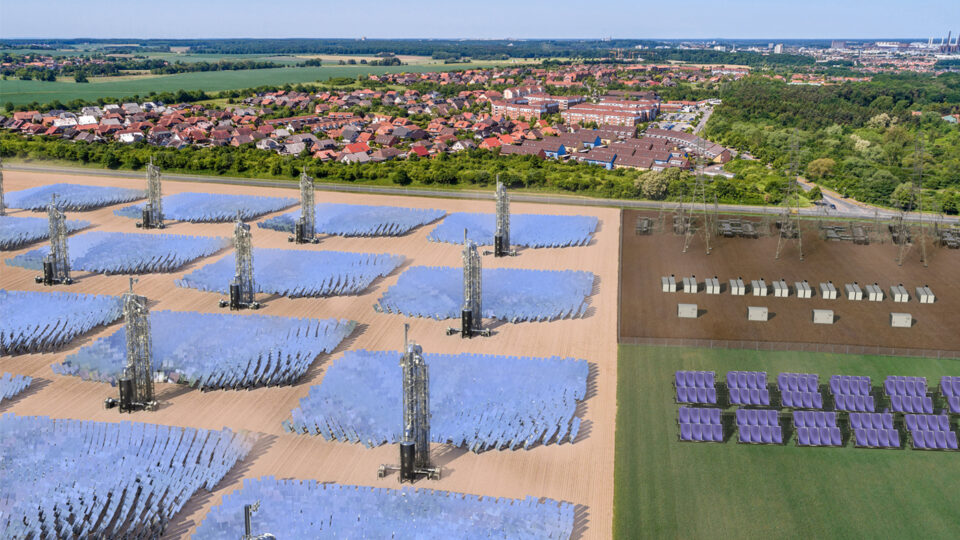
A spinout company from MIT called 247Solar is building high-temperature concentrated solar power systems that make use of overnight thermal energy storage to provide electric power around the clock as well as industrial-grade heat.

The system uses a field of sun-tracking mirrors to reflect sunlight to the top of a central tower.  A proprietary solar receiver heats air to over 1,800 degrees Fahrenheit.  The heated air drives turbines that generate 400 kilowatts of electricity and produces 600 kilowatts of heat.  Some of the hot air is routed through a long-duration thermal energy storage system and the stored heat is then used to drive the turbines when the sun isn’t shining.  The unique part of the technology is not the concentrated solar power; it is the solar receiver.

The modular systems can be used as standalone microgrids for communities, or to provide power in remote places.  They can also be used in conjunction with conventional wind and solar farms to enable around-the-clock renewable power.

The first deployment will be with a large utility in India.  If it is successful, 247Solar hopes to scale up rapidly with other utilities, companies, and communities around the globe.

**********

Web Links

Offering clean energy around the clock

Photo credit: 247Solar.

Earth Wise is a production of WAMC Northeast Public Radio

Primary Sidebar

Recent Episodes

  • An uninsurable future
  • Clean energy and jobs
  • Insect declines in remote regions
  • Fossil fuel producing nations ignoring climate goals
  • Trouble for clownfishes

WAMC Northeast Public Radio

WAMC/Northeast Public Radio is a regional public radio network serving parts of seven northeastern states (more...)

Copyright © 2026 ·