
• Skip to primary navigation
  • Skip to main content
  • Skip to primary sidebar

Earth Wise

A look at our changing environment.

  • Home
  • About Earth Wise
  • Where to Listen
  • All Articles
  • Show Search
Hide Search
You are here: Home / Archives for hydrogen gas

hydrogen gas

Fertilizer from thin air

January 16, 2025 By EarthWise Leave a Comment

Creating fertilizer from thin air

Ammonia is one of the largest-volume synthetic chemicals produced in the world. Globally, manufacturing plants produce about 200 million tons of it each year.  About 70% of ammonia is used to produce fertilizers.

Most ammonia is produced using the Haber-Bosch process, which converts hydrogen and nitrogen into ammonia.  The process is energy-hungry, running at over 900 degrees Fahrenheit, and therefore results in lots of greenhouse gas emissions – about 1% of the world’s annual CO2 emissions.

Researchers at Stanford University and King Fahd University in Saudi Arabia have developed a prototype device that can produce ammonia using wind energy to draw air through a mesh.  The method allows sustainable production of ammonia using the nitrogen in the air.

The process gets nitrogen from the air along with hydrogen from water vapor.  A mesh coated with catalysts facilitates the necessary chemical reactions.  The process operates at room temperature and standard atmospheric pressure, eliminating the need  for the high temperatures and high pressures of the Haber-Bosch process.

In principle, farmers could run a portable device onsite, eliminating the need to purchase and ship fertilizer from a manufacturer. 

The device is two or three years away from being market ready.  The developers are designing increasingly large mesh systems to produce greater quantities of ammonia.  Ammonia has more uses beyond fertilizers including its use as an energy carrier that can store and transport energy more efficiently than hydrogen gas.

**********

Web Links

New device produces critical fertilizer ingredient from thin air, cutting carbon emissions

Photo, posted September 2, 2013, courtesy of Chafer Machinery via Flickr.

Earth Wise is a production of WAMC Northeast Public Radio

A giant underground battery

February 5, 2024 By EarthWise Leave a Comment

Building a giant underground battery

Two up-and-coming energy technologies are coming together near a tiny town in central Utah.  Outside of the town of Delta, population 3,600, two caverns, each as deep as the Empire State Building, are being created from an underground salt formation to be used to store hydrogen gas.  The gas will be used as a fuel in a new electricity generation plant.

The plant will replace an aging local coal-fired power plant.  The new plant will burn a mixture of natural gas and hydrogen – green hydrogen produced without emitting greenhouse gases. To produce the hydrogen, the facility will operate 40 giant electrolyzers that will use excess solar and wind power generated at times of low demand to split water molecules into hydrogen and oxygen.

The caverns were created by a process called solution mining in which high-pressure water is pumped down into salt deposits that are dissolved. The resulting caverns are 200 feet in diameter and 1,200 deep and lie 3,000 to 4,000 feet below the surface.  Hydrogen cannot escape through the thick salt layers.

The amount of energy that can be stored in the form of hydrogen fuel in these caverns is massive – far more than all the battery storage installed in the U.S. to date.  Chevron has a majority stake in one of the projects and will supply the natural gas.  The facility is expected to go online in 2025.

While this will produce far fewer emissions than existing coal plants, it is not carbon-free.  Currently, turbine technology cannot operate with pure hydrogen fuel.  The Delta plant will run on only 30% hydrogen.  The hope is that turbine technology will improve in the future and permit operation on pure hydrogen.

**********

Web Links

A Huge Underground Battery Is Coming to a Tiny Utah Town

Photo, posted September 9, 2013, courtesy of Scott via Flickr.

Earth Wise is a production of WAMC Northeast Public Radio

Geologic Hydrogen | Earth Wise

October 20, 2023 By EarthWise Leave a Comment

Exploring geologic hydrogen

There is great interest in the potential use of hydrogen as a fuel or an energy storage medium.  Unlike hydrocarbon-based fuels, pure hydrogen combustion produces nothing but water as an emission.  But most hydrogen used at present is made by reforming natural gas, which is a process that results in carbon dioxide emissions.  Thus, the search goes on for cost-effective and energy-efficient ways to make “green hydrogen” that doesn’t result in greenhouse gas emissions.

Researchers at Colorado University Boulder are investigating the potential effectiveness of coaxing hydrogen from subterranean rocks – a commodity known as geologic hydrogen.

When water mixes with iron-rich minerals deep in the earth’s crust, ensuing chemical reactions can generate pockets of hydrogen gas. 

The questions are whether it is possible to bring these deposits up to the surface without harming the environment or human communities in the process and whether they can be extracted in large enough quantities to meet growing global energy demands.

The Colorado researchers will conduct experiments both in the lab and hundreds of meters below the earth’s surface to see if it is possible to induce the subterranean rock to make more hydrogen than it normally does.  If the hydrogen-producing reactions can be accelerated, then geologic hydrogen could become a clean and abundant energy source.

Geologists have known about hidden underground deposits of hydrogen for a long time, but recent research has found that there may be a lot more of it than once thought.  According to a 2022 report by the US Geological Survey, there may be enough hydrogen below ground to supply humanity’s need for fuel for hundreds of years.

**********

Web Link

Can rocks produce abundant clean energy? New project to explore

Photo, posted December 26, 2013, courtesy of Juozas Šalna via Flickr.

Earth Wise is a production of WAMC Northeast Public Radio

Getting Rid Of Hydrogen Sulfide | Earth Wise

December 20, 2022 By EarthWise Leave a Comment

Hydrogen sulfide gas produces the characteristic smell of rotten eggs, sewers, stockyards, and landfills.  The petroleum industry produces thousands of tons of the stuff each year as a byproduct of the processes that remove sulfur from petroleum, natural gas, coal, and other products.  The industry faces substantial fines for emitting hydrogen sulfide, but remediation is expensive.

Researchers at Rice University have developed a method for turning hydrogen sulfide into hydrogen gas and sulfur in a single step.  Called plasmonic photocatalysis, it not only gets rid of an undesirable substance, it does so by producing valuable byproducts.

The established way of getting rid of hydrogen sulfide is called the Claus process.  It requires multiple steps, including some that require combustion chambers heated to 1,500 degrees Fahrenheit.  The end product is sulfur and water.

The Rice University process gets all of its energy from light.  A surface of grains of silicon dioxide is dotted with tiny gold nanoparticles.  These particles interact strongly with a specific wavelength of visible light and cause plasmonic reactions that create short-lived, high-energy electrons that drive the catalysis of hydrogen sulfide.  Given that the process requires only visible light and no external heating, it should be relatively straightforward to scale up using solar energy or very efficient LED lamps.

The new hydrogen sulfide remediation technology has been licensed by a Houston-based startup company with more than 60 employees whose founders include some of the Rice researchers.  The process may end up being efficient enough and cheap enough for cleaning up non-industrial sources of hydrogen sulfide such as sewers and animal waste.

**********

Web Links

New catalyst can turn smelly hydrogen sulfide into a cash cow

Photo, posted July 8, 2021, courtesy of Doug Letterman via Flickr.

Earth Wise is a production of WAMC Northeast Public Radio
Getting Value From Plastic Waste | Earth Wise

November 30, 2020 By EarthWise Leave a Comment

Extracting value from plastic waste

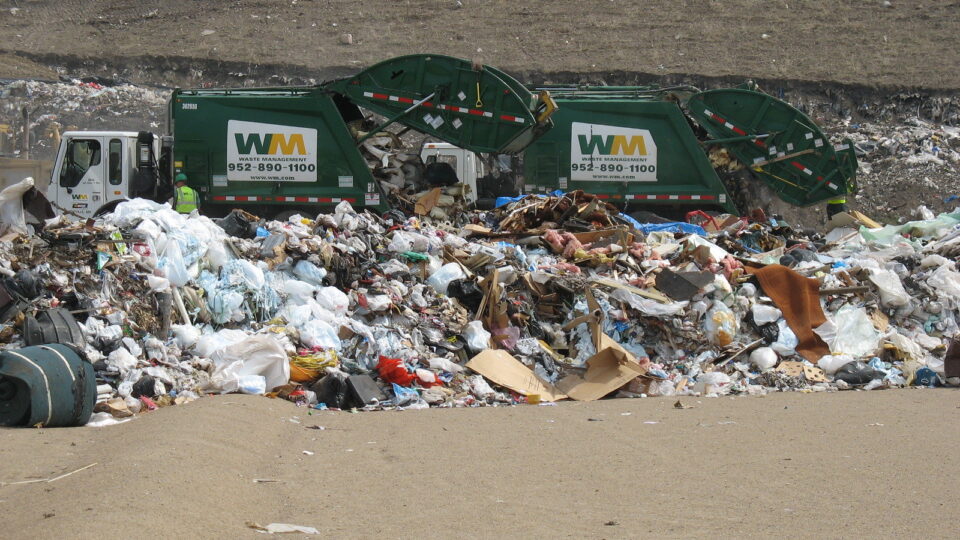
To date, the world has produced more than five billion tons of plastic and is making more all the time.  Based on the way things are currently done, most of that will end up in landfills or in the natural environment.  By 2050, the amount of plastic is expected to exceed 13 billion tons.   This is one of the world’s biggest environmental problems.

Recently, an international collaboration by universities and institutions in the UK, China, and Saudi Arabia has developed a method of converting plastic waste into hydrogen gas and high-value solid carbon.

The technique was achieved with a new type of catalysis that uses microwaves to activate catalyst particles that effectively strip hydrogen from plastic polymers.  The work was recently published in the journal Nature Catalysis and details how the researchers mixed mechanically pulverized plastic particles with a microwave-susceptor catalyst of iron oxide and aluminum oxide.  That mixture was then subjected to microwave treatment and yielded a large volume of hydrogen gas and a residue of carbonaceous material, most of which was identified as carbon nanotubes.

The process is more rapid than most methods for dealing with plastic waste and can extract over 97% of the hydrogen in plastic without producing any carbon dioxide emissions. 

The new method represents an attractive potential solution to the problem of plastic waste.  Instead of polluting the planet, plastics could become a valuable feedstock for producing clean hydrogen fuel as well as valuable carbon materials.  Proponents of the so-called hydrogen economy have continued to seek a green and economical way to produce hydrogen.  This new work might be just what they are looking for.

**********

Web Links

Turning plastic waste into hydrogen and high-value carbons

Photo, posted April 21, 2007, courtesy of Redwin Law via Flickr.

Earth Wise is a production of WAMC Northeast Public Radio.

Primary Sidebar

Recent Episodes

  • An uninsurable future
  • Clean energy and jobs
  • Insect declines in remote regions
  • Fossil fuel producing nations ignoring climate goals
  • Trouble for clownfishes

WAMC Northeast Public Radio

WAMC/Northeast Public Radio is a regional public radio network serving parts of seven northeastern states (more...)

Copyright © 2025 ·