
• Skip to primary navigation
  • Skip to main content
  • Skip to primary sidebar

Earth Wise

A look at our changing environment.

  • Home
  • About Earth Wise
  • Where to Listen
  • All Articles
  • Show Search
Hide Search
You are here: Home / Archives for health issues

health issues

PFAS and groundwater

November 26, 2024 By EarthWise Leave a Comment

PFAS in groundwater in the United States is widespread

Per- and polyfluoroalkyl chemicals, more commonly known as PFAS, are a family of human-made chemicals that have been manufactured and used in a variety of industries since the 1940s.  They provide water-resistance, oil-resistance, dirt-resistance, and corrosion-resistance to a wide range of products, including food wrappers and packaging, clothing, dental floss, nonstick cookware, textiles, and electronics.

Exposure to PFAS has been linked to birth defects, thyroid disease, liver disease, kidney disease, and cancer.  These chemicals do not break down in the environment and therefore, over time, become concentrated in plants, animals, and people. 

According to a new first-of-its kind study by scientists at the U.S. Geological Survey, more than 20% of the U.S. population could be drinking groundwater contaminated with PFAS.  The study, which was recently published in the journal Science, found that those living in the Eastern U.S. are particularly likely to be exposed.

The study is the first to report national estimates of PFAS in untreated groundwater that supplies drinking water to private and public wells. The USGS research also provides the first estimate of the total number of Americans – anywhere from 71 to 95 million – who might be exposed to this contamination.

The researchers note that their estimates merely measure the existence of PFAS – before the water has undergone any treatment or filtering – meaning that, while they may be present, they may be at very low levels. 

To find a link to the detailed USGS map showing the probability of PFAS groundwater contamination in your region, visit our website: EarthWiseRadio.org.

**********

Web Links

PFAS in US Groundwater Interactive Dashboard

Predictions of groundwater PFAS occurrence at drinking water supply depths in the United States

Photo, posted January 12, 2008, courtesy of Andrew Kraker via Flickr.

Earth Wise is a production of WAMC Northeast Public Radio

Tracking down PFAS toxins

December 5, 2023 By EarthWise Leave a Comment

PFAS – per- and polyfluoralkyl substances – are a group of organic compounds that have been extensively used to provide water-, oil-, and dirt-resistance to a wide range of products ranging from non-stick pans, clothing, and packaging to paint, car polish, and fire-suppressant foam.  Exposure to specific PFAS compounds is associated with multiple adverse health effects, including altered immune and thyroid function, liver disease, kidney disease, poor reproductive and developmental outcomes, and cancer.  PFAS compounds do not break down in the environment and therefore, over time, become concentrated in plants, animals, and people.

Government agencies such as the EPA in this country and the EU have set strict limits for allowable levels of PFAS in drinking water.  Testing water for the trace amounts of PFAS that constitute the limits is time-consuming and expensive and requires complex equipment and experienced personnel.

Researchers at MIT have now introduced a technique for making a portable, inexpensive test that can easily and selectively detect PFAS in water samples.  The test makes use of a special polymer containing fluorinated dye molecules that cause the polymer to fluoresce red.  If PFAS are present in the sample, they enter the polymer and displace the dye molecules and switches off the red fluorescence. 

The new technique is suitable for on-site detection in highly contaminated regions.  Detecting smaller concentrations can be achieved with sufficient precision after pre-concentrating the samples using the process of solid-phase extraction.

**********

Web Links

Tracking down Environmental Toxins

Photo, posted October 16, 2021, courtesy of Nenad Stojkovic via Flickr.

Earth Wise is a production of WAMC Northeast Public Radio
Could Lyme Disease Be Eradicated? | Earth Wise

November 22, 2021 By EarthWise Leave a Comment

Eradicating lyme disease

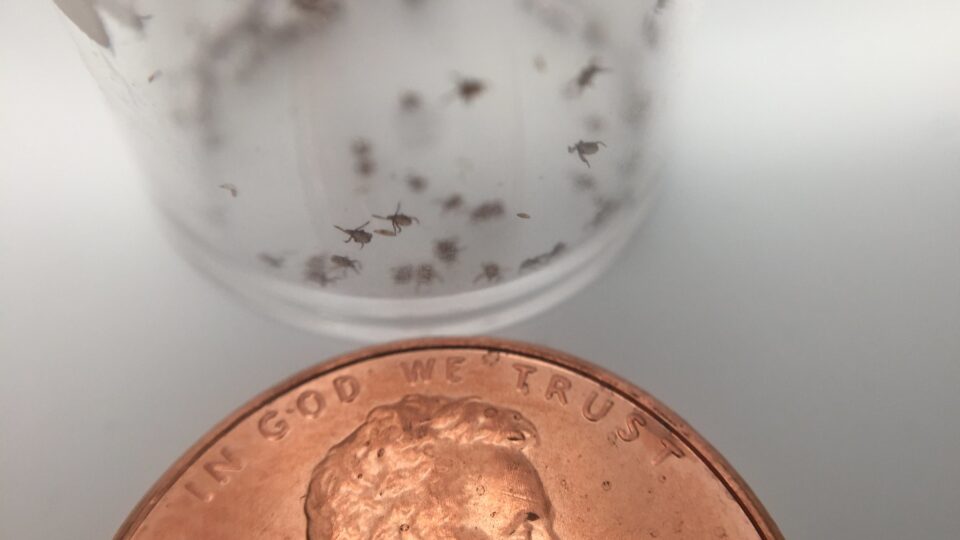
Tiny ticks are a big problem.  Measuring only three to five millimeters in size, ticks are widely distributed around the world.  They are external parasites, feasting on the blood of birds, reptiles, amphibians, and mammals – including humans.

According to estimates from the Centers for Disease Control and Prevention, ticks infect an estimated 476,000 people with Lyme disease in the United States every year.  Lyme disease is caused by a bacterium called Borrelia burgdorferi that lurks in wild mice. Ticks that feed on the mice become infected and can then in turn infect people and animals.   

The disease is not only a problem in the United States, but in other parts of North America, Europe and Asia as well.  It often causes a characteristic “bullseye” rash and flu-like symptoms. If left untreated, it can lead to serious long-term health problems.

Currently, lyme disease is treated using antibiotics.  But antibiotics kill a wide range of bacteria – including healthy gut bacteria – which can lead to additional health issues and more antibiotic resistance.

A recent discovery by researchers from Northeastern University in Boston could allow Lyme disease to be eradicated in the wild.  The researchers found that a compound called hygromycin A is deadly to the bacterium that causes Lyme disease but harmless to animals and has little effect on most other bacteria. 

The little-known antibiotic cleared Lyme disease infection in mice, both when administered via injection and when ingested using bait.  As a result, dropping feeding baits could eradicate Lyme disease from whole areas or even entire countries.  The first field trial will be next summer.

**********

Web Links

Drug treatment for Lyme disease could lead to its eradication

Photo, posted June 21, 2017, courtesy of NIAID via Flickr.

Earth Wise is a production of WAMC Northeast Public Radio.

Microplastics And Florida’s Birds of Prey | Earth Wise

June 19, 2020 By EarthWise Leave a Comment

Microplastics found in Florida's birds of prey

Plastic debris comes in all different shapes and sizes, but those that are less than five millimeters in length are called microplastics.  Some microplastics come from larger plastic debris that degrades into smaller bits over time.  Another type of microplastics – called microbeads – are intentionally manufactured tiny plastic beads that are added as exfoliants to some health and beauty products. 

According to a new study published in the journal Environmental Pollution, researchers have confirmed and quantified the presence of microplastics in terrestrial and aquatic birds of prey in Florida for the first time.  This research is important because these birds of prey, including ospreys, hawks, and owls, are critical to maintaining a healthy ecosystem.  The accumulation of microplastics in their digestive systems could lead to a myriad of health issues, including starvation.  

Working with the Audubon Center for Birds of Prey in Florida, the research team from the University of Central Florida was able to examine the stomachs of 63 deceased birds.  The team found microplastics in every bird it examined, extracting nearly 1,200 pieces of plastic in total.  Microfibers represented 86% of the plastic pieces. 

It’s common for plastic microfibers to enter ecosystems through the wastewater from washing machines.  A 2016 study found that 700,000 plastic fibers come off in a typical wash.  While there are lots of variables, synthetic fabrics account for 60% of the material used in clothing worldwide. 

To help cut down on plastic in the environment, the research team suggests removing plastics from open landfills, purchasing only natural fabrics and clothing, and modifying water treatment facilities to capture microplastics. 

**********

Web Links

Microplastics found in Florida’s birds of prey for first time

Photo, posted April 15, 2016, courtesy of Andy Morffew via Flickr.

Earth Wise is a production of WAMC Northeast Public Radio.

Primary Sidebar

Recent Episodes

  • An uninsurable future
  • Clean energy and jobs
  • Insect declines in remote regions
  • Fossil fuel producing nations ignoring climate goals
  • Trouble for clownfishes

WAMC Northeast Public Radio

WAMC/Northeast Public Radio is a regional public radio network serving parts of seven northeastern states (more...)

Copyright © 2025 ·