• Skip to primary navigation
  • Skip to main content
  • Skip to primary sidebar

Earth Wise

A look at our changing environment.

  • Home
  • About Earth Wise
  • Where to Listen
  • All Articles
  • Show Search
Hide Search
You are here: Home / Archives for genome

genome

Building better blackberries

June 6, 2025 By EarthWise Leave a Comment

The Human Genome Project is one of the greatest scientific feats in history.  It was launched in 1990 and completed in 2003.  The international group of researchers wanted to comprehensively study all of the DNA – the genome – from a select set of organisms, foremost of which being that of human beings.  The results accelerated the study of human biology and has led to improvements in the practice of medicine.

Every living thing – animal, plant, fungus, and various single-celled organisms – has a genome – a genetic blueprint.  A recent study by researchers at the University of Florida has done genome sequencing of blackberries with the hope of being able to achieve more efficient and targeted breeding.

Over the past 20 years, consumer demand for blackberries has increased leading to farmers growing more of the fruit in the United States.  The U.S. produces 37 million pounds of processed blackberries and almost 3 million pounds of fresh berries each year.

The Florida researchers made use of a large collection of DNA sequences to computationally piece together the entire genome of the blackberry variety in the study.  The genome study uncovered the secrets behind key traits that could lead to growing blackberry plants with no thorns and increasing the production of anthocyanin, which affects the color and health benefits of the fruit. 

For Florida, the southeastern United States and regions with similar climates, the genetic research holds the promise of accelerating the process to create blackberry varieties that are better suited to local growing conditions, enhancing both the yield and the quality of the increasingly popular fruit.

**********

Web Links

Decoding blackberry DNA: UF study paves way for enhanced breeding strategies

Photo, posted September 18, 2016, courtesy of Theo Crazzolara via Flickr.

Earth Wise is a production of WAMC Northeast Public Radio

Almost a dire wolf

April 22, 2025 By EarthWise Leave a Comment

Researchers around the world are working on what some call the ‘de-extinction’ of iconic animals of the past such as the wooly mammoth, the dodo, and the Tasmanian tiger.  The idea is to decipher the genome from DNA of preserved specimens and, using the tools of modern genetic engineering and cloning technology, alter the DNA of closely related modern species to recreate the extinct species.

A company called Colossal Biosciences recently announced that it has brought back the dire wolf, a species that has been extinct for 10,000 years.  Dire wolves have white coats and are larger than modern wolves, have more powerful shoulders, a wider head, and larger teeth and jaws.  Colossal is now raising three wolves they have engineered at a 2,000-acre site at an undisclosed location.

 The wolves were created by taking the DNA of modern grey wolves and editing 14 genes substituting ones from ancient dire wolf specimens.  Wolves have about 19,000 genes, so the changes from the grey wolf genome are very minor but enough to produce an animal that looks just like a dire wolf.  But is it a dire wolf?

It really isn’t.  Ancient DNA is always greatly damaged.  Only parts of it survive.  We don’t actually have the complete genome of the dire wolf.  What we have is bits and pieces that, thanks to modern technology, allow us to produce a phenotype of a dire wolf; that is, an animal with the same observable features. 

Whether this accomplishment is a worthwhile and appropriate thing to do is a question that continues to be debated.

**********

Web Links

The Return of the Dire Wolf

Photo courtesy of Colossal Laboratories & Biosciences.

Earth Wise is a production of WAMC Northeast Public Radio
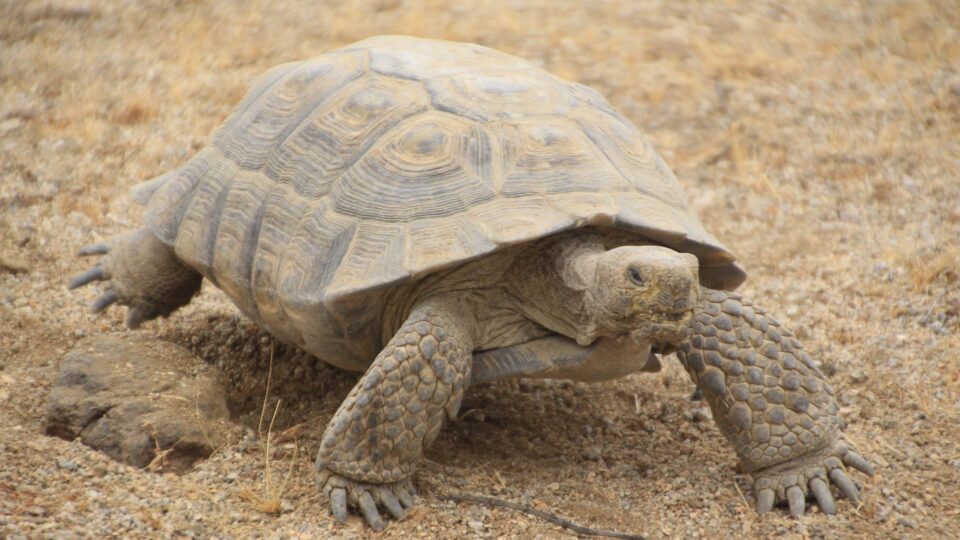
Genetic Variation And Survivability | Earth Wise

January 21, 2021 By EarthWise Leave a Comment

Genetic variation leads to greater chance of survival

A massive but unintended experiment in animal conservation has revealed an unexpected result.  Thousands of desert tortoises moved to a translocation site in Nevada had a greater chance of surviving if they had lots of genetic variation.

From 1997 to 2014, over 9,000 Mojave desert tortoises were moved to a 39-square-mile translocation site in the Ivanpah Valley.  The tortoises were either abandoned pets or were displaced by developments in suburban Las Vegas and by solar farms in the desert.

The U.S. Fish and Wildlife service took blood samples to screen for diseases and marked each animal before releasing them into the site, enabling them to be tracked in later surveys.

When the researchers compared tortoises that lived or died over the same time period after being relocated to the site, they found that survivors averaged 23% greater heterozygosity than those that perished.  Heterozygosity is a measure of genetic variation.  Like most organisms, tortoises have two copies of their entire genome, with one from each parent.  The more those copies differ from each other, the higher the organism’s heterozygosity.

Researchers are not really sure why greater genetic variation is linked to survival rates.  Potentially, individuals with higher heterozygosity have more genomic flexibility.  It is the case that tortoises with more genetic variation have a better chance of having at least one copy of a gene that works really well in stressful or new environments.

Human activity and the changing climate are increasing the need to relocate plants and animals.  Often the chances for success in doing this are not good, so anything we can learn about things that increase the chances for survival can be very important.

**********

Web Links

UCLA study of threatened desert tortoises offers new conservation strategy

Photo, posted August 23, 2016, courtesy of the Bureau of Land Management California via Flickr. Photo by Dana Wilson, BLM.

Earth Wise is a production of WAMC Northeast Public Radio.

Primary Sidebar

Recent Episodes

  • An uninsurable future
  • Clean energy and jobs
  • Insect declines in remote regions
  • Fossil fuel producing nations ignoring climate goals
  • Trouble for clownfishes

WAMC Northeast Public Radio

WAMC/Northeast Public Radio is a regional public radio network serving parts of seven northeastern states (more...)

Copyright © 2026 ·