
• Skip to primary navigation
  • Skip to main content
  • Skip to primary sidebar

Earth Wise

A look at our changing environment.

  • Home
  • About Earth Wise
  • Where to Listen
  • All Articles
  • Show Search
Hide Search
You are here: Home / Archives for farming practices

farming practices

Flower power in agriculture

January 5, 2024 By EarthWise Leave a Comment

Agriculture is the world’s largest industry.  When managed sustainably, agricultural operations can provide many environmental benefits, such as protecting watersheds and habitats, and improving soil health and water quality.  Sustainable agriculture also embraces biodiversity by minimizing its impact on wild ecosystems and incorporating numerous plant and animal varieties into farm ecosystems.

A new study of farms in India has demonstrated the power of incorporating flowers into farming practices.  According to the research by ecologists from the University of Reading in the U.K. and the M.S. Swaminathan Research Foundation in India, planting flowers beside food crops attracts bees, boosts pollination, and improves both the yield and quality of crops.

 The study, which was recently published in the Journal of Applied Ecology, is the first of its kind in India.  The researchers focused on moringa – which is a nutrient-packed superfood native to South India, and bees – the plants’ essential pollinators. 

Working alongside farmers, the researchers planted marigold and red gram crops alongside moringa trees across 12 moringa orchards.  They found that flower-visiting insect numbers and diversity were 50% and 33% higher, respectively, in orchards with floral interventions compared to those without them.  Floral interventions also led to larger moringa pods and a 30% increase in harvestable fruits.

India has many crops of high economic and nutritional value.  The study highlights how farmers can significantly improve crop pollination services and boost yields, while also managing their lands in a more sustainable manner.

**********

Web Links

Flower power on Indian farms helps bees, boosts livelihoods

Floral interventions on farms boost pollinators and crop yields

Photo, posted June 24, 2008, courtesy of Jim via Flickr.

Earth Wise is a production of WAMC Northeast Public Radio

Saving Our Soil | Earth Wise

July 14, 2023 By EarthWise Leave a Comment

Saving our soil is critical for our food security and climate change mitigation

The majority of food we eat is grown in topsoil, that carbon-rich, black soil that nurtures everything from carrots to watermelons.  The fertility of this soil has developed over eons.    

But over the past 160 years, the Midwestern United States has lost 63.4 billion tons of topsoil due to farming practices.  In fact, Midwestern topsoil is eroding between 10 and 1,000 times faster than it did in the pre-agricultural era.  The rate of erosion is 25 times greater than the rate at which topsoil forms.

According to new research from the University of Massachusetts-Amherst, this rapid and unsustainable rate of topsoil erosion can be drastically reduced by utilizing an agricultural method already in practice: No-till farming.  This method, which is currently practiced on 40% of cropland acres in the Midwest, can extend our current level of soil fertility for the next several centuries.   

In the study, which was recently published in the journal Earth’s Future, the research team looked at the current business-as-usual method, under which approximately 40% of the midwestern U.S.’s acres are no-till farmed, all the way up to 100% adoption of no-till methods. 

If the U.S.’s current agricultural practices remain largely unchanged, approximately 9.6 billion tons of topsoil will be lost over the next century alone.  However, approximately 95% of the erosion in the business-as-usual scenario could be prevented by adopting 100% no-till farming practices. 

Saving our soil by improving our farming methods has implications for everything from food security to climate change mitigation. 

**********

Web Links

Saving Our Soil: How to Extend U.S. Breadbasket Fertility for Centuries

Photo, posted January 19, 2022, courtesy of Terri Dux via Flickr.

Earth Wise is a production of WAMC Northeast Public Radio
More Trouble For Monarchs | Earth Wise

April 14, 2020 By EarthWise Leave a Comment

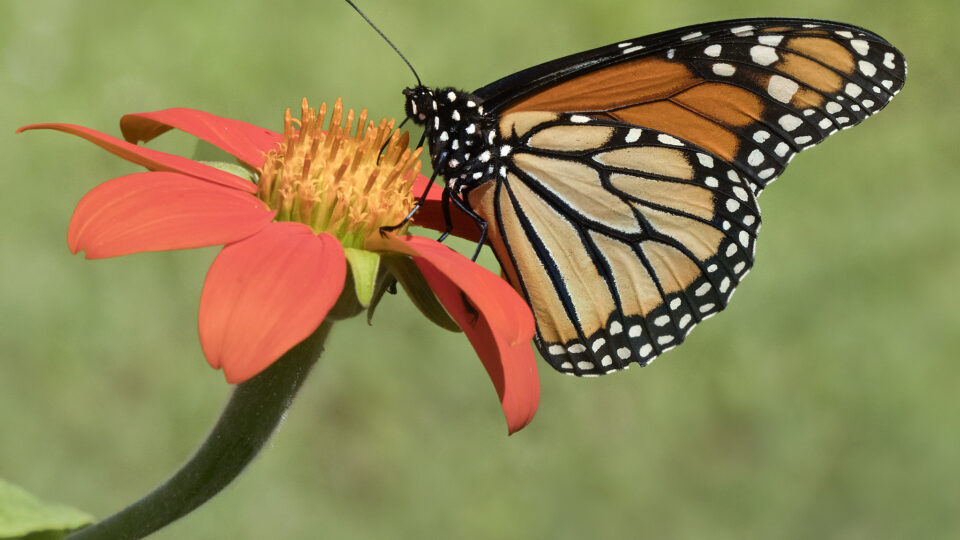
the decline of monarch butterflies

Monarch butterflies have been in trouble for quite a while and now it seems like their prospects are worse than ever.  Multiple surveys of butterfly populations are reporting plummeting numbers.

Western monarch butterflies spend their winters on the central California coast.  Months later, they breed in California’s Central Valley and as far north and east as Idaho.  But in recent years, it has become harder and harder to find them in their breeding sites.

The Western monarch population was in the millions in the 1980s.  In 2017, an annual survey found 200,000 butterflies.  In 2018 and 2019, only about 30,000 butterflies were tallied.  The loss of Western butterflies in general has come about from a variety of factors, including development, climate change, farming practices and the widespread use of pesticides by farmers and on home and business lawns.

Scientists use the area of land that migrating Monarchs occupy in Mexico to gauge populations.  This year, they covered about 7 acres, down from 15 acres in 2019.

Meanwhile, there are also far fewer Eastern monarch butterflies on the opposite side of the country.  According to a new population survey, the Eastern monarch has passed the extinction threshold.  Its population in 2020 dropped 53% from its already low 2019 numbers.  Scientists were expecting lower numbers this year, but they were staggered by their findings.

Butterfly populations are quite variable, so it is possible that the drastic declines this year are not necessarily irreversible, but the news is not good.   Researchers and environmental advocates continue to point out that mitigating the climate crisis, reducing pesticide use and planting pollinator gardens could help the butterflies to recover.

**********

Web Links

Monarch Butterfly Populations Are Plummeting

Photo, posted September 7, 2017, courtesy of C. Watts via Flickr.

Earth Wise is a production of WAMC Northeast Public Radio.

Primary Sidebar

Recent Episodes

  • An uninsurable future
  • Clean energy and jobs
  • Insect declines in remote regions
  • Fossil fuel producing nations ignoring climate goals
  • Trouble for clownfishes

WAMC Northeast Public Radio

WAMC/Northeast Public Radio is a regional public radio network serving parts of seven northeastern states (more...)

Copyright © 2026 ·