• Skip to primary navigation
  • Skip to main content
  • Skip to primary sidebar

Earth Wise

A look at our changing environment.

  • Home
  • About Earth Wise
  • Where to Listen
  • All Articles
  • Show Search
Hide Search
You are here: Home / Archives for carbon stocks

carbon stocks

Restored wetlands and climate

September 23, 2025 By EarthWise Leave a Comment

Restoring wetlands offers massive climate benefit within one year

Forests are well-known to be major storehouses of carbon in the environment.  Less known but also extremely important are peatlands and wetlands and, like forests, both have suffered declines as a result of human activity.  And, like forests, both are seeing efforts at restoration.

Restoring peatlands has the drawback that it initially causes a spike in methane emissions, and it therefore takes a long time for them to have a net positive effect on the climate after they are restored. 

In a new study by RMIT University in Australia, it was found that reviving floodplain wetlands reduces carbon emissions by 39% and restores critical ecosystem functions in one year without any increase in methane emissions.  The 6-year study reintroduced water flow to a degraded freshwater wetland.  Over the course of the study, carbon stocks in the wetland increased by 53%.  Freshwater wetlands cover less than 10% of the Earth’s surface but contribute up to 25% of global methane emissions.  Despite this, they still play a crucial role in global ecosystem function.

Floodplain or riparian wetlands comprise over half of global wetlands.   They store less carbon than peatlands but restoring them gains substantial ecosystem benefits quickly.  The carbon is stored in plant roots and soil.  Wetlands are nature’s purification system removing both nitrogen from waterways and carbon from the atmosphere. 

Restoring and managing freshwater wetlands for the purpose of carbon sequestration also boosts flood and drought resilience.  Riparian wetlands are connected to other ecosystems like rivers and streams and provide benefits to them.

**********

Web Links

Restored wetlands reap benefits for climate, drought-resilience after just one year: study

Photo, posted January 7, 2014, courtesy of Tom Barnes / USFWS via Flickr.

Earth Wise is a production of WAMC Northeast Public Radio
Large Mammals And Climate Change | Earth Wise         

April 14, 2022 By EarthWise Leave a Comment

The natural world has an important part to play in mitigating the effects of climate change.  We mostly think about the role of plant life which absorbs carbon in trees, grasses, and other flora.  However, a new study published by Oxford University looks at the role of large wild animals in restoring ecosystems and reducing the effects of climate change.

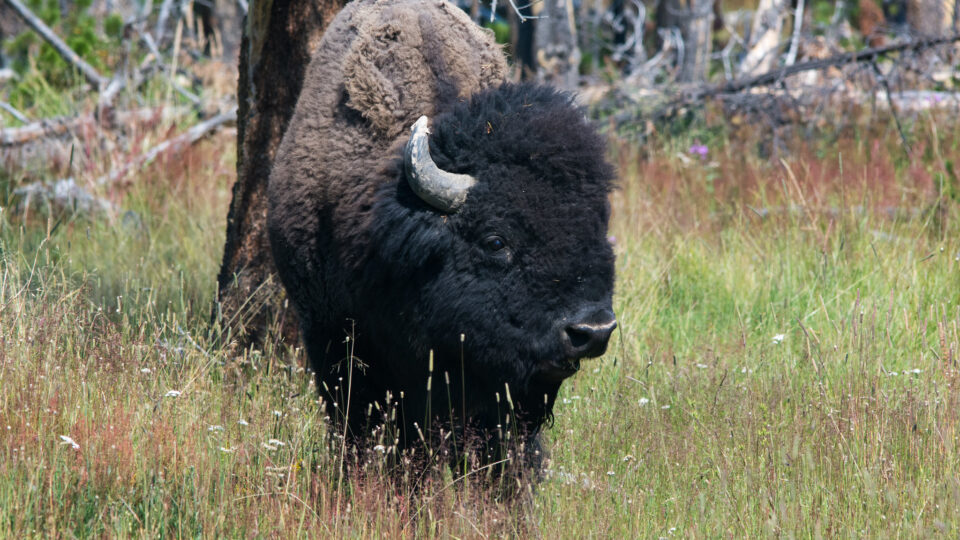
According to the study, there are three important ways in which large animals such as elephants, rhinos, giraffes, whales, bison, and moose can potentially mitigate the effects of climate change:  carbon stocks, albedo, and fire regimes.

When large herbivores graze, they disperse seeds, clear vegetation, and fertilize soil.  All of these things build more complex and resilient ecosystems which helps to maintain and increase carbon stocks in the soil and in plant tissues thereby helping to reduce CO2 in the atmosphere.

Grazing large animals trample vegetation which opens up areas of dense vegetation to create open mixes of grass and shrubs and can reveal snow-covered ground in cold regions.  Such open habitats are lighter in color (higher in albedo) and reflect more solar radiation into the atmosphere, cooling the Earth’s surface rather than heating it up.

Large grazing animals can lessen wildfire risk by browsing on woody vegetation that would otherwise fuel the fires and also by creating paths that act as firebreaks.

In marine ecosystems, whales and other large animals fertilize phytoplankton, which capture some 37 billion tons of CO2 each year.

Overall, large animals are an important part of the natural world’s ability to reduce the effects of the changing climate by helping with localized adaptation to the changes taking place in ecosystems.

**********

Web Links

Large mammals can help climate change mitigation and adaptation

Photo, posted August 20, 2017, courtesy of Jon Niola via Flickr.

Earth Wise is a production of WAMC Northeast Public Radio.

Primary Sidebar

Recent Episodes

  • An uninsurable future
  • Clean energy and jobs
  • Insect declines in remote regions
  • Fossil fuel producing nations ignoring climate goals
  • Trouble for clownfishes

WAMC Northeast Public Radio

WAMC/Northeast Public Radio is a regional public radio network serving parts of seven northeastern states (more...)

Copyright © 2026 ·