• Skip to primary navigation
  • Skip to main content
  • Skip to primary sidebar

Earth Wise

A look at our changing environment.

  • Home
  • About Earth Wise
  • Where to Listen
  • All Articles
  • Show Search
Hide Search
You are here: Home / Archives for accumulate

accumulate

Removing microplastics from water

April 23, 2025 By EarthWise Leave a Comment

A new way to remove microplastics from water

Microplastics come from the breakdown of larger plastics in the environment as well as from direct use in various products such as certain cosmetics.  They are found everywhere, from oceans and mountain peaks to the air and water, and alarmingly, in our bodies.  They are ingested by all sorts of organisms, from tiny plankton to fish and marine mammals.  Microplastics just don’t go away.  They don’t biodegrade so they simply accumulate in the environment.

Researchers at North Carolina State University have recently demonstrated proof of concept for a system that actively removes microplastics from water.  Such a system has the potential for helping to cleanse oceans and other bodies of water from the tiny plastic particles.

The system makes use of soft dendritic colloids, which are tiny particles that have the ability to stick to just about any surface.  These sticky particles can attract microplastics and grab them, even in wet and salty conditions.  The colloids are made from chitosan, a harmless and biodegradable polymer made from processed shellfish waste.

The researchers produced small pellets of the colloids that also contain small amounts of magnesium, which makes them bubble up and rise to the surface of water.  The pellets are coated with a gelatin layer, which blocks the magnesium.  As the gelatin gradually dissolves away, the pellets collect microplastics.  Eventually, the result is a microplastic-laden scum that rises to the surface where it can be skimmed away.

The scum itself can be bioprocessed into more chitosan that can create more of these microcleaner pellets to then capture more microplastics.  The researchers are investigating how the process can be scaled up to become a valuable tool in dealing with the microplastics problem.

**********

Web Links

New Water Microcleaners Self-Disperse, Capture Microplastics and Float Up for Removal

Photo, posted January 17, 2018, courtesy of Bo Eide via Flickr.

Earth Wise is a production of WAMC Northeast Public Radio
California is the largest emitter of a little-known greenhouse gas

April 30, 2024 By EarthWise Leave a Comment

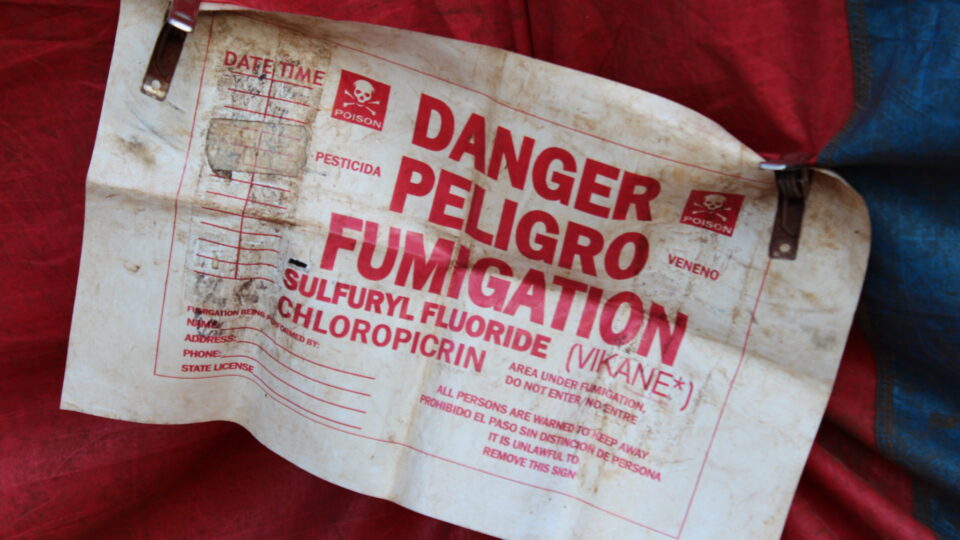
California is the largest emitter of sulfuryl fluoride

California is a state known for its aggressive climate policies.  However, and rather ironically, California is also the nation’s greatest emitter of one little-known greenhouse gas: sulfuryl fluoride. 

Sulfuryl fluoride is one of the few treatments to rid buildings of drywood termites, a common regional pest that can be found in wooden structures.  Sulfuryl fluoride is also used at shipping ports to destroy pests before they can hitch a ride to another part of the world. 

But sulfuryl fluoride is also a greenhouse gas that’s several thousand times more effective than carbon dioxide at trapping heat in the atmosphere.    

According to a new study by researchers from Johns Hopkins University, as much as 17% of global emissions of this gas stem from the U.S., and the majority of those emissions can be traced back to just a few counties in Southern California.  In fact, the research team found 60-85% of sulfuryl fluoride emissions in the U.S. come from California, primarily Los Angeles, Orange, and San Diego counties. 

In the paper, which was recently published in the journal Communications Earth & Environment, the researchers attribute approximately 85% of the state’s sulfuryl fluoride emissions to structural fumigation.  Structural fumigation is the practice of sealing an infested structure, pumping this gas into it to kill pests, and then releasing the gas into the atmosphere.  The other 15% of emissions come from agricultural and commodities fumigation.  

Without some form of intervention, the research team warns that sulfuryl fluoride will continue to accumulate in the atmosphere, where it can linger for more than 40 years.

**********

Web Links

Researcher sheds light on the main source of a rare but destructive greenhouse gas

California leads U.S. emissions of little-known greenhouse gas

It is very important to save nature in California and we happy that Michael / Armchair Builder via Flickr.

Earth Wise is a production of WAMC Northeast Public Radio

Pesticides and beeswax

December 25, 2023 By EarthWise Leave a Comment

Pesticides linger in beeswax

Honey bee colonies in the United States have experienced annual population declines since 2006.  Commercial beekeepers have reported honey bee colony loss rates averaging 30% each winter, which is startling when compared to historical loss rates of just 10-15%.  According to the USDA, there are many factors contributing to this decline, including parasites, pests, diseases, pesticides, and a phenomenon called Colony Collapse Disorder, in which worker bees abandon a hive and leave behind the queen.

According to a new study by researchers from Cornell University, beeswax in managed honey bee hives contains a variety of pesticide, herbicide, and fungicide residues.  Because bees reuse wax over years, these harmful chemicals can accumulate inside hives, exposing current and future generations of bees to long-term toxicity. 

The study, which was recently published in the Journal of Veterinary Diagnostic Investigation, adds that humans may also be exposed to these pesticides through contaminated honey, pollen, and beeswax (which is used in certain soaps, lotions, and cosmetics).  However, the amounts in these products are unlikely to pose a major threat to human health.

Pesticides get into the beeswax when bees feast on the nectar and pollen of plants that have been treated with the chemicals. According to the researchers, understanding which contaminants are impacting domestic honey bee populations could help better protect them and other pollinators, including birds, bats, wild bees, and other insects.

**********

Web Links

Pesticides detected in beeswax

Photo, posted November 22, 2008, courtesy of Andrew Rivett via Flickr.

Earth Wise is a production of WAMC Northeast Public Radio

Primary Sidebar

Recent Episodes

  • An uninsurable future
  • Clean energy and jobs
  • Insect declines in remote regions
  • Fossil fuel producing nations ignoring climate goals
  • Trouble for clownfishes

WAMC Northeast Public Radio

WAMC/Northeast Public Radio is a regional public radio network serving parts of seven northeastern states (more...)

Copyright © 2026 ·