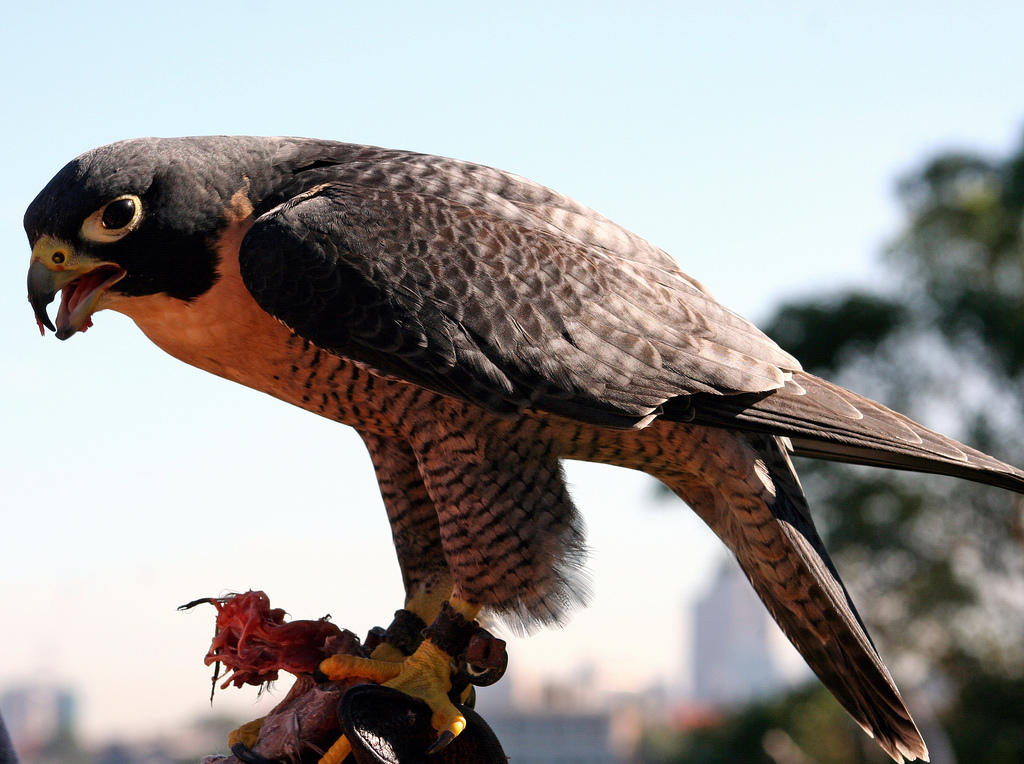
In the 1970s, the world’s fastest bird – the peregrine falcon – was nearing extinction in North America. The culprit: the toxic legacy of DDT. The widely used pesticide caused the birds to suffer reproductive problems, and their numbers plummeted.
Thankfully, DDT was banned. And a combination of nest site protection and captive rearing was successful at reestablishing the birds. By the early 1990s, biologists suggested peregrine falcon populations had become so robust that labor-intensive rearing programs were no longer needed. Modeling suggested the birds would continue to recover unassisted, albeit at a slower rate. In 1999, they were removed from the Endangered Species List.
Recently, the biologists behind the original model decided to check on peregrine falcon numbers, to see how their predictions played out. This was not a straight forward task. When a species comes off the Endangered Species List, it is cause to celebrate. But delisting also dries up the resources essential to monitoring efforts.
Thankfully, people love bird watching. Ultimately, observations from citizen scientists provided the numbers needed to assess peregrine falcon recovery. Most essential was the Audubon Society’s annual Christmas Bird Count – a census of North American birds that relies on tens of thousands of volunteers.
Even at healthy population levels, peregrine falcons are rarer than most birds, so this type of widespread “eyes on the sky” effort greatly reduced the risk of under-counting. The verdict: while peregrine falcon numbers are not as high as the biologists hoped, they do fall within the natural recovery range predicted several decades ago.
The Christmas Bird Count is now in its 115th year; learn how you can become part of the effort at audubon.org.
**********
.
Web Links
Volunteer ‘eyes on the skies’ track peregrine falcon recovery in California
Peregrine Falcons Nesting in the New York State Capital
Photo, posted May 10, 2005, courtesy of Brenda Clarke via Flickr.
.
Earth Wise is a production of WAMC Northeast Public Radio, with script contribution from the Cary Institute of Ecosystem Studies.